
Defy V1 2025
Maximum Attack, Minimum Forgiveness — Is the Trade-Off Worth It?
The short verdict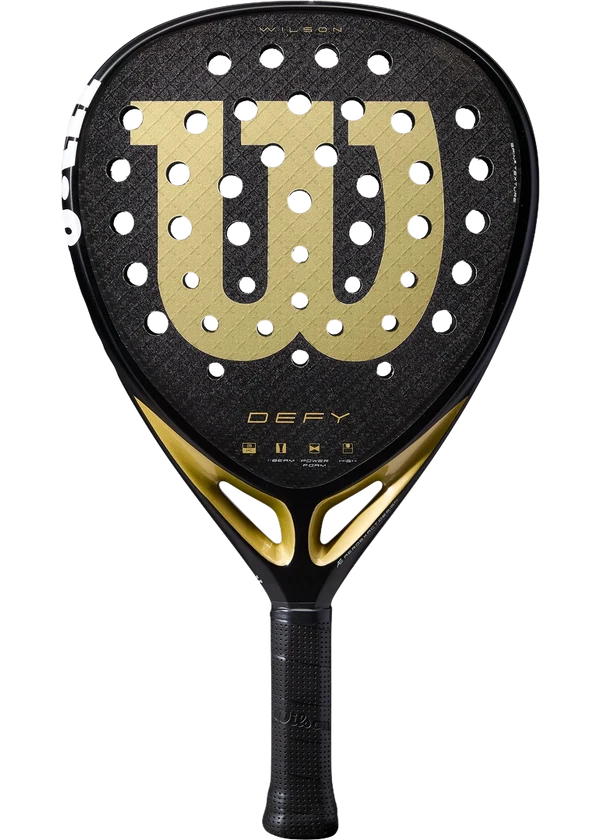


8 Parameters
Defy V1 2025
On this page
Review
Wilson Defy V1 2025 Review: Maximum Attack, Minimum Forgiveness — Is the Trade-Off Worth It?
Diamond rackets at the advanced end of the market all face the same tension: the harder you push the ceiling on power and spin, the lower you drop the floor on comfort and sweetspot. Most manufacturers blur this line with marketing language. The Wilson Defy V1 2025 doesn’t bother. It’s built explicitly for attackers who want a tool, not a compromise — and that clarity of purpose is both its greatest strength and the clearest warning sign for the wrong player.
On the specs side, the Defy V1 runs a dense Power Foam core inside a 3K carbon face finished with Wilson’s Spin² textured surface. The frame integrates I-Beam technology for rigidity, Aeroexact Design for swing efficiency, and a Duo Grid Hole Pattern — larger holes toward the top of the face for power transfer, smaller holes toward the bottom for spin and directional control. Frame profile sits at 38 mm. Declared weight is 365 g with a 265 mm balance point. Part of Wilson’s 2025 Defy lineup that also includes the heavier Pro V1 (370 g, 15K carbon) and the lighter LS V1 (355 g). Explore the full Wilson lineup to see where the Defy V1 sits in context.
Comfort scores 6.2 — the lowest parameter and the one that defines this racket’s ceiling. The gap between the Attacker and Defender profiles isn’t a suggestion — it’s a hard line. If you’re not attacking, you’re fighting the racket.
Performance Breakdown
How the Wilson Defy V1 2025 Plays
STABILITY 8.0
The Diamond Does What Diamonds Do
High balance point combined with the dense Power Foam core creates a racket that loads and releases energy efficiently on attacking shots. The I-Beam frame reinforcement keeps the structure rigid under hard contact, which is what pushes Stability to 8.0 — you won’t feel the frame flex robbing you of pace. Power at 8.2 is strong but not the ceiling of this category; it reflects a racket calibrated for consistency of power output rather than maximum peak force on any single shot. These two scores are the reason the Attacker profile leads by a clear margin.
MANEUVERABILITY 7.4
Spin That Earns Its Score, Speed That Has a Cost
The Spin² textured surface combined with the Duo Grid’s lower-zone small holes gives the Defy V1 genuine grip on the ball — 7.8 reflects a surface that actively contributes to rotation rather than simply allowing it. Maneuverability at 7.4 is the more interesting number here: the Aeroexact Design does reduce drag meaningfully, which is why this figure isn’t lower, but 365 g at a high balance point remains a physical reality. This is a racket you set up for rather than react with — lateral exchanges and quick defensive blocks will expose the weight distribution.
PLAYABILITY 6.9
Precision on Your Terms, Not the Ball’s
Control at 7.6 is the score most likely to surprise first-time readers of this review. For a hard diamond racket, that figure is genuinely solid — the Duo Grid’s lower hole zone and the I-Beam’s frame consistency do contribute real directional precision when you’re generating your own pace. The caveat is Playability at 6.9: when the ball is dictating pace rather than you, the dense core and stiff frame return less feedback and less margin for adjustment. Control here is attacker’s control — structured, intentional, unforgiving of passive play.
SWEETSPOT SIZE 6.8
The Numbers That Define the Ceiling
Comfort at 6.2 is the lowest score on the card and the one parameter that shapes every other decision in this review. The stiffness rating of 65 combined with the 3K carbon surface and rigid I-Beam frame means vibration transmission on off-center hits is significant — players with arm or elbow sensitivities should treat this as a firm boundary, not a minor consideration. Sweetspot Size at 6.8 compounds this: the compact hitting zone characteristic of diamond rackets like this one means off-center contact is more frequent and more costly. Together, these two scores explain the Defender profile gap directly — a racket that punishes mistiming is not a racket built for defensive retrieval.
Technology
I-Beam + Duo Grid: Does the Engineering Justify the Stiffness Penalty?
The I-Beam is the frame’s structural backbone — a beam running along the racket’s interior that resists torsional flex under hard contact. What this means on court is consistent energy return at the point of impact: you hit the same shot twice in the same spot and get the same pace back. That’s what drives Stability to 8.0. The trade-off is that a stiffer frame absorbs less vibration, which is the direct mechanical explanation for the 6.2 Comfort score. The technology isn’t a flaw — it’s a deliberate engineering choice, and it’s honest about what it costs.
The Duo Grid Hole Pattern is more nuanced than most hole-pattern marketing. Larger apertures in the upper zone reduce face resistance on power shots and smashes, while the tighter lower-zone holes increase dwell time fractionally on lower-contact spin shots. This contributes to both the 7.8 Spin score and the 7.6 Control figure — the lower face is where your serve-and-volley precision lives. It’s not a gimmick: the geometry produces measurably different ball response across the face zones.
Aeroexact Design works by reducing drag through optimized frame geometry rather than weight reduction. The 7.4 Maneuverability score reflects its contribution: without it, a 365 g head-heavy diamond would score lower. It buys back some swing speed without softening the frame or reducing mass — an engineering compromise that serves attackers who need rapid swing initiation on smashes but aren’t willing to sacrifice the power delivered by the heavier balance.
The Spin² textured surface is the most straightforward technology in the package. The double-relief texture increases friction between ball and face, translating to the 7.8 Spin score. For attackers hitting with topspin or generating kicking serves, the surface does real work. The player who benefits from all of this sits in one profile: an advanced attacker with established arm health, consistent technique, and the court position to dictate rallies rather than extend them.
Player Fit
Who Should Buy the Wilson Defy V1 2025?
The Advanced Attacker Who Owns the Net
If you’re the type who organizes rallies around getting to the smash rather than sustaining baseline exchanges, this racket was built around your game. You already have the arm strength and technical consistency to make contact in the sweetspot with regularity — Sweetspot Size at 6.8 doesn’t intimidate you because your preparation is early and your positioning is deliberate. You’ve played diamond rackets before; you know what stiffness feels like, and your elbow isn’t a concern. Power at 8.2 and Stability at 8.0 mean your attacking shots land with authority and predictability. Spin at 7.8 gives your smashes an additional kicking dimension that makes defence harder. You want a tool, not a safety net — and this one delivers exactly what it promises.
Players Still Building Technique or Managing Arm Issues
The Defender score of 7.21 tells the whole story: this racket has no patience for passive play. If your game relies on retrieving, extending rallies, or converting defence into attack, the stiff frame and compact sweetspot will accelerate fatigue and multiply errors before you see any benefit. And if you have any history of arm or elbow discomfort, Comfort at 6.2 is not a minor inconvenience — it’s a hard stop. Intermediates seeking a diamond to grow into should look at the Wilson Defy LS V1 instead, which offers the same shape at reduced weight and a more forgiving response.
FAQ
Frequently Asked Questions
What is the PadelVerdict score for the Wilson Defy V1 2025?
Overall score: 7.8, with a Consensus Modifier of 0. Consistent data without independent validation earns neutral, not positive. Independent measurements would support a positive adjustment. Profile breakdown: Attacker 7.77 · Hybrid 7.31 · Defender 7.21. That 0.56-point spread makes this a single-profile racket — the attacker designation isn’t a suggestion, it’s the only profile with a strong fit.
Is the Wilson Defy V1 2025 good for advanced players?
Yes — but only advanced players with an attacking game and no arm sensitivities. Playability at 6.9 and Comfort at 6.2 mean the racket doesn’t assist the player; the player has to bring their own technique to it. Intermediates seeking to step up to diamond should start with a lighter, softer option. If control under pressure is your weakness, the Wilson Bela line serves that need better.
Is the Wilson Defy V1 2025 good for attacking players?
Yes, without qualification. Attacker score of 7.77 leads the profile breakdown. Power 8.2, Stability 8.0, and Spin 7.8 are the three scores that make this work for attacking players — consistent power output, frame rigidity that doesn’t bleed energy, and a textured surface that adds kick to attacking shots. If you’re comparing options, see the full best attacker rackets category.
What is the actual weight of the Wilson Defy V1 2025?
Declared weight is 365 g. No independent measured weight exists for this model — the research found no on-camera weigh-ins or lab measurements. The declared figure is consistent across multiple distribution sources, which gives reasonable confidence in the number. No weight variance data is available to assess. At 365 g with a 265 mm balance point, the head-heavy feel will be perceptible in hand.
How does the Wilson Defy V1 2025 compare to the Wilson Defy Pro V1 2025?
The Pro V1 adds 5 g (370 g) and upgrades the face to 15K carbon, which delivers higher energy return and a crisper, more demanding response. The V1 is the choice for advanced attackers who want the Defy platform’s power and spin without pushing into pro-level stiffness and weight. Choose the Pro if your game is already at that ceiling and you want more from it; choose the V1 if you’re approaching it.
Why does the Wilson Defy V1 2025 have a Consensus Modifier of 0?
Specs are consistent across multiple markets with no contradictions between sources — declared weight, balance, and shape all align. However, no independent specialist analysis beyond distributor and manufacturer descriptions was found for this model, and no independent physical measurements exist to confirm the declared figures. Consistent data without independent validation earns neutral, not positive. Independent on-camera measurements or structured specialist testing would support a positive adjustment.
Similar Rackets
Independent testing, funded by readers
No brand deals, no sponsored picks. If you found this useful, you can support the next round of tests with a small tip.

