
Defy LS V1 2025
The Lightest Punch in the Defy Line
The short verdict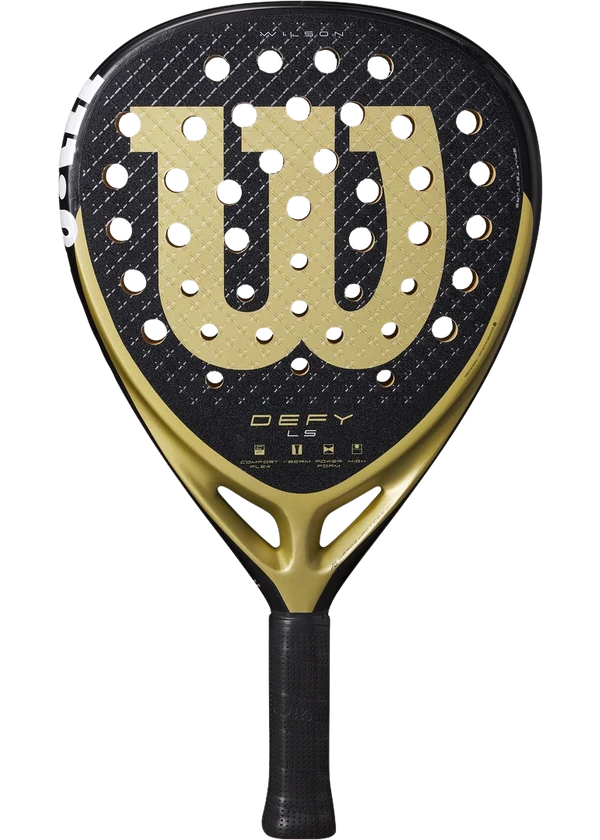


8 Parameters
Defy LS V1 2025
On this page
Review
Wilson Defy LS V1 2025 Review: The Lightest Punch in the Defy Line
Diamond-shape rackets make a promise: pure attacking power from the top of the frame, positioned high above the hand where momentum becomes exit velocity. The catch is always the same — the more you chase power and spin, the more you sacrifice the forgiveness and touch that keep aggressive play consistent. The Wilson Defy LS V1 2025 enters that trade-off from an unusual angle. It is the lightest frame in Wilson’s Defy diamond collection, which means it is asking you to trust aerodynamic speed rather than raw mass to generate the power a diamond shape normally demands.
The LS V1 is built around a dense Power Foam core sitting inside a carbon frame reinforced by an I-Beam structure across the middle profile — a 38mm beam that adds torsional stiffness without sacrificing the aerodynamic geometry Wilson calls Aeroexact Design. The hitting surface is the Comfort Flex Face, a hybrid fiberglass-carbon construction with Spin2 rough texture, and the hole pattern runs a Duo Grid layout: larger holes at the top of the face for power transfer, smaller holes lower down for spin generation and control. Balance point sits at 265mm — legitimately neutral for a diamond racket, which is part of what gives the LS V1 its unusual maneuverability for the shape. Browse the full Wilson lineup to see where this sits in context.
Spin at 8.7 is the headline — top-tier for any diamond, exceptional given the 355g frame weight. The gap between Attacker and Defender profiles is decisive: this racket has a clear identity, and it belongs at the net or mid-court, not the back glass.
Performance Breakdown
How the Wilson Defy LS V1 2025 Plays
SPIN 8.7
The Offensive Engine Is Real
Diamond shape combined with a head-heavy balance point creates the conditions for explosive exit velocity, and the Defy LS V1 delivers on that architecture — Power lands at 8.4, credible for the category. What stands out more is Spin at 8.7: the Spin2 rough texture and the Duo Grid hole pattern work in combination, generating bite on the ball that makes aggressive slice and topspin genuinely threatening rather than decorative. The result is a racket that rewards offensive intent, particularly on smashes and drive volleys where speed and spin converge. This is the LS V1’s clearest competitive argument against heavier diamond rackets in the same class.
STABILITY 7.6
Speed Without Sacrifice
Maneuverability at 8.2 is the LS V1’s most counterintuitive number — diamond frames typically concede swing speed for power, but the 355g weight combined with Aeroexact aerodynamic geometry produces a racket that moves through the air faster than its shape suggests. At the net, that translates to reaction volleys that feel light and quick rather than planted. Stability sits at 7.6, which is reasonable for the weight class and reflects the I-Beam reinforcement doing its job — off-center balls don’t twist the frame dramatically, even if they don’t reward with the solid feedback a heavier racket would give. The Aeroexact Design is not marketing terminology here; the swing speed data supports it.
SWEETSPOT SIZE 7.1
The Diamond Tax
Control at 6.8 is not a flaw unique to this racket — it is the structural cost of a hard Power Foam core inside a diamond shape, and it shows up predictably in defensive exchanges and reset shots from the back glass. When you are under pressure and need to place a soft ball, the LS V1 demands technical precision the racket itself cannot compensate for. Sweetspot Size at 7.1 is honest but not generous: the Duo Grid pattern helps, moving the effective hitting zone slightly beyond what raw shape and balance would suggest, but this remains an expert’s tool rather than a margin-builder. Players who rely on control to structure points from depth will feel the difference immediately.
PLAYABILITY 7.6
Softer Than the Shape Looks
Comfort at 7.4 is the number that surprises most for a hard-core diamond at RA 68. The Comfort Flex Face — a hybrid fiberglass-carbon surface — absorbs a meaningful amount of vibration on clean contact, reducing the harsh feedback that stiff diamond frames typically transmit to the arm. It does not make this a comfort-focused racket, but it means extended sessions are less punishing than the specs imply. Playability at 7.6 reflects a genuine middle ground: the LS V1 is accessible enough for capable intermediate players, but it will ask questions of players who are not yet generating their own pace consistently.
Technology
Aeroexact + Duo Grid: Do They Actually Earn the Spin and Speed Numbers?
The Aeroexact Design is Wilson’s aerodynamic frame geometry — a 38mm profile shaped to reduce drag through the swing arc. The practical outcome is measurable in the Maneuverability score of 8.2: for a diamond frame, that number is unusual, and the aerodynamic geometry is the primary mechanical reason. Most diamond rackets at this weight class sit below 8.0 in maneuverability because the head-heavy balance creates rotational resistance; Aeroexact partially offsets that by reducing the force required to initiate and complete the swing. Players who transition from round or drop-shape rackets will notice the difference in swing speed almost immediately.
The Duo Grid Hole Pattern is the more tactically interesting system. By distributing larger holes across the upper hitting zone and smaller holes toward the lower face, Wilson has tuned the face to behave differently depending on where contact happens: upper-zone balls get more trampoline effect and power, lower-zone balls get more spin. This is the mechanical explanation behind the Spin score of 8.7 — the lower grid creates genuine grip on the ball during aggressive slice and topspin rather than simply relying on rough surface texture alone. The Spin2 texture on the Comfort Flex Face adds a second layer of friction on top of the structural hole pattern, which is why the spin output feels disproportionate to the racket’s weight.
The I-Beam running across the middle frame section addresses the structural trade-off that a lightweight carbon diamond creates: without it, a 355g diamond would flex torsionally on off-center contact and bleed stability. With it, Stability reaches 7.6 — not exceptional, but sufficient for aggressive play. The Comfort Flex Face’s fiberglass component is the reason Comfort scores 7.4 despite the hard Power Foam core; fiberglass dampens arm-transmitted vibration in a way that full-carbon surfaces do not. These technologies are not independently revolutionary, but the combination is coherent — each element has a traceable effect on a specific score.
Player Fit
Who Should Buy the Wilson Defy LS V1 2025?
The Aggressive Intermediate Who Wants Diamond Without the Weight Penalty
If you’re the type who plays primarily from the net and mid-court, generates your own pace, and wants your racket to multiply your swing speed rather than just carry it — the LS V1 is built for you. The combination of Maneuverability at 8.2 and Spin at 8.7 rewards players who attack early and disguise direction through heavy rotation. The Attacker profile leads by a clear margin — this is a clean offensive tool. You’re at the intermediate-to-advanced level and you’ve outgrown forgiving round frames but don’t yet want the full mass of a professional-grade diamond. The LS V1 meets you exactly there — enough power and spin to punish short balls, light enough that you won’t fatigue before the third set. Not sure a diamond is your shape yet? Here’s what a diamond mold means in practice — shapes explained before you commit.
The Control-Oriented Player Who Structures Points from the Back
Control at 6.8 is not going to improve under pressure — that is the hard truth of a stiff diamond core. If your game depends on precision from the back glass, on reset shots under pace, or on sustained rallies where placement matters more than power, the Defy LS V1 will work against you in the moments that decide points. The Defender score is the lowest of the three profiles and the gap to Attacker is not one you negotiate around. Players who want diamond attacking power with more touch and control built in should look at the Wilson Defy V1 or drop-shape alternatives in a similar price range.
FAQ
Frequently Asked Questions
What is the PadelVerdict score for the Wilson Defy LS V1 2025?
The overall PadelVerdict score is 8.1, including a Consensus Modifier of +0.1. Profile breakdown: Attacker 8.13 · Hybrid 7.81 · Defender 7.31. The gap between Attacker and Defender confirms this is a committed offensive tool — the profile spread is not one you negotiate around.
Is the Wilson Defy LS V1 2025 good for intermediate players?
Yes, conditionally. The Playability score of 7.6 and the lighter 355g frame make this more accessible than most diamond rackets at this spec level. But the critical caveat is Control at 6.8 — intermediates who are still learning to structure points under pressure will find the limited touch from the back court more punishing than a round or drop-shape alternative. If you’re an intermediate who already attacks instinctively and generates your own pace, this works. If you rely on the racket to help you build the point, look elsewhere.
Is the Wilson Defy LS V1 2025 good for attacking players?
Yes. Attacker profile score of 8.13, Power at 8.4, Spin at 8.7, Maneuverability at 8.2 — that combination is exactly what an attacking player is looking for. The lightness means you can swing faster and still generate the spin that makes overhead and drive shots dangerous. It feels like a racket that confirms your attacking instincts rather than fighting them. Browse all best attacker rackets to compare your options.
What is the actual weight of the Wilson Defy LS V1 2025?
The declared weight is 355g, with a manufacturer-stated tolerance of +/-10g. No independent on-camera measurements exist for this model, so no verified measured weight is available. The declared figure is consistent across multiple markets. At 355g nominal, this is genuinely light for a diamond shape — a difference you will feel in swing speed and net reaction time compared to standard 360-365g competitors in the category.
How does the Wilson Defy LS V1 2025 compare to the Wilson Defy V1 2025?
The LS is the lighter sibling — same Aeroexact and Duo Grid architecture, but optimized for swing speed over planted power. The Wilson Defy V1 will offer more mass behind the ball on smashes and feel more stable on hard exchanges; the LS V1 gives you more maneuverability and a faster reaction window at the net. This is a choice between two attacker types: the LS suits the quick, mobile net player; the standard Defy suits the player who wins through power and frame solidity.
Why does the Wilson Defy LS V1 2025 have a Consensus Modifier of +0.1?
Specs are present and consistent across multiple markets — but that consistency alone contributes nothing positive or negative. What moves the modifier to +0.1 is cross-market editorial convergence: specialist sources independently align on the same attacking profile, Power, Spin, and Maneuverability character without contradictions or outliers, and community sentiment follows without over-hyping the racket. The remaining component stayed neutral — no independent physical measurements of weight or balance exist to confirm the declared figures, and that gap prevents the modifier from going further.
Similar Rackets
Independent testing, funded by readers
No brand deals, no sponsored picks. If you found this useful, you can support the next round of tests with a small tip.

