
Joma Hyper Pro SFT 2026
Can a Diamond Racket Earn Its Softness?
The short verdict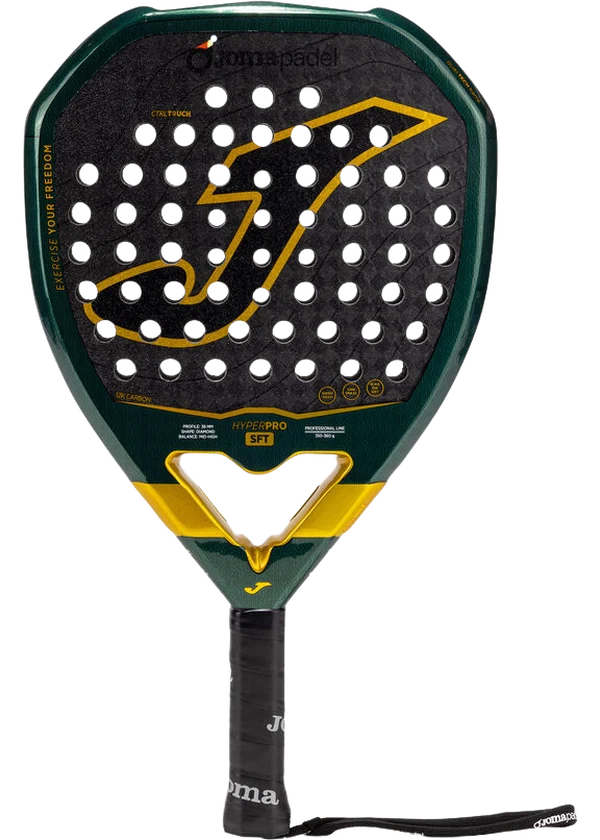
8 Parameters
Joma Hyper Pro SFT 2026
On this page
Review
Joma Hyper Pro SFT 2026 Review — Can a Diamond Racket Earn Its Softness?
Diamond rackets carry a deal: you accept stiffness in exchange for power. The question every attacking player faces is how much that stiffness costs them over a two-hour match — in fatigue, in arm discomfort, in shots that go slightly wrong because the feel is gone by the third set. The Joma Hyper Pro SFT 2026 is built around a specific answer to that deal: keep the diamond geometry, soften the core, and see how much power you can hold without making the racket punishing.
The construction pairs a 12K carbon frame with a Black EVA soft foam core — the SFT designation signals a slightly lower density than the standard formulation, calibrated to reduce harsh vibration without collapsing the power ceiling. Joma runs the Hyper Pro line in two versions: the SFT (softer, lighter, more forgiving) and the HRD (firmer, more direct). The surface is 12K carbon with a 3D roughness texture, designed to amplify spin generation. Frame tech includes a Dual Tech Frame for structural rigidity and a Speed Hole System — channels cut through the core to reduce swing weight and improve maneuverability without altering the head-heavy balance point at 268mm. Declared weight sits at 357g, with sources reporting a range of 350–370g depending on market. You can explore the full Joma racket lineup to see how the Hyper Pro fits within their 2026 collection.
Sweetspot Size at 7.0 is the sharpest constraint on this racket. Attacker 8.09 / Hybrid 7.72 / Defender 7.43 — a 0.66-point spread that confirms a clear offensive profile. The gap between Attacker and Defender is the whole story: precision is rewarded, wayward contact is not.
Performance Breakdown
How the Hyper Pro SFT 2026 Plays
STABILITY 7.8
Head-Heavy and Honest About It
The 268mm balance point and diamond shape deliver exactly the power signature you expect from this geometry — smashes and viboras carry real weight, and the 12K carbon frame transfers energy efficiently without the dead feeling you sometimes get from softer constructions. Power lands at 8.4, which is strong but not exceptional for this category of diamond. What keeps it credible is Stability at 7.8: the Dual Tech Frame provides enough structural rigidity that off-axis shots don’t lose all energy, which matters when you’re taking the ball late at the net. The head-heavy bias is a feature, not an oversight — if you play forward and finish points, this is the geometry that rewards you.
MANEUVERABILITY 7.8
The Speed Holes Actually Do Something
Spin at 7.9 is driven by the 3D roughness texture on the 12K carbon surface — this isn’t a marketing claim, it’s a construction choice that creates genuine friction at ball contact, and bandejas and slices carry noticeably more bite as a result. Maneuverability at 7.8 is the more interesting number for a diamond racket at this balance point: the Speed Hole System channels cut through the core to reduce effective swing weight, which helps explain why this racket moves faster through the hitting zone than the balance figure alone would suggest. For a diamond-shaped racket, 7.8 maneuverability is genuinely above average and it makes the SFT version noticeably easier to live with during extended rallies than its HRD sibling.
COMFORT 7.2
Softer Core, But Not a Free Pass
Control at 7.6 sits in solid territory for an attacking racket — the soft EVA core helps here, giving slightly more dwell time at ball contact and lending a bit of feedback that harder-cored diamonds often sacrifice. Comfort at 7.2 reflects honest reality: the SFT formulation does reduce harsh vibration compared to the HRD version, and the EVA density choice means this is not an arm-unfriendly racket, but it’s still a stiff 12K carbon frame and players with chronic elbow issues should approach carefully. The soft core buys you comfort relative to the category, not comfort in absolute terms.
PLAYABILITY 7.4
The Number That Sets the Ceiling
Sweetspot Size at 7.0 is the parameter that defines who this racket is actually for. Diamond geometry pushes the sweetspot high and narrow by design — that elevated position is perfect for overhead play and net finishing, but it means off-center contact on defensive retrieves is punished more than on a round or drop-shaped frame. Playability at 7.4 reflects the SFT core doing its job: the racket is more forgiving than the geometry alone would imply, and the Speed Hole System helps, but there’s no disguising that this is a precision instrument for players who are already comfortable in the striking zone. The 7.0 sweetspot is the honest cost of the 8.4 power — you can’t have both without the tradeoff.
Technology
Speed Hole System + Homa 3D Spin: Engineering Compromise or Genuine Addition?
The Speed Hole System is the most structurally meaningful technology in this racket. By cutting channels through the EVA core, Joma reduces the effective swing weight without altering the balance point — the head-heavy geometry stays intact, but the racket accelerates faster through the swing arc. That’s the direct explanation for the Maneuverability score of 7.8 on a diamond frame: the holes do redistributive work that grip tape and weight adjustments can’t replicate. For attacking players who need to generate racket head speed on tight volleys and quick bandejas, this is the feature that makes the SFT version feel nimbler than its balance figure suggests.
Homa 3D Spin is the surface technology — a 3D roughness profile applied to the 12K carbon face. The practical effect is increased surface friction at contact, which translates to more reliable spin generation on topspin drives and slice bandejas. Spin at 7.9 reflects this directly: the texture does measurable work, and players who rely on spin to redirect pace or create angles at the net will feel the difference versus a smoother carbon surface. This isn’t a coating that wears away in three weeks — it’s built into the carbon weave structure itself.
The Dual Tech Frame provides the structural foundation — 12K carbon reinforcement at the frame perimeter that maintains rigidity under repeated high-impact shots. This is what underpins the Stability score of 7.8: the frame doesn’t flex inconsistently under load, which keeps Power delivery predictable over the course of a match. Together, these three systems form a coherent package for intermediate-to-advanced attacking players who want power and spin without completely sacrificing the ability to play at pace for a full match.
Player Fit
Who Should Buy the Joma Hyper Pro SFT 2026?
The Net-Dominant Intermediate Who Wants More Arm
If you’re the type who plays from the net, finishes with overheads, and has been eyeing diamond rackets but worried about whether your arm will survive a full season — this is the SFT’s exact brief. The Attacker score of 8.09 is backed by Power at 8.4, Spin at 7.9, and Maneuverability at 7.8 that makes the diamond geometry more accessible than most in this class. You’re an intermediate-to-advanced player who has developed clean technique and can consistently find the high sweetspot — the 7.0 Sweetspot Size doesn’t scare you because you’ve already got the stroke production to use it. The Comfort at 7.2 won’t fix chronic elbow problems, but it will let you play two hours without paying for it the next morning. If that’s your reality, this racket was built for you.
Defensive Players and Anyone Still Finding Their Strike Zone
The Defender score of 7.43 — a full 0.66 points below Attacker — tells you everything: this racket is not designed to help you retrieve, reset, or absorb pace. If your game is built around consistency from the back, reading the play, and constructing points patiently, the narrow sweetspot at 7.0 and the head-heavy balance will work against you on almost every defensive touch. And if you’re still building technique — still finding where the ball actually meets the face — a 7.0 sweetspot on a diamond frame will make that process slower and more frustrating. The SFT label makes this more forgiving than the HRD, but it doesn’t change the fundamental geometry. Look at a round or drop-shaped alternative that serves your defensive profile instead.
FAQ
Frequently Asked Questions
What is the PadelVerdict score for the Joma Hyper Pro SFT 2026?
The overall PadelVerdict score is 8.0, with a Consensus Modifier of +0.1 applied. Specs are consistent across multiple sources (Data Quality: neutral), specialist sources across multiple markets align on shape, core, surface, and technologies with no contradictions found (Field Validation: positive), but no independent physical measurements exist to go further (Market Correction: neutral). That Field Validation component is what earns the +0.1. Profile breakdown: Attacker 8.09 / Hybrid 7.72 / Defender 7.43. The 0.66-point gap between Attacker and Defender means this racket has a clear identity — don’t buy it hoping to play both roles.
Is the Joma Hyper Pro SFT 2026 good for intermediate players?
Yes — with a condition. It’s good for intermediates who already play a predominantly offensive game and have consistent technique. The Sweetspot Size at 7.0 is the parameter to watch: if you’re still working on finding the strike zone reliably, that narrow hitting area will cost you. If your technique is solid and you’re pushing toward net play and power, Playability at 7.4 and Maneuverability at 7.8 make the transition into diamond territory more manageable than most.
Is the Joma Hyper Pro SFT 2026 good for attacking players?
Yes. The Attacker score of 8.09 is backed by the right numbers: Power 8.4, Spin 7.9, Stability 7.8, and Maneuverability 7.8. That combination means overhead finishing, net aggression, and spinning bandejas all land with real authority. If you want to see how it stacks up against the full field, check out our best attacker rackets category.
What is the actual weight of the Joma Hyper Pro SFT 2026?
Declared weight is 357g, but sources report a range of 350–370g depending on market — with some markets citing 350–360g and others 360–370g. No independent on-camera weighing exists to confirm the actual figure. The mid-range estimate used in our scoring is 357g. A 10–15g variance at this weight class is perceptible on court, particularly in swing speed and fatigue over longer matches.
How does the Joma Hyper Pro SFT 2026 compare to the Hyper Pro HRD?
These are two answers to the same question. The Hyper Pro HRD is for players who want maximum power feedback and direct feel — a firmer core means faster energy return but more vibration transmission. The SFT is for players who want the same diamond geometry and attacking intent, but need the racket to remain playable and comfortable over a full match. Choose HRD if you prioritize raw power and your arm tolerates firm rackets. Choose SFT if you want to last two sets without fatigue accumulating in your shoulder and elbow.
Why does the Joma Hyper Pro SFT 2026 have a Consensus Modifier of +0.1?
The +0.1 reflects what the data actually showed. Specs — shape, core, surface, technologies, balance orientation — appeared consistently with no contradictions across multiple markets. That earns a neutral baseline, not a positive. What moves the modifier is the depth of that consistency: specialist sources across multiple markets aligned on key construction parameters without discrepancies, which represents a stronger signal than simple retailer repetition. The ceiling stays at +0.1 because no independent physical measurement — on-camera weighing, lab-measured balance point, or RA stiffness value — exists to validate the declared figures. That confirmation would be required to go further.
Similar Rackets
Independent testing, funded by readers
No brand deals, no sponsored picks. If you found this useful, you can support the next round of tests with a small tip.

