
Ultimate Pro Plus
Does Max Offense Still Leave Room to Play?
The short verdict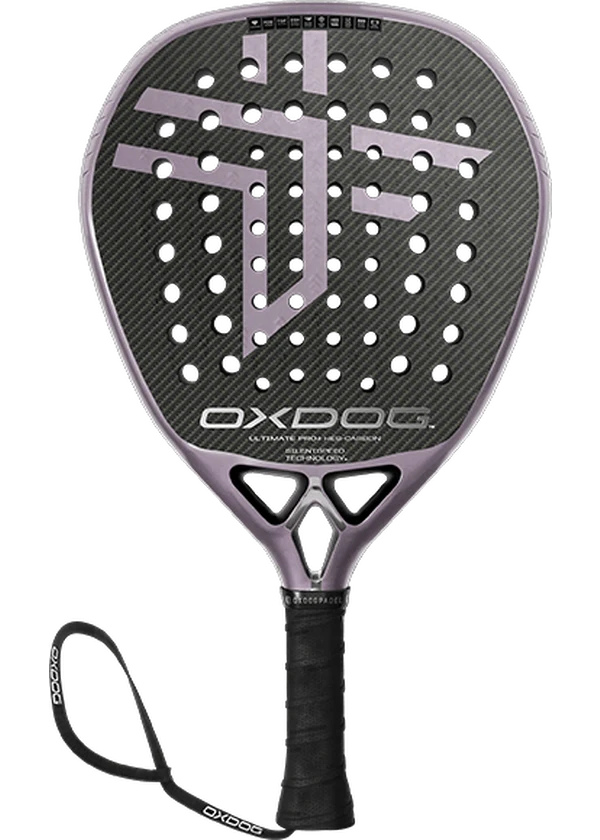
8 Parameters
Ultimate Pro Plus
On this page
Review
Oxdog Ultimate Pro+ 2024 Review: Does Max Offense Still Leave Room to Play?
The hardest trade-off in offensive padel isn’t between power and control — it’s between power and access. A racket that punishes from the left side with conviction often becomes unplayable for anyone operating below peak form. The Oxdog Ultimate Pro+ 2024 sits directly inside that tension: a diamond-shaped attacker tuned for maximum aggression, but one that apparently refuses to abandon its better qualities when the rally demands something other than a kill shot.
Built around a rigid hard foam core and HES-Carbon surfaces with a rough, sandy texture, the Ultimate Pro+ delivers on Oxdog’s most offensive brief. The frame integrates PowerRibs for structural rigidity and aerodynamic balance, DSH (Double Size Holes) to extend playability at the sweetspot edges, Vibradamp silicone inserts at the grip end, and an RBS removable weight system that lets players fine-tune balance by 8 grams. Declared weight is 368g with a high balance at 258mm — head-heavy geometry that concentrates mass exactly where overhead power originates. Stiffness rating reaches 75, placing it firmly in hard-touch territory. Explore the full Oxdog lineup to see how this model sits within the range.
Comfort lands at 6.4 — the lowest score and the sharpest limit on this racket’s accessibility. Attacker: 8.38 · Hybrid: 7.88 · Defender: 7.57. A gap of exactly 0.5 between peak and floor profiles tells you this is a specialist’s tool: capable in multiple situations, but always most itself when someone is attacking.
Performance Breakdown
How the Oxdog Ultimate Pro+ 2024 Plays
STABILITY 8.2
The Overhead Is the Point
Diamond geometry and a 258mm balance point are the structural prerequisites for what this racket does at 8.7 Power — the highest single parameter score on the sheet. The rigid HES-Carbon shell acts as a catapult on smashes and bandeja exits, with the measured weight confirmation (366–374g depending on plate configuration) validating that the declared 368g is accurate on court. Stability at 8.2 is the natural companion: the same head-heaviness that concentrates power also resists twisting under off-center contact, keeping the racket honest even when the connection isn’t perfect. PowerRibs reinforce the frame’s torsional resistance without adding dead weight, which is why this combination holds together at pace rather than rewarding only textbook strikes.
CONTROL 8.1
Sandy Texture Isn’t Just Cosmetic
The rough, sandy HES-Carbon surface is where Spin 8.3 comes from — a face that physically grips the ball through contact. On kick smashes and viboras this translates into trajectory deviation that defenders genuinely struggle to read. The more surprising result is Control at 8.1: for a racket operating at stiffness 75, that figure suggests the rigid core isn’t sacrificing feedback entirely. The ball doesn’t disappear on volleys or touch shots the way it can on purely explosive platforms — there’s a defined, crisp response that lets players trust their placement on third-ball exits from the net.
SWEETSPOT SIZE 7.2
Agile Enough — But Only Just
At 7.4, Maneuverability is the score most likely to surprise anyone who has picked up the racket and found it more responsive than its profile suggests. The RBS weight system and PowerRibs geometry distribute mass in ways that prevent the racket from feeling as head-heavy as a 258mm balance would imply — reviewers note it remains agile at the net and manageable in defensive exchanges at the baseline. Sweetspot Size at 7.2 is honest for a diamond-shaped racket at this stiffness level; DSH perforations extend the usable zone beyond the geometric sweet spot, but this is still a racket that rewards central contact rather than forgiving it.
PLAYABILITY 7.1
Vibradamp Softens the Blow — Not the Warning
Comfort at 6.4 is the score that carries the most decision-making weight here. Stiffness 75 means vibration is real, and while Vibradamp’s four silicone inserts do dampen the harshest feedback at the grip, they cannot neutralize what a rigid core and carbon shell transmit on heavy contacts. A score below 6.0 carries automatic weight in our scoring system — this racket stays above that threshold, but 6.4 is a genuine caution for players with any history of elbow or wrist sensitivity. Playability at 7.1 reflects the racket’s advanced-level entry cost: the power and spin are accessible to the right player, but nothing about the Oxdog Ultimate Pro+ 2024 makes the game easier for someone still building technique.
Technology
HES-Carbon + DSH: A System That Earns Its Claims
HES-Carbon — Oxdog’s High Energy System — is the load-bearing technology of this racket. Rather than simply specifying carbon fibre as a material, HES-Carbon describes a construction philosophy: a highly reactive, rigid shell designed to transfer kinetic energy into the ball with minimal absorption. The result shows directly in Power at 8.7. On full-swing smashes and high-contact volleys, the surface converts stroke momentum into ball velocity more completely than softer or more dampened constructions would. The rough, sandy texture applied over the HES-Carbon face is what drives Spin to 8.3 — physical friction on the surface creates the ball grip that softer or smooth-faced rackets generate through structural dynamics alone.
DSH (Double Size Holes) addresses the structural penalty that normally comes with diamond shape and high stiffness: compressed sweetspot size. By enlarging the perforation pattern strategically across the face, DSH extends playability beyond the geometric centre — which is exactly what supports Sweetspot Size at 7.2 rather than a lower figure that the stiffness rating alone might predict. PowerRibs run laterally along the frame to increase torsional stability and keep the head from rotating under off-axis contact, which explains why Stability reaches 8.2 despite the head-heavy geometry.
The RBS (Racket Balance System) is the most tactically interesting component. An 8-gram removable weight in the cap allows players to shift the balance point, trading some of the head-heaviness for a faster, more neutral swing profile. For left-side players who need maximum overhead power, the plate stays in. For those who need to survive more demanding defensive exchanges without switching rackets, removing it shifts the racket one step closer to the 7.4 Maneuverability ceiling. Vibradamp’s four silicone inserts sit under the grip and do measurably reduce the harshest vibration transmission — but at stiffness 75, they work as attenuation, not elimination. The Comfort score of 6.4 is the honest outcome of that equation.
Player Fit
Who Should Buy the Oxdog Ultimate Pro+ 2024?
The Advanced Left-Side Player Who Closes Points
If you’re the type who considers the smash a finishing move rather than a reset — who plays left side, builds rallies deliberately, and then ends them with force — this is the racket the numbers describe. Power at 8.7 and Spin at 8.3 are the combination that makes overhead exits dangerous and hard to read. Stability at 8.2 means the racket holds shape under full-swing contact, so your technique isn’t fighting the equipment at the moment it matters most. Control at 8.1 is what keeps this from being a pure power device: if you can generate your own pace, the racket will let you direct it. You already know you’re not a beginner. This racket knows it too. If the diamond mold is part of why it fits, here’s why diamond rackets play like this — shapes explained.
Developing Players or Anyone Protecting Their Arm
Comfort at 6.4 and Playability at 7.1 are the two scores that close the door. If you’re still building consistency, the rigid core will amplify every technical error as vibration — and at stiffness 75, there’s no cushion built into the racket’s character. The Defender score of 7.57 is the lowest profile score for a reason: on the right side under pressure, retrieving with a head-heavy diamond that punishes imprecise contact is a task, not a game. If arm sensitivity is a factor or your level sits below advanced, a softer construction will serve you better. The defender racket category has options built for that workload.
FAQ
Frequently Asked Questions
What is the PadelVerdict score for the Oxdog Ultimate Pro+ 2024?
Overall Verdict Score: 8.3, with a Consensus Modifier of +0.1 applied. Specs are consistent across multiple sources (Data Quality: neutral), specialist sources across multiple markets align on weight, balance, and surface construction with no contradictions found (Field Validation: positive), but no independent lab measurements exist to go further (Market Correction: neutral). That Field Validation component is what earns the +0.1. Profile breakdown: Attacker 8.38 · Hybrid 7.88 · Defender 7.57. The 0.5 gap between Attacker and Defender is a clear directional signal — buy it knowing what role you’re buying it for.
Is the Oxdog Ultimate Pro+ 2024 good for advanced players?
Yes — but exclusively. Playability at 7.1 and Comfort at 6.4 make this a racket that requires the player to bring the technique. At advanced level, the Power and Spin returns are outstanding. Below that, stiffness 75 and a head-heavy balance make every technical gap feel worse than it is. If you’re intermediate, look at the standard Ultimate Pro instead — it offers a more accessible balance of the same core qualities.
Is the Oxdog Ultimate Pro+ 2024 good for attacking players?
Straight answer: yes. Attacker profile score of 8.38 is the highest of the three, backed by Power 8.7, Spin 8.3, and Stability 8.2 — exactly the combination that makes left-side offensive play effective. The rough surface adds trajectory variation on smashes, and the DSH perforations keep the sweetspot accessible enough to finish from slightly off-center contact. If attacking is your identity on court, browse the best attacker rackets to see how this sits in context.
What is the actual weight of the Oxdog Ultimate Pro+ 2024?
Declared weight is 368g. An independent on-camera measurement found 366g without the RBS plate and 374g with it installed — a range that reflects the removable 8-gram weight system rather than a manufacturing discrepancy. The declared figure sits squarely in the middle of that range. The difference between 366g and 374g is perceptible on court, particularly in swing speed; removing the plate shifts the balance point from 252mm to 259mm, making the racket meaningfully more neutral in hand.
How does the Oxdog Ultimate Pro+ 2024 compare to the Ultimate Pro?
The core difference is surface and intent. The Pro+ uses a rough, sandy HES-Carbon face that grips the ball aggressively; the standard Ultimate Pro uses a smooth surface, producing less effect but a more predictable ball exit. If you want to add spin and finishing power to your overhead game, the Pro+ is the call. If you want a slightly more controlled, versatile platform that works across both sides of the court, the Ultimate Pro is the more balanced choice — and the more forgiving one for imperfect contacts.
Why does the Oxdog Ultimate Pro+ 2024 have a Consensus Modifier of +0.1?
The +0.1 reflects a scoring process that separates consistency from validation. Specs appearing identically across sources is the baseline — it earns neutral, not credit. What moves the modifier is alignment at the specialist level: sources across multiple markets converge on weight, balance, surface construction, and core character with no contradictions found. That convergence is what a positive adjustment requires. The ceiling stays at +0.1 because no independent physical measurements exist beyond a single on-camera confirmation — broader multi-unit data would be the condition for going further.
Similar Rackets
Independent testing, funded by readers
No brand deals, no sponsored picks. If you found this useful, you can support the next round of tests with a small tip.

