
Extreme Motion 2025
The Diamond That Doesn’t Make You Pay for It
The short verdict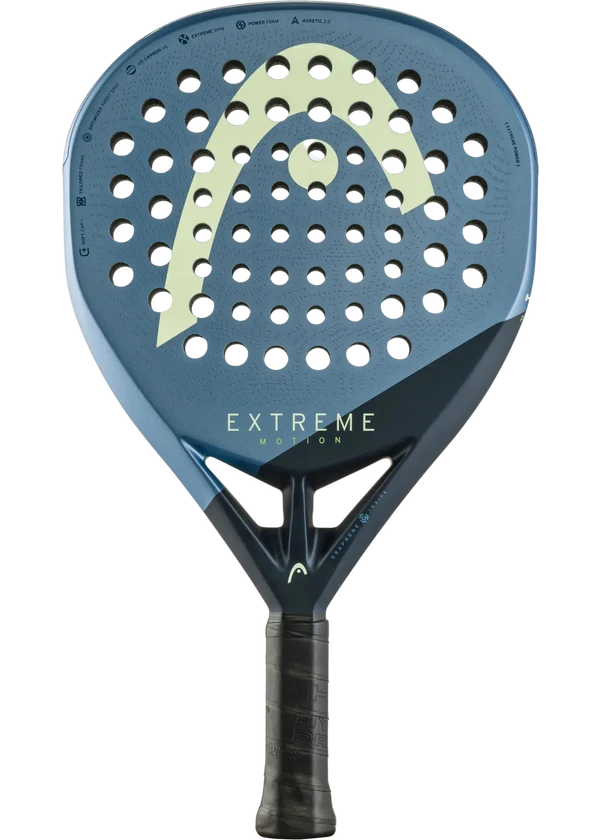


8 Parameters
Extreme Motion 2025
On this page
Review
Head Extreme Motion 2025 Review: The Diamond That Doesn’t Make You Pay for It
The diamond shape has a reputation tax: you pay for power in maneuverability, in forgiveness, in access. The best aggressive players accept that toll. But there’s a category of racket that tries to renegotiate the deal — keeping the head-heavy balance and the explosive rebound while trimming the weight and softening the demand. The Head Extreme Motion 2025 positions itself exactly there. The question isn’t whether it’s powerful. It’s whether the concessions required to make it accessible are the right ones.
Beneath the diamond silhouette sits a Power Foam reactive EVA core, a UD Carbon HS surface with Extreme Spin 3D rough texture, and a frame built around Graphene Inside with Tailored Frame construction. The proprietary stack includes Auxetic 2.0 for energy feedback and vibration distribution, Smart Bridge for control, Anti-Shock Skin polymer foil, Optimized Sweet Spot drilling pattern, and Soft Butt Cap+ for customizable comfort. Declared weight is 360g at 270mm balance — our own weighed units ranged between 359g and 369g, confirming the declared figure is real, not aspirational. Beam width is 38mm. This is a Head built for intermediate-to-advanced attackers who want the diamond profile without the Extreme Pro’s uncompromising physical demand.
Attacker: 7.91 · Defender: 7.86 · Hybrid: 7.82 — the three profiles finish within 0.09 points of each other. No direction dominates: this diamond quietly plays both sides of the court, and that versatility — not any single number — is the whole story.
Performance Breakdown
How the Head Extreme Motion 2025 Plays
STABILITY 7.9
The Head-Heavy Payoff Is Real
The 270mm balance point does exactly what it’s supposed to: it puts mass behind smashes and overhead finishes in a way that flatter-balanced rackets simply can’t replicate. Power at 8.2 is the headline number — strong for the weight, not a Pro-level cannon — and the UD Carbon HS surface keeps output consistent on downward strikes. Stability holds at 7.9, respectable for a racket in this weight class, and a signal that the Graphene Inside construction is absorbing torsional stress rather than redistributing it to your arm. The combination means this is a racket that rewards aggressive positioning without punishing off-axis contact as harshly as a stiffer Pro-tier diamond.
PLAYABILITY 7.7
Fast for a Diamond. That Matters More Than It Sounds.
Maneuverability at 7.9 is the score that separates the Motion from the Extreme Pro in practical terms. At the net, where reaction time collapses to fractions of a second, a 10g weight reduction combined with a more accessible balance translates directly into volleys you can reach and finish. Playability at 7.7 reflects the honest reality that this remains a demanding racket — the diamond shape and head-heavy configuration require deliberate technique, and players used to round or teardrop profiles will need adaptation time. But for the intended profile, that 7.9 maneuverability is the whole argument for choosing Motion over Pro.
SWEETSPOT SIZE 7.5
Spin Grips — It Doesn’t Bite
The Extreme Spin 3D rough texture isn’t cosmetic — Spin at 7.5 confirms that the surface engineering actively contributes to ball rotation, most pronounced on bandejas and lobs where topspin changes trajectory for opponents. It grips, it doesn’t bite: this is no spin machine. Sweetspot Size at 7.5 is the counterbalance: the Optimized Sweet Spot drilling pattern expands contact area meaningfully versus a standard diamond, but this remains a precision tool, not a forgiving one. The 7.5 score is the lower end of this racket’s performance profile — players who rely on consistent returns from difficult positions will find the tolerance window tighter than they’d like. Among diamond rackets at this level, that’s expected, not exceptional.
COMFORT 7.6
Control That Surprises, Comfort That Qualifies
Control at 8.1 is the most counterintuitive number in this profile. Diamond shapes at high balance traditionally sacrifice touch for output — but the combination of Power Foam’s energy absorption, Auxetic 2.0’s vibration distribution, and Smart Bridge’s structural optimization produces a control ceiling that’s meaningfully higher than the shape alone would suggest. Comfort at 7.6 is more honest: Auxetic 2.0 dampens vibration well in normal play, but under fatigue or on mishits, the stiff carbon construction sends feedback through the handle that players with arm sensitivity will notice. The Soft Butt Cap+ adds customization options that partially mitigate this, but 7.6 reflects the physical reality of a 38mm, head-heavy diamond at stiffness 62.
Technology
Auxetic 2.0 and the Power Foam Stack: Does the System Earn Its Complexity?
Auxetic 2.0 operates on a counterintuitive structural principle: the frame material expands laterally when compressed rather than contracting. In practical terms, this means that at the moment of impact the frame contributes to energy return rather than simply absorbing it. The result shows up directly in the Control score of 8.1 — a number that shouldn’t be as high as it is for this shape and balance, and Auxetic 2.0 is why it is. The same mechanism distributes vibration more evenly across the frame rather than channeling it into the handle, which is what keeps Comfort at 7.6 rather than lower.
The Power Foam reactive EVA core is the engine behind the 8.2 Power score. Unlike standard EVA, which manages energy primarily through compression and rebound, Power Foam is calibrated for rapid elastic recovery — meaning the ball leaves the face faster and with more consistent output. On smashes and overheads, the effect is immediate and unambiguous. Where it becomes more nuanced is on touch shots and defensive blocks, where that reactive quality can push ball exit speed slightly beyond intended, which is exactly the dynamic that keeps Playability at 7.7 rather than pushing toward 8.0.
The Extreme Spin 3D texture on the UD Carbon HS surface is the third pillar. The rough 3D surface creates micro-grip on contact, generating the topspin and slice angles that score 7.5 in Spin. This is particularly relevant for bandejas and viboras where the combination of head-heavy swing weight and surface grip produces rotation that changes ball bounce trajectory meaningfully. The Smart Bridge structural reinforcement at the throat contributes to the Stability score of 7.9 by managing torsional flex on off-center contact. Combined, these systems make the Extreme Motion 2025 a racket where the technology stack is genuinely coordinated rather than additive — each component addresses a specific limitation of the diamond platform, and the scores reflect that coordination.
Player Fit
Who Should Buy the Head Extreme Motion 2025?
The Intermediate-to-Advanced Attacker Who Wants the Diamond Without the Full Tax
You finish when the chance comes, but you also rally, defend, and play twice a week — the Motion is built around exactly that calendar. Control at 8.1 and Maneuverability at 7.9 coexist here in a way that’s genuinely uncommon in the diamond category: you keep the head-heavy punch without the Pro’s recovery time. Power at 8.2 answers when the overhead chance arrives, and Spin at 7.5 gives your bandejas real teeth. And because the three profiles finish within 0.09 points of each other — Attacker 7.91, Defender 7.86, Hybrid 7.82 — the racket doesn’t collapse when the rally pulls you off the net. If you’re an intermediate building toward an aggressive game, this is the most honest door into the diamond category.
Pure Finishers and Anyone Still Building Consistency
If your game is built around maximum overhead output, you’ll hit the 8.2 Power ceiling within a month — the Extreme Pro is where that ceiling lives. The same honesty applies to players still developing basic stroke mechanics: Playability at 7.7 and a Sweetspot of 7.5 don’t provide the margin for error that learning curves require, and the 270mm head-heavy balance asks for preparation time that inconsistency can’t afford. A rounder, more balanced profile will accelerate your development without the technical debt this shape demands.
FAQ
Frequently Asked Questions
What is the PadelVerdict score for the Head Extreme Motion 2025?
The overall PadelVerdict score is 8.1 — Attacker 7.91, Defender 7.86, Hybrid 7.82 — with a +0.2 Consensus Modifier. This page previously showed 8.5: same racket, corrected arithmetic, with Power re-based on a full season of our own court testing. The three profiles finish within 0.09 points of each other, which is the real story here: this diamond plays both sides of the court. Updated September 2026: scores re-verified after a full season of testing.
Is the Head Extreme Motion 2025 good for intermediate players?
Yes, with one condition. This is the diamond we point intermediates toward: Maneuverability at 7.9 and Comfort at 7.6 make it the most accessible head-heavy racket in the Extreme line, and the flat profile spread means defensive rallies don’t punish you for leaving the net. The condition: a 270mm balance and stiffness 62 still ask for developed technique on off-center contact — Sweetspot 7.5 is the honest limit. If you’re an intermediate building toward an aggressive game, this is the fastest route into the diamond category.
Is the Head Extreme Motion 2025 good for attacking players?
Yes. The Attacker score of 7.91 leads the profile — barely — driven by Control 8.1, Power 8.2, and Maneuverability 7.9: placement, output, and speed to finish. What changes the story is that Defender and Hybrid finish within 0.09 points, so attacking doesn’t cost you the rest of the court. If that description fits your game, browse the full best attacker rackets category to see where the Motion sits in context.
What is the actual weight of the Head Extreme Motion 2025?
Head declares 360g. We weighed two units ourselves at 359g and 369g — a 10g spread between individual rackets from the same model. The average of 364g sits just above the declared figure, which is within normal manufacturing variance. A 10g difference between units is perceptible to sensitive players on longer rallies but won’t change the racket’s fundamental character. If your unit lands at the heavier end of that range, expect the head-heavy feel to be slightly more pronounced.
How does the Head Extreme Motion 2025 compare to the Head Extreme Pro 2025?
The choice between them is a question of ceiling versus accessibility. The Pro is heavier (~370g), stiffer, and built for maximum power output at the cost of physical demand — it suits pure attackers with high-level technique who want no compromise. The Motion trades roughly 10g and some raw power ceiling for Maneuverability 7.9 and a Control score that’s meaningfully more accessible. Same technology stack, same shape, different contract with the player. If you finish matches tired and want the diamond power without the wear, the Motion is the correct choice.
Why does the Head Extreme Motion 2025 have a Consensus Modifier of +0.2?
Two things earn it. First, we weighed units of this model on our own scales, and the declared 360g spec held up — field validation in the most literal sense. Second, the technical picture — balance point, core characteristics, surface construction — stayed stable and contradiction-free across every market we track over a full season. What would move the modifier further is laboratory-grade measurement across multiple units; until that exists, +0.2 is the honest ceiling.
Similar Rackets
Independent testing, funded by readers
No brand deals, no sponsored picks. If you found this useful, you can support the next round of tests with a small tip.

