
Metalbone HRD 2026
Maximum Aggression, No Apologies
The short verdict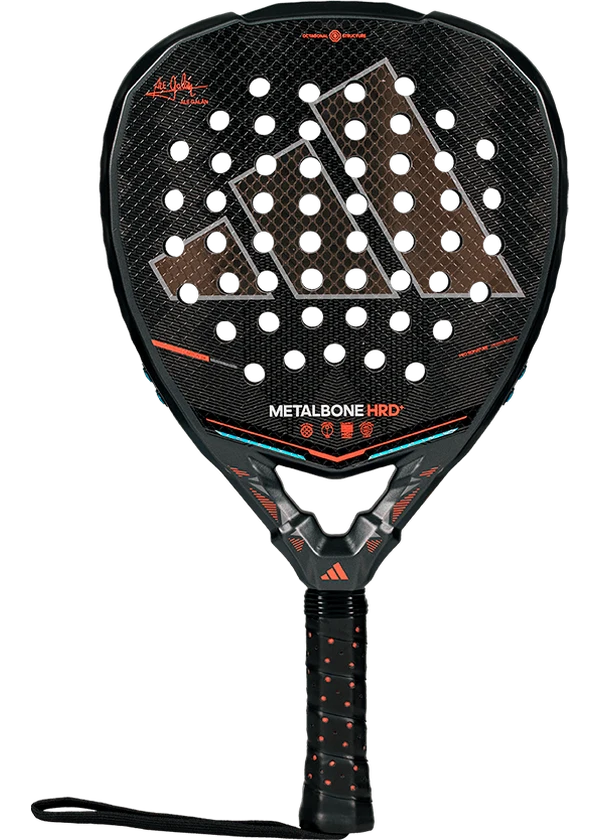


8 Parameters
Metalbone HRD 2026
On this page
Review
Adidas Metalbone HRD 2026 Review: Maximum Aggression, No Apologies
There is a category of racket that refuses to meet you halfway — built entirely for the player who has already decided the rally ends at the net, not from the baseline. The Adidas Metalbone HRD 2026 lives in that category. The central tension is simple: you gain a finishing weapon that very few rackets can match, and you surrender the margin for error that makes padel accessible at most levels. That trade-off is the whole story here.
The Metalbone HRD 2026 is built around a diamond shape with a high balance point (278mm), a high-density EVA High Memory core branded as HRD — High Recovery Density — running at a declared stiffness of 78. The face uses Carbon Aluminized 16K with a rough Spin Blade Decal texture. Structurally, the frame incorporates an Octagonal Structure (eight-edged carbon tube), Low Poly design, and Power Groove perimeter rail, all working toward one goal: rigidity. The signature Weight and Balance System allows customization of up to 11.2g, shifting the character from flat power to controlled aggression. The Extra Power Grip lengthens the handle to push the sweetspot further toward the top of the frame. This is Ale Galán’s weapon in the Adidas lineup, and it is engineered accordingly.
Power lands at 9.1 — the highest single parameter in this review. Attacker: 8.52 · Hybrid: 7.74 · Defender: 7.19. The gap between Attacker and Defender is 1.33 points — a spread that tells you exactly who this racket is built for and who it will punish.
Performance Breakdown
How the Metalbone HRD 2026 Plays
STABILITY 8.8
A Finishing Machine That Means It
When a diamond-shaped racket reaches a stiffness of 78 combined with Carbon Aluminized 16K faces and a high-density HRD core, the energy equation tips decisively toward the ball — and the scores reflect exactly that. Power at 9.1 is elite-tier, driven by the frame’s refusal to absorb impact rather than redirect it. Stability at 8.8 means the racket holds its line through contact even on hard lateral volleys, which is why players at the net can commit fully without fear of the frame twisting. The Octagonal Structure and Power Groove are not marketing language here — they are the engineering reason this combination exists. For smashes and víboras, this is among the most complete offensive platforms in the diamond racket category.
MANEUVERABILITY 7.2
Spin Is the Surprise; Weight Is the Tax
A spin score of 8.0 on a racket this stiff is not obvious. The Spin Blade Decal texture on the Carbon Aluminized 16K surface genuinely grips the ball differently from a standard carbon face — it earns that score rather than inheriting it from frame geometry alone. Maneuverability at 7.2 is honest but demanding: the high balance point and head-heavy construction mean this racket does not move quickly through tight defensive exchanges. The Weight and Balance System can shift some weight toward the handle to recover responsiveness, but even optimized, this is a racket for players who set up their shots rather than react to them. That 7.2 is not a flaw — it is the cost of 9.1 power, and players at this level know the deal.
PLAYABILITY 7.0
Control at Speed, Not at Rest
Control at 7.8 may look generous for a racket this aggressive, but it reflects a specific truth: precision on fast offensive shots — the víbora, the bandeja from deep, the finishing smash — is what this score is measuring. Playability at 7.0 accounts for the narrower operating window; the Metalbone HRD rewards clean mechanics and punishes shortcuts. The HRD core’s high recovery density does contribute to shot consistency at high swing speeds, which is where this racket operates best. The customizable Weight and Balance System is meaningfully useful here — dialing weight toward the handle raises both control feel and playability for players whose technique is strong but not yet at the pro ceiling.
SWEETSPOT SIZE 6.8
The Numbers That Define the Ceiling
Comfort at 6.2 and Sweetspot Size at 6.8 are where the Metalbone HRD draws its line in the sand. Neither score triggers a floor penalty — both stay above 6.0 — but together they define the technical floor for this racket’s target player. The stiffness of 78 means off-center contact communicates directly to the arm; players with any elbow sensitivity will notice it in extended sessions, particularly on defensive retrievals where swing speed is lower. The sweetspot sits high in the frame by design, and hitting below it consistently degrades both power and feel in a way that intermediate players will not be able to manage. A score below 6.0 in either parameter would carry automatic weight in our scoring system — these two numbers are close enough to that line that they cannot be ignored when matching this racket to the right player.
Technology
HRD System: Does Engineered Stiffness Actually Deliver Power You Can Control?
The Hybrid Ribs Dynamic system — HRD — is not about adding stiffness for its own sake. It is an energy return architecture: the internal rib structure is designed to maximize how much of each swing’s kinetic energy transfers into ball speed rather than frame deformation. On a high-swing-speed smash, this means the ball leaves faster and deeper than on conventional EVA cores. That is what drives the 9.1 Power score — not the carbon surface alone, but the interaction between the HRD core’s recovery density and the Octagonal Structure frame that contains it without flexing.
The Low Poly design reduces the frame’s heart area, which directly supports the Maneuverability score of 7.2 — it is meaningfully higher than a standard diamond at this weight and stiffness because the geometry reduces rotational mass at the frame’s widest point. The Power Groove perimeter rail locks the frame against torsion under lateral stress, which is the mechanical explanation behind Stability at 8.8. These are not independent features — they are a system. Remove any one component and the overall balance shifts.
The Weight and Balance System is the most practically significant customization feature in the lineup. Shifting weight toward the head amplifies the already elite power output; shifting toward the handle recovers enough control feel to lift Playability from 7.0 toward the upper end of its range. This is not a gimmick — it is a meaningful tuning mechanism for a racket that operates at the edge of what advanced players can handle. The Extra Power Grip elongates the handle to move the sweetspot further toward the frame’s tip, compounding the power coefficient at the cost of the already-constrained 6.8 Sweetspot Size score. Players who use this racket as delivered — without adjusting the weight system — are accepting the full stiffness profile. Those who tune it earn a racket that feels more like a tool than a weapon.
Player Fit
Who Should Buy the Adidas Metalbone HRD 2026?
The Advanced Left-Court Attacker Who Finishes Rallies
If you are the type who plays left court at an advanced or competitive level, sets up the point from the net, and ends rallies with a smash rather than a lob — this was built for you. The 9.1 Power and 8.8 Stability scores mean every finishing shot has the weight and consistency of a player who has done this ten thousand times before. The 8.0 Spin score means your víbora carries real threat. You are technically clean enough that Comfort at 6.2 does not concern you on most sessions, and your technique means the 6.8 Sweetspot stays in your hit zone the majority of the time. You have probably already hit with something in the Metalbone family — this version tells you what the ceiling feels like when the engineers stopped compromising.
Intermediate Players and Anyone Who Defends from the Baseline
The Defender score of 7.19 — the lowest of the three profiles, sitting 1.33 points below the Attacker score — is not an oversight. This racket does not defend. It does not absorb pace from the back of the court. It does not forgive. If your game involves spending time at the baseline retrieving hard shots, the combination of 6.2 Comfort and 6.8 Sweetspot will expose every technical gap in your game within the first set. Intermediate players will fight the frame rather than use it, and the arm fatigue from a stiff 78 racket on defensive retrievals is real. The Metalbone Carbon CTRL is the more honest choice for players who want Adidas quality without the punishment of this stiffness profile.
FAQ
Frequently Asked Questions
What is the PadelVerdict score for the Adidas Metalbone HRD 2026?
The overall Verdict Score is 8.8, with a Consensus Modifier of +0.1 applied. Profile breakdown: Attacker 8.52 / Hybrid 7.74 / Defender 7.19. Specialist sources across multiple markets align consistently on the aggressive attacker profile with no contradictions, and a single on-camera independent measurement confirmed a base weight of 356g — that cross-market consistency and field validation is what earns the positive adjustment. No independent stiffness or balance measurements exist to push the modifier further. The 1.33-point gap between Attacker and Defender scores is the clearest signal in this review: this is a specialist’s weapon, not a versatile tool.
Is the Adidas Metalbone HRD 2026 good for advanced players?
Yes — for advanced players who attack. The 7.0 Playability score is the honest signal: this racket rewards technical consistency and punishes gaps in mechanics. Advanced players who play net-dominant, offensive padel will extract 9.1 Power and 8.8 Stability regularly. Advanced players whose game includes significant baseline defense will find Comfort at 6.2 and Sweetspot Size at 6.8 expose that side of their game quickly. Know your game before committing.
Is the Adidas Metalbone HRD 2026 good for attackers?
Definitively yes. The Attacker score of 8.52 is built on 9.1 Power, 8.8 Stability, and 8.0 Spin — a combination that covers the three things an attacking player needs: finishing force, frame integrity under hard contact, and enough spin to generate threat on víboras and bandejas. If your game ends rallies at the net, this belongs on your shortlist. Browse all best attacker rackets to see how it ranks against the full field.
What is the actual weight of the Adidas Metalbone HRD 2026?
Declared weight is 345–360g plus up to 11.2g from the customizable Weight and Balance System. A single on-camera independent measurement confirmed 356g without additional weights — sitting at the upper end of the base declared range. Comparative sources cite 360–375g, likely measuring with weights installed. The variance across sources exceeds 10g. On court, a base weight of 356g at a high balance point of 278mm is perceptible — this is a head-heavy racket that plays heavier than its nominal weight suggests.
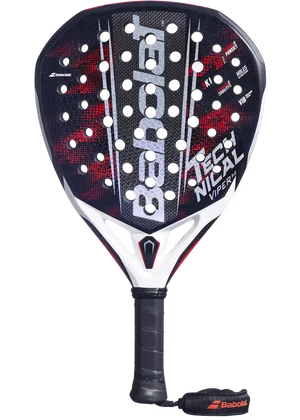
How does the Adidas Metalbone HRD 2026 compare to the Babolat Technical Viper Lebrón 3.0 2026?
These are two rackets for the same player type — aggressive, advanced, left-court attackers — but they make different bets. The Metalbone HRD bets on stiffness and energy return via the HRD core; the Viper Lebrón 3.0 uses a multi-layer X-EVA core and Dynamic Stability System that progressively absorbs vibration. If you prioritize raw finishing power and want to customize weight distribution, the Metalbone HRD is your choice. If you play long sessions or have any elbow sensitivity, the Viper Lebrón’s more forgiving construction earns consideration. Different tools for the same job.
Why does the Adidas Metalbone HRD 2026 have a Consensus Modifier of +0.1?
The modifier reflects how well the available evidence holds together. Specialist sources across multiple markets align without contradiction on the aggressive attacker profile, the high stiffness character, and the off-center limitations — that cross-market convergence carries genuine analytical weight and is what moves the modifier above zero. A single on-camera independent measurement confirmed 356g at base weight, which is useful corroboration but not enough on its own to push further. What keeps the modifier at +0.1 rather than higher is the absence of independent stiffness and balance measurements to verify the declared figures beyond what manufacturers and retailers report. Additional independent physical measurements would support a positive adjustment to the modifier.
Similar Rackets
Independent testing, funded by readers
No brand deals, no sponsored picks. If you found this useful, you can support the next round of tests with a small tip.

