
Technical Viper 3.0 2026
Is the Power Worth the Penalty?
The short verdict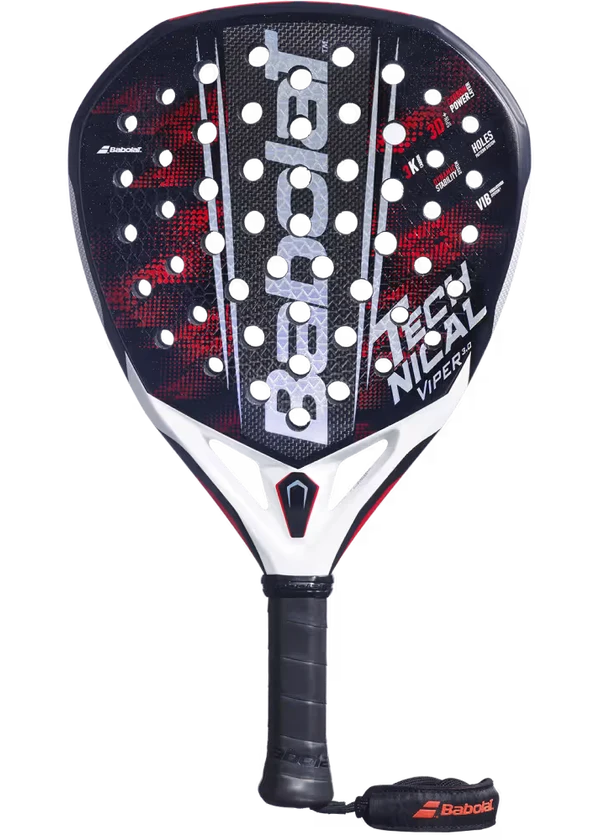


8 Parameters
Technical Viper 3.0 2026
On this page
Review
Babolat Technical Viper 3.0 2026 Review — Is the Power Worth the Penalty?
Diamond-shaped attackers always force the same compromise: you load up the head for explosive power, and somewhere else in the racket’s personality, something gives. The question is never whether that trade-off exists — it always does — but whether the racket manages it well enough that the right player never notices. The Babolat Technical Viper 3.0 2026 draws that line hard. It is built for a specific type of player executing a specific kind of game, and it makes no apology for the players it leaves behind.
At its core — literally — the Technical Viper 3.0 runs an X-EVA multilayer triple-density hard EVA foam, sitting inside a 100% carbon 3K frame at a 38mm profile with a declared stiffness of 78. The hitting surface is 3K carbon with a 3D Spin+ rough texture designed to generate traction on contact. Babolat stacks multiple proprietary systems here: the Carbon Power Layer adds a carbon sheet inside the core for explosive response, the Dynamic Stability System uses a central bar for torsional resistance, and the Vibrabsorb System² with SMAC elastomers handles vibration attenuation at the handle. The declared balance sits at 270mm — a high balance point that positions every gram of this racket toward the head. Declared weight range spans 360–375g across markets.
Stability scores 8.6 — the highest parameter in this racket’s profile. Attacker: 8.55 · Hybrid: 7.7 · Defender: 7.1. The 1.45-point gap between Attacker and Defender profiles is the widest signal in the data: this is a specialist’s weapon, not a versatile all-court tool.
Performance Breakdown
How the Babolat Technical Viper 3.0 2026 Plays
STABILITY 8.6
The Smash Is Not a Shot — It’s a Statement
When a high-balance diamond frame is combined with a Carbon Power Layer and 3K carbon construction, power figures don’t describe a gentle increment — they describe a fundamentally different type of ball exit. The 9.2 in Power is earned: expert testers specifically called out smashes and viboras as brutal, rating the power dimension 4.8/5 in on-court testing. Stability at 8.6 reinforces that figure — torsional resistance from the Dynamic Stability System means the racket doesn’t twist on aggressive contact, so the energy you generate actually arrives at the ball. These two parameters are the reason the Attacker profile sits at 8.55, and they are the whole reason to consider this racket.
CONTROL 7.8
The Rough Surface Does Its Job — If You Do Yours
The 3D Spin+ texture is not a marketing flourish — it scores 8.4 in Spin and produces measurable traction on both lifted and sliced shots, rated 4.4/5 in independent court testing. Control at 7.8 reads well for a racket this stiff, but the context matters: that precision holds when the technique is there. Expert testing specifically noted surgical precision on volleys and aggressive shots, while equally noting that defensive control is a different story. Control on your terms, from positions you’ve already won — that’s the model. Trying to work the ball from defensive situations below 7.8 quality is where this racket starts to show its edges.
PLAYABILITY 6.7
MANEUVERABILITY 7.0
The Gap Between Power and Access Is Real
These three scores together explain the 1.25-point gap between Attacker and Defender profiles more clearly than any single metric could. Sweetspot at 6.8 — explicitly noted as smaller than the Air Viper and around 520cm², with testers calling it demanding on off-center hits — means the margin for positional error is narrow. Playability at 6.7 reflects the learning curve: the racket’s reactivity rewards clean mechanics and punishes half-measures. Maneuverability at 7.0 is expected for a high-balance diamond; the head-heavy distribution slows the arm slightly, particularly in fast exchanges at the net. Collectively, these are not flaws to fix — they are the logical consequence of how this racket was built. Among diamond-shaped rackets, this access/power trade-off is inherent to the category.
Vibrabsorb Helps. It Doesn’t Solve.
Comfort at 6.2 is the most honest score in this racket’s profile, and it should be read carefully. Stiffness at 78, combined with a hard triple-density EVA core and a head-heavy balance, generates significant vibration on contact — particularly on off-center hits where the sweetspot’s narrowness amplifies the shock. The Vibrabsorb System² with SMAC elastomers does measurably reduce peak vibration transmission, and testers rated comfort at 3.9/5 in on-court testing — not terrible, but not something to dismiss if you have a history of arm sensitivity. The note about potential arm fatigue in long matches is sourced from multiple independent reviews across languages and should be taken seriously. No durability concerns have been reported at this stage. This section updates as long-term data becomes available — typically 60+ days post-launch.
Technology
Carbon Power Layer + Dynamic Stability System: Do Two Systems Add Up to One Solution?
The Carbon Power Layer is a dedicated carbon sheet embedded inside the core — not on the frame surface, but within the EVA structure itself. Its function is to stiffen the core’s response without requiring additional frame thickness, concentrating energy transfer at the hitting surface rather than dissipating it through core flex. The direct result is visible in the Power score of 9.2: the ball exit is explosive in a way that purely frame-based stiffness often can’t match, because the energy release point sits closer to the hitting face. This is what testers described as brutal on smashes — not just power, but immediacy.
The Dynamic Stability System works orthogonally to the Power Layer: a central reinforcing bar running through the frame’s spine resists torsion when the ball makes contact away from the central axis. In practice, this is what drives the 8.6 Stability score — off-axis impacts that would rotate a conventional frame instead compress into a more predictable response. That predictability is also part of what keeps Control at 7.8 despite the racket’s stiffness; without torsional resistance, precise volleying at pace would be far harder to reproduce consistently.
The Vibrabsorb System² with SMAC elastomers in the handle addresses the comfort deficit partially — it intercepts vibration at the grip rather than at the frame, which means the energy attenuation happens after the shot rather than during it. This explains why Comfort lands at 6.2 rather than lower: the system is working, but the physics of a 78-stiffness diamond under a heavy EVA core means it’s managing a significant vibration load, not eliminating it. Players with healthy arms who generate their own pace will find this system adequate. Players who rely on the racket to do work they don’t have the physical condition to sustain will find the limitation sooner than the technology.
Who benefits: advanced attackers who hit from positions of dominance, generate their own pace, and need a racket that converts that pace into maximum ball exit speed without energy loss. The technology stack is coherent — every system points at the same type of player. The Babolat lineup positions this as the apex power option in the Technical collection, above the Air Viper and alongside the Viper Juan Lebrón 3.0 — and the scores support that positioning.
Player Fit
Who Should Buy the Babolat Technical Viper 3.0 2026?
The Technical Striker Who Wins From the Net
If you’re the type who ends points rather than extends them — who looks for the smash, who hits viboras with intent, who plays most of your tennis in the attacking third of the court — this racket was assembled around your game. The 9.2 Power and 8.6 Stability mean the shots you’re already generating get amplified and stabilized simultaneously. The 8.4 Spin score means your attacking lobs and overhead angles have real traction behind them. You’re physically fit, your technique is clean, and arm sensitivity isn’t something you’ve ever had to think about. You’ve probably already played a few high-power diamonds and felt something was missing — a central bar, a more explosive core, something that converts your effort more completely. That’s exactly what this racket is built to deliver.
Anyone Building Their Game Rather Than Executing It
The Defender score of 7.1 is the bluntest signal in the data — and it should end this conversation quickly for most players. If you play long baseline exchanges, if you rely on retrieving and resetting before attacking, if your positional game requires arm-friendly forgiveness during a three-set match, the 6.2 Comfort and 6.8 Sweetspot will drain you before you drain your opponent. The 6.7 Playability score says the same thing differently: this racket demands technique that is already there, not technique that is still developing. Intermediate players chasing a power upgrade will find the margin for error too narrow to maintain. If arm fatigue has cost you a match in the last year, don’t let a 9.2 Power score convince you otherwise.
FAQ
Frequently Asked Questions
What is the PadelVerdict score for the Babolat Technical Viper 3.0 2026?
The overall PadelVerdict score is 8.6, with a Consensus Modifier of +0.05. That modest modifier reflects a specific data situation: specs are consistent across Spanish, Portuguese, Italian, and French markets, but no independent measurements exist to validate them — so the score is adjusted minimally upward rather than penalized for uncertainty. Profile breakdown: Attacker 8.55, Hybrid 7.7, Defender 7.1. The 1.25-point spread between top and bottom profiles tells you exactly who this racket is and isn’t for.
Is the Babolat Technical Viper 3.0 2026 good for advanced players?
Yes — but specifically for advanced attackers, not advanced players broadly. Playability at 6.7 is the qualifying parameter: it signals that technique must already be present, not in development. An advanced defender or all-court player with arm sensitivity will be fighting this racket, not using it. If you’re intermediate, look at the Air Viper 2.6 instead — more maneuverable, more forgiving, still within the Viper family.
Is the Babolat Technical Viper 3.0 2026 good for attacking players?
Yes, unambiguously. Attacker profile score of 8.55 is the highest of the three, backed by Power at 9.2, Stability at 8.6, and Spin at 8.4. If smashing and viboras are the core of your point-finishing game, these three numbers cover every dimension that matters to you. It’s exactly what it says it is.
What is the actual weight of the Babolat Technical Viper 3.0 2026?
Declared at 368g centrally, with a range of 360–375g across market sources. No independent measured weight exists at this stage — all figures are manufacturer declarations. A 15g spread is noticeable on court, particularly in a head-heavy diamond where variance at the top of the range will amplify the felt swing weight. Until independent measurements emerge, treat the declared figure as an approximation rather than a guarantee.
How does the Babolat Technical Viper 3.0 2026 compare to the Viper Juan Lebrón 3.0?
These are nearly the same racket on paper, but they split on balance and positioning. The Lebrón 3.0 sits with a more forward balance and a slightly reduced sweetspot, making it the more demanding option for players who want the signature’s extreme head weight. The Technical Viper 3.0 is marginally more balanced and more accessible — the choice between a player who wants the most aggressive tool available and a player who wants elite power with slightly more reliability.
Why does the Babolat Technical Viper 3.0 2026 have a Consensus Modifier of +0.05?
The modifier is small because the data situation is specific: manufacturer specs are coherent across four markets — Spain, Portugal, Italy, and France — which suggests internal consistency. But no independent tester has published measured weight or balance figures to validate those specs. PadelVerdict applies a minimal positive modifier for cross-market spec alignment while holding back a stronger adjustment until independent measurements confirm what the manufacturer has declared. It’s a data-quality call, not a performance judgment.
What is the best padel racket for attacking players in 2026?
The Babolat Technical Viper 3.0 2026 is among the strongest options in the category, but it’s not the only one. Player weight, arm sensitivity, and preferred balance point all shift the answer. For a full comparison of the top-rated options, see all best attacker rackets ranked and filtered by PadelVerdict score.
Similar Rackets
Independent testing, funded by readers
No brand deals, no sponsored picks. If you found this useful, you can support the next round of tests with a small tip.

