
Fenix Elite 2026
Most of Leo Augsburger's attacking template with part of the physical bill removed. Less extreme than the Fenix Pro, not less serious.
The short verdict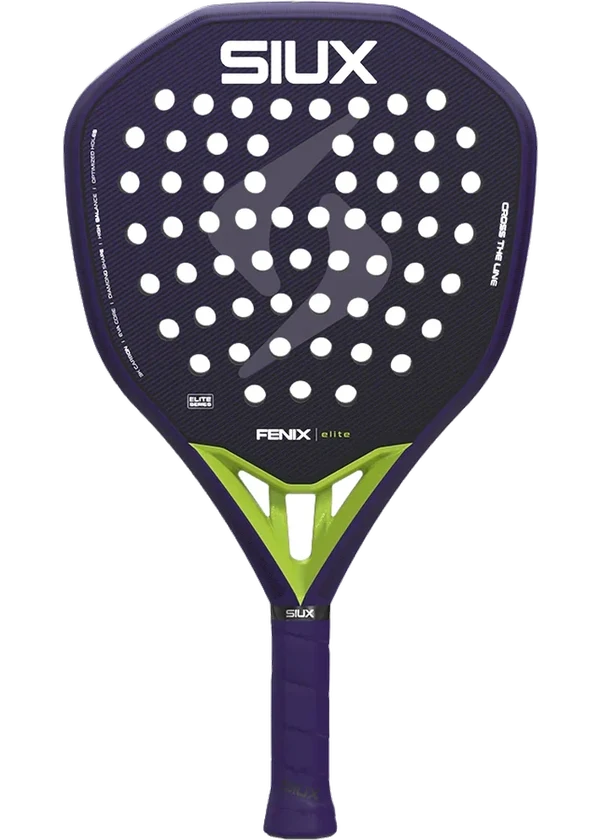


8 Parameters
Fenix Elite 2026
On this page
PadelVerdict Review · Siux Fenix Elite 2026
Siux Fenix Elite 2026 Review: The Friendlier Fenix Still Plays Like a Fenix
The Fenix Elite does not replace the Fenix Pro. It answers a more useful question: how much of Leo Augsburger’s attacking template can you keep while removing part of the physical bill? The answer is “most of it”. The Elite keeps the diamond shape, high balance and hard response, then swaps the Pro’s 12K face for 3K carbon and makes the racket marginally easier to move. It is less extreme, not less serious.
The spec sheet reads 355–375g, with our declared reference set at 365g, and a 270mm high balance. The face is 3K carbon with a 3D sand finish; the core is high-density EVA; the frame is carbon. Estimated stiffness is 68 — firm, but a step below the hardest attacking builds. The Fenix name remains tied to Leo Augsburger’s power game. Compare the full family in our Siux archive.
Sibling test
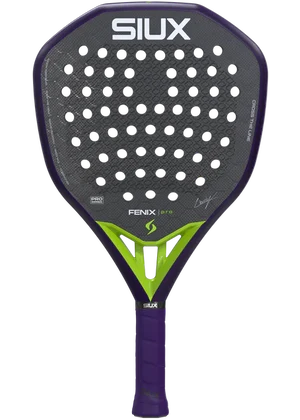
Fenix Elite 2026 vs Fenix Pro 2026
The Pro remains the ceiling. The Elite’s job is to keep the same identity while lowering the physical and technical entry bar.
Performance
Shot by Shot: Attack First, With a Lower Toll
Attacker 8.10 · Hybrid 7.56 · Defender 7.42. The 0.68 gap between attack and defense is wider than 56.2% of our database. The Elite softens the Fenix experience; it does not change its job.
Still built to finish
Power 8.7 sits 19th among the 72 2026 diamonds in our database, and Stability 8.3 ranks 16th. That combination is why the Elite still feels like a Fenix: the frame stays quiet on hard contact and the high balance gives the smash real mass behind it.
A touch more precision than the Pro
Control rises from 7.6 on the Pro to 7.8 here. The difference is not a personality change; it is the 3K face giving a fraction more dwell and direction. Spin 7.9 is helped by the sandy 3D finish, especially on víboras played with angle rather than maximum violence.
Less severe, still not easy
Maneuverability improves only slightly over the Pro (7.3 vs 7.2), and Sweetspot moves from 7.0 to 7.1. Those are honest numbers. The Elite is friendlier at the margin; it is not a round racket wearing diamond clothes.
Comfort remains the warning label
Comfort 6.7 is the parameter to read before buying. The high-density EVA and 68 stiffness keep feedback direct, and players with elbow sensitivity should not treat “Elite” as a synonym for soft. Playability 7.1 improves on the Pro’s 6.7 because the racket is easier to move — not because it suddenly forgives everything.
On court
Where the Fenix Elite Feels Like the Pro — and Where It Doesn’t
From the baseline
Better than the Pro, still demanding. The slightly shorter balance helps on late preparation and glass recoveries, but the head-heavy geometry is always present. Defensive depth requires a full, technically clean swing.
At the net
Strong and stable. Volleys come out with pace and direction, and the frame resists twisting well when contact drifts high. The Elite is quicker than the Pro in reactive exchanges, though still not a pure touch racket.
Bandeja
The most improved shot. The 3K face keeps the ball on the strings a fraction longer, the rough finish adds slice, and Control 7.8 makes repeated placement more reliable than on the Pro.
Víbora
Heavy enough to finish, grippy enough to angle. Spin 7.9 works best when you swing through the ball and let the high balance add leverage. If your víbora depends on wrist snap alone, the racket will feel slower than a lighter drop.
Smash
The reason to buy it. Power 8.7 and Stability 8.3 produce real finishing output without needing the Pro’s full 12K/274mm commitment. The Pro still has the higher ceiling; the Elite lets more players reach theirs.
Player fit
Who Should Buy the Siux Fenix Elite 2026?
The advanced attacker who wants Fenix power with a smaller entry fee
You finish from the left, want a high-balance diamond and like a firm response, but the Pro feels too narrow or too demanding over a full match. The Elite keeps the same identity and removes just enough edge.
Intermediates, defensive specialists, and anyone with arm concerns
This is still a hard diamond with Comfort 6.7. If your priority is defensive depth, joint protection or a large sweetspot, the Electra Elite or a softer control racket will be the smarter purchase.
FAQ
FAQ
What is the PadelVerdict score for the Siux Fenix Elite 2026?
8.2 — Attacker 8.10, Hybrid 7.56, Defender 7.42, plus a +0.1 consensus modifier. The Fenix Pro remains higher at 8.5 because it has the higher attacking ceiling.
What is the actual weight of the Fenix Elite?
We use 365g as the declared reference within the 355–375g range. We have not yet verified an independent weighed unit, and the FAQ says so deliberately.
Is the Fenix Elite easier than the Fenix Pro?
Yes, but only in degrees. Playability rises from 6.7 to 7.1, Control from 7.6 to 7.8 and Sweetspot from 7.0 to 7.1. It remains an advanced attacking racket.
Does the Elite use the same 12K face as the Pro?
No. The Elite uses 3K carbon with a 3D sand finish; the Pro uses 12K carbon. That material difference is one reason the Elite feels a little more directed and a little less explosive.
Is the Siux Fenix Elite good for advanced players?
Yes — advanced attackers are the primary fit. Strong intermediates can grow into it, but the 270mm balance and Comfort 6.7 make it a deliberate choice, not a default upgrade.
Why is the consensus modifier +0.1?
Court reports converge on the same profile: slightly easier handling, lower physical cost and the same attacking identity. The absence of an independently measured unit keeps the modifier conservative.
Similar Rackets
Independent testing, funded by readers
No brand deals, no sponsored picks. If you found this useful, you can support the next round of tests with a small tip.

