
FX Lite 2026
Is Lighter Always Better?
The short verdict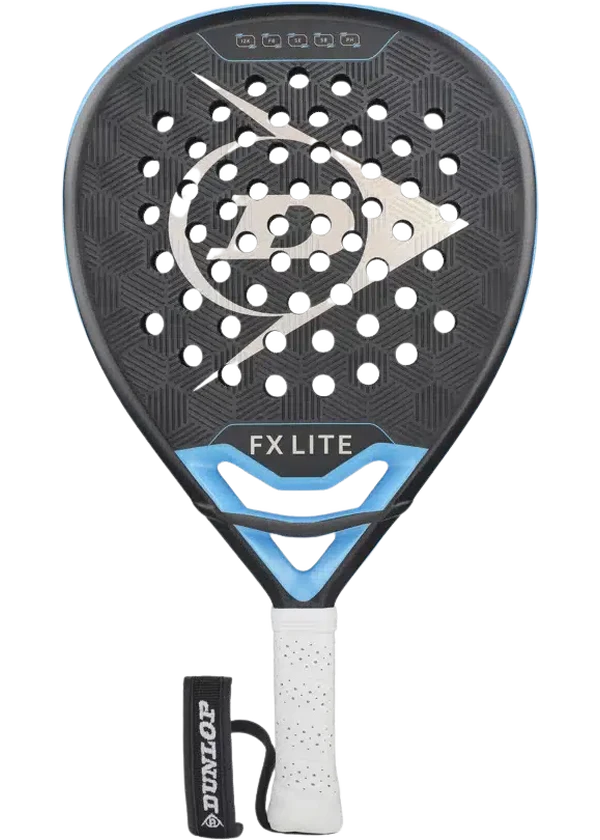

8 Parameters
FX Lite 2026
On this page
Review
Dunlop FX Lite 2026 Review: Is Lighter Always Better?
Diamond rackets are supposed to be power tools — heavy, high-balance, unforgiving at the net. The Dunlop FX Lite 2026 challenges that assumption directly. It keeps the diamond shape and the attacking geometry, but cuts the weight to 355g with a medium balance point, betting that maneuverability and comfort don’t have to be sacrificed for power. That trade-off is real, and it has a cost: control and sweetspot size are where the compromise shows up, and understanding whether that matters for your game is the whole purchase decision.
Under the 12K Super Premium Carbon frame sits a Soft EVA foam core with Sonic Core Infinergy inserts positioned at 3 and 9 o’clock — a combination designed to absorb vibration without deadening the response. The surface runs a SpinBoost raised texture finish. Dunlop layers in Force Bridge (geometric frame reinforcement), Power Holes (aerodynamic hole pattern), and VibroShield (anti-vibration layer positioned low on the frame). The result is a 38mm-profile diamond that looks aggressive on paper but plays noticeably softer than its shape suggests. It sits above the FX Team and FX Start in Dunlop’s lineup, distinguished from the FX Pro by its lighter weight, lower balance, and softer core.
Maneuverability leads at 8.4 — the highest single parameter. Attacker: 7.97 | Hybrid: 7.93 | Defender: 7.72. The 0.04 gap between Attacker and Hybrid is the tightest profile spread we score on a diamond — this racket doesn’t demand you pick a lane.
Performance Breakdown
How the Dunlop FX Lite 2026 Plays
MANEUVERABILITY 8.4
The Diamond That Doesn’t Slow You Down
Most attacking rackets trade net speed for punch. At 355g with a medium balance, the FX Lite sidesteps that trade entirely. Maneuverability at 8.4 is the standout number — the highest in this racket’s profile — and it translates directly to faster arm speed and quicker exchanges at the net. Power lands at 8.1, driven by V-Energy Channel frame stiffness and Power Holes aerodynamics. The combination works: you get diamond-level aggression without the sluggishness that typically comes with it.
STABILITY 7.6
Softer Than the Shape Promises
Comfort at 8.2 is genuinely surprising for a diamond racket — the Sonic Core Infinergy inserts and VibroShield layer are doing real work here, not just branding. Fatigue across long sessions is measurably lower than you’d expect from the frame geometry. Stability sits at 7.6, which is the profile score that pulls the Defender rating down relative to the other two — the softer core and lighter weight give up some resistance when the ball arrives hard from the back of the court. That’s the honest trade.
SWEETSPOT SIZE 7.3
Where the Diamond Tax Appears
Control at 7.2 and sweetspot size at 7.3 are the lowest parameters in the profile, and they’re inseparable from each other. The diamond geometry concentrates energy high in the frame, which rewards precise contact but punishes off-center strikes more than a round or drop shape would. Force Bridge helps with torsional consistency, and the Soft EVA core provides more forgiveness than a hard core would — but the geometry still sets the ceiling. These scores aren’t failures; they’re the honest cost of the shape.
PLAYABILITY 7.9
Spin as a Supporting Role, Not the Lead
Spin lands at 7.6 — solid, not spectacular. The SpinBoost raised texture generates meaningful grip on the ball, particularly on serve and smash, but this isn’t a spin-first racket. Playability at 7.9 tells the more complete story: the FX Lite 2026 is genuinely versatile across shot types, accessible enough for intermediate players to get into immediately, and structured enough to grow with developing technique. The FX Lite 2026 executes its brief — fast, comfortable, aggressive — without overreaching.
Technology
Sonic Core Infinergy: Does Comfort Tech Belong in an Attacking Racket?
The Sonic Core Infinergy inserts — positioned at 3 and 9 o’clock — are the most counterintuitive feature on this frame. Comfort technology in an attacking diamond is a genuine design tension, and Dunlop resolves it by using the inserts not to soften the feel, but to manage rebound timing. The result is a livelier exit off the face with significantly less shock transmission to the arm. That’s what’s behind the Comfort score of 8.2 — not padding, but energy management that protects the player without killing the response.
VibroShield, positioned lower on the frame, handles residual vibration at the handle end — the type that accumulates over a long match and accelerates arm fatigue. Combined with the Soft EVA core, it’s what keeps Comfort at 8.2 even as Control and Sweetspot Size sit in the low 7s. Force Bridge reinforces the frame geometry at stress points, contributing to the 7.6 Stability score and keeping the frame honest under lateral pressure. Among all diamond rackets, this system delivers an unusually accessible comfort profile without the typical stiffness penalty.
The SpinBoost raised texture and Power Holes complete the picture — the texture adds grip on the ball for the 7.6 Spin score, while the hole pattern lowers aerodynamic drag to support the 8.4 Maneuverability reading. Every system here has a specific job, and none of them are purely cosmetic. The player who benefits most is someone transitioning from a round or drop shape into a diamond for the first time: the tech absorbs enough of the diamond’s traditional harshness to make the move manageable.
Player Fit
Who Should Buy the Dunlop FX Lite 2026?
The Intermediate Attacker Who Wants Speed Without Punishment
If you’re the type who plays at the net, lives for the smash, but finds most diamond rackets either too heavy or too harsh on the arm — this is the racket that resolves that conflict. The 8.4 Maneuverability means you won’t be late on fast exchanges, the 8.2 Comfort means you’ll still feel good in the third set, and the 8.1 Power means you’re not sacrificing aggression to get there. The 0.04 gap between Attacker (7.97) and Hybrid (7.93) profile scores confirms this works across positions — you don’t have to commit to a single role. If your game is developing and you want a diamond that meets you halfway, you’ve found it.
The Back-Court Specialist Who Needs Defensive Mass
If your game is built on reading pace from the back, absorbing hard shots, and redirecting with precision — the Defender score of 7.72 tells you this isn’t your frame. The 7.6 Stability and 7.2 Control mean that under pressure, when the ball arrives fast and you need the racket to hold its line, the lighter weight and softer core give more than a dedicated defensive frame would. The 7.3 Sweetspot Size punishes the off-center contact that’s unavoidable when defending deep. You’ll want more mass and a lower balance point than the FX Lite offers.
FAQ
Frequently Asked Questions
What is the PadelVerdict score for the Dunlop FX Lite 2026?
The PadelVerdict score is 8.0 with a Consensus Modifier of 0, giving a final published score of 8.0. Specs are consistent across multiple sources (Data Quality: neutral), declared figures show no implausible outliers (Field Validation: neutral), but no independent physical measurements exist to confirm them (Market Correction: neutral). Profile breakdown: Attacker 7.97 | Hybrid 7.93 | Defender 7.72. That 0.04 gap between Attacker and Hybrid is unusually tight for a diamond — it means the racket fits more player types than its shape implies.
Is the Dunlop FX Lite 2026 good for intermediate players?
Yes — more confidently than most diamond rackets. The 8.2 Comfort and 7.9 Playability scores make it genuinely accessible at intermediate level, where arm fatigue and off-center contact are more frequent. The caveat is Control at 7.2: if your technique is still inconsistent on volleys and smashes, the tighter sweetspot will expose it. Intermediate players with an attacking instinct will grow into this racket well; those still developing their positioning may want a drop shape first.
Is the Dunlop FX Lite 2026 good for attacking players?
Yes. Attacker score of 7.97, Power at 8.1, Maneuverability at 8.4 — that’s a coherent attacking package. The lighter weight and medium balance make it faster at the net than most diamonds without sacrificing the punch. If you prioritize net aggression and arm comfort over raw baseline control, this is a strong fit. Browse all best attacker rackets to compare your options.
What is the actual weight of the Dunlop FX Lite 2026?
Declared weight is 355g, and no independent on-camera or lab measurements exist to verify or contradict that figure. No weight variance data was found. At 355g, the racket sits at the lighter end of the intermediate-advanced range — perceptibly lighter than the FX Pro and noticeably so after extended play. Until independent measurements are published, treat 355g as a manufacturer figure rather than a confirmed spec.
How does the Dunlop FX Lite 2026 compare to the FX Pro?
The choice is simple: the FX Pro is for players who want maximum power and don’t mind the extra weight and higher balance — it uses Pro EVA and sits heavier in the hand, prioritizing stability and punch. The FX Lite is for players who want attacking geometry with better arm protection and faster handling. If you value maneuverability and comfort over raw mass-driven power, the Lite wins. If you need that extra stability under pressure, go Pro.
Why does the Dunlop FX Lite 2026 have a Consensus Modifier of 0?
Consistent data without independent validation earns neutral, not positive. Specs align across multiple specialist and retailer sources with no contradictions — that consistency is the baseline, not a reward. What would move the modifier is either specialist community convergence across multiple markets validating real-world performance, or an independent physical measurement confirming the declared weight and balance. Neither exists for the FX Lite 2026 yet. Independent measurements would support a positive adjustment.
Similar Rackets
Independent testing, funded by readers
No brand deals, no sponsored picks. If you found this useful, you can support the next round of tests with a small tip.

