
Defy Pro V1 2025
Is This the Diamond Racket That Actually Delivers on Comfort Too?
The short verdict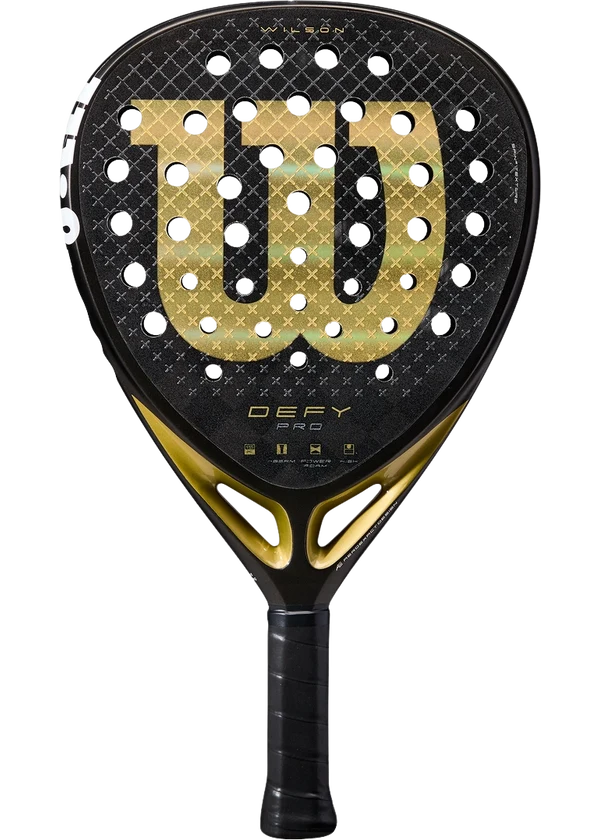


8 Parameters
Defy Pro V1 2025
On this page
Review
Wilson Defy Pro V1 2025 Review: Is This the Diamond Racket That Actually Delivers on Comfort Too?
Diamond-shaped power rackets make a familiar promise — explosive pace, high spin, aggressive play — and then collect their cost in arm fatigue, reduced forgiveness, and a sweetspot you have to earn every time. The Wilson Defy Pro V1 enters that conversation carrying an unusual credential: specialist sources across multiple markets consistently describe it as playing softer than its 15K carbon construction and 72 stiffness rating imply. That is either the most important sentence in this review or a cautionary tale about marketing language. The data suggests it is largely true — with one significant asterisk.
The Wilson Defy Pro V1 is built around a dense Power Foam core encased in a 15K carbon fiber frame with C2 Tubular Construction — a uniform 38mm beam designed for consistent torsional stiffness under impact. The surface is finished with a rough Spin² texture for aggressive ball grip, and Wilson’s proprietary Duo Grid hole pattern differentiates the top portion of the face (larger holes for power amplification) from the lower section (smaller holes for spin and directional control). The Aeroexact Design shapes the frame geometry for swing speed and off-center performance. This is the flagship of the Wilson lineup for attacking players — no Light or Women’s variant exists at this level.
Comfort sits at 6.2 — the lowest parameter in the set and the number that defines everything else here. The spread between Attacker and Defender profiles runs over one full point. This racket has a clear identity. Play to it or feel the friction.
Performance Breakdown
How the Wilson Defy Pro V1 2025 Plays
STABILITY 8.5
The Frame Holds What Other Rackets Scatter
Diamond shape and a head-heavy 265mm balance create the structural conditions for explosive pace even before the player generates swing speed. The Power score of 8.7 reflects the full chain: geometry, balance, dense core response, and 15K carbon stiffness all contributing simultaneously. Stability at 8.5 is equally significant — the C2 Tubular Construction and I-Beam reinforce torsional resistance at contact, meaning off-center smashes maintain directional integrity where lighter or softer frames give ground. That combination is what makes this racket genuinely competitive at the net under pressure. These are two of the strongest parameters in the set, and they work together.
MANEUVERABILITY 7.4
Spin Is Not an Afterthought Here
A Spin score of 8.2 on a racket already competing for power supremacy is notable — this is not a trade-off situation. The Spin² texture creates genuine ball grip, and the Duo Grid hole pattern concentrates spin mechanics in the lower face where serve and bandeja contact most frequently occurs. Maneuverability at 7.4 is the more interesting number: a 370g head-heavy diamond has no business being described as whippy, yet the Aeroexact frame profile reduces aerodynamic drag enough to make rapid transitions credible for an advanced player. It will not feel nimble to someone coming from a round or drop shape, but it does not punish quick exchanges the way comparable power rackets do.
PLAYABILITY 7.1
More Precise Than the Power Score Suggests
Control at 7.6 is one of the genuinely surprising scores on this racket. Diamond-shape power tools typically concede control to achieve their pace numbers, but the Duo Grid’s differentiated hole pattern contributes real directional feedback — particularly on volleys and placed drives. Playability at 7.1 is an honest reflection of the learning curve: this racket rewards technique, and it does not compensate for mechanical errors. Advanced players will access the full 7.6 control figure; intermediate players may find it closer to 6.5 in practice.
SWEETSPOT SIZE 7.1
The Number This Racket Cannot Escape
Comfort at 6.2 is where the profile gap is earned. A score below 6.0 carries automatic weight in our scoring system, and while this racket stays just above that threshold, it remains the number that governs everything else in this review. The Power Foam core does attenuate vibration compared to raw carbon cores — and that is likely the reason specialist sources describe the feel as softer than the stiffness rating alone would predict — but a 72 stiffness rating in a 370g frame is not a comfort proposition. The Sweetspot Size of 7.1 is respectable for a diamond shape, partly thanks to Aeroexact’s off-center performance engineering, but players with existing arm issues should treat the 6.2 as a real constraint, not a formality.
Technology
Aeroexact + Duo Grid: Engineering That Earns Its Name
The Aeroexact Design is not a marketing surface treatment — it shapes the cross-sectional geometry of the 38mm frame to reduce air resistance through the swing arc. The practical output is a racket that moves faster through contact than its weight implies, which is exactly what the 7.4 Maneuverability score reflects. At 370g head-heavy, any aerodynamic gain matters, and specialist sources note that transitions feel less laboured than comparable power diamonds at this weight class. This is not a racket that has become light — it is a heavy racket that wastes less energy on drag.
The Duo Grid hole pattern divides the face into two functional zones: enlarged apertures in the upper third amplify trampoline effect and contribute directly to the 8.7 Power score, while smaller holes in the lower portion increase dwell time and face-to-ball contact — the mechanism behind both the 8.2 Spin score and the 7.6 Control. This is a meaningful design distinction. Most diamond rackets treat the face as a single ballistic surface; Duo Grid acknowledges that different shot types contact different areas of the face and optimises accordingly. Among diamond rackets, that kind of zone-specific face engineering is genuinely uncommon.
The C2 Tubular Construction maintains uniform wall thickness around the entire frame, which prevents the localized flex points that cause vibration spikes on off-center contact. Combined with the I-Beam structural reinforcement, this is what produces Stability at 8.5 — and it also partially explains why Comfort lands at 6.2 rather than lower. There is a floor here, but the ceiling is deliberately set by the stiffness specification. Players who benefit most are those who already generate their own pace and need the frame to translate it accurately rather than absorb it.
Player Fit
Who Should Buy the Wilson Defy Pro V1 2025?
The Advanced Attacker Who Plays Through the Ball
If you’re the type who closes the net aggressively, finishes points with overhead pace rather than placement, and has already developed the technique to keep a 370g diamond in front of you rather than dragging behind — this is precisely calibrated for you. Power at 8.7 and Stability at 8.5 mean your hardest shots land with structural backing. Spin at 8.2 gives you bandeja variation and serve aggression on top of the pace. The 6.2 Comfort score is not your concern if your arm is conditioned and your swing mechanics are sound. You have been playing for years and you are done compromising on power to protect a score you outgrew two seasons ago.
Anyone Still Building Technique or Managing Arm Problems
The Defender score of 7.26 is the profile floor, but the Comfort score of 6.2 is the real disqualifier. If your swing is still developing, this racket will not meet you halfway — the Playability score of 7.1 confirms that the full performance envelope only opens for players with established mechanics. If you have any ongoing elbow or shoulder sensitivity, that 72 stiffness rating in a head-heavy frame will remind you of it before the session ends. And if your game is built around rallying from the back and constructing points rather than finishing them, the Hybrid score of 7.63 tells you there are better tools for that purpose.
FAQ
Frequently Asked Questions
What is the PadelVerdict score for the Wilson Defy Pro V1 2025?
The PadelVerdict score is 8.4, including a +0.1 Consensus Modifier. Profile breakdown: Attacker 8.3 · Hybrid 7.63 · Defender 7.26. That gap of over one full point between attacker and defender profiles is the clearest editorial signal in this review — this is a specialist tool, not a versatile one.
Is the Wilson Defy Pro V1 2025 good for advanced players?
Yes — but only if you are genuinely advanced. The Playability score of 7.1 is the parameter that matters here: it signals that the racket’s full performance requires established technique to unlock. Power at 8.7 and Stability at 8.5 reward players who already generate pace rather than those seeking to borrow it from the frame. If you are intermediate, the Wilson Defy V1 (3K carbon, softer construction) is the more honest choice within the same lineup.
Is the Wilson Defy Pro V1 2025 good for attacking players?
Yes. Attacker score of 8.3, Power at 8.7, Stability at 8.5, and Spin at 8.2 — that is a complete offensive toolkit. The Duo Grid face engineering delivers spin and power from the same swing, and the Aeroexact frame means you are not fighting the weight to close the net. If you are building a shortlist of best attacker rackets, the Defy Pro V1 belongs in the conversation.
What is the actual weight of the Wilson Defy Pro V1 2025?
Wilson declares 370g with a ±10g tolerance, meaning production examples can legitimately range from 360g to 380g. No independent on-camera measurements have been recorded for this model. The declared figure is consistent across all retail sources, but in the absence of physical verification, expect real-world units to land anywhere in that 20g window. At the upper end, you will feel the difference on extended rallies.
How does the Wilson Defy Pro V1 2025 compare to the Wilson Defy V1?
The choice comes down to whether you want a racket that amplifies your existing game or one that builds toward it. The Defy Pro V1 uses 15K carbon and a denser Power Foam core — more stiffness, more power, more Spin² aggression, and a higher arm-load ceiling. The Defy V1 uses 3K carbon, which plays softer and is more forgiving for players still developing their attacking mechanics. If you are already at the level where you want zero forgiveness in the frame, the Pro V1 is the upgrade. If you are not there yet, you will spend time managing the Pro V1 rather than playing through it.
Why does the Wilson Defy Pro V1 2025 have a Consensus Modifier of +0.1?
Specs are consistent across multiple sources with no contradictions — that consistency alone does not earn a positive adjustment. What moves the modifier to +0.1 is independent editorial alignment: specialist sources across multiple markets converge on the same counterintuitive playing characteristic — that the racket feels softer than its carbon specification implies — without contradiction or outlier claims. That cross-market convergence on a non-obvious finding is what earns the positive signal. The remaining component stayed neutral — no independent physical measurements of weight or balance exist to confirm the declared figures, and that gap prevents the modifier from going further.
Similar Rackets
Independent testing, funded by readers
No brand deals, no sponsored picks. If you found this useful, you can support the next round of tests with a small tip.

