
Blast Pro HRD 2026
The Mid-Range Attacker That Refuses to Specialize
The short verdict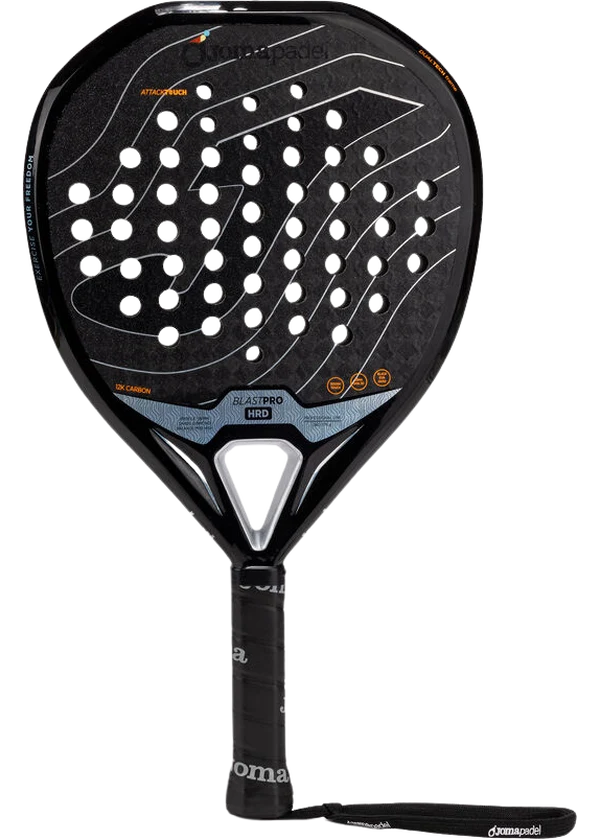
8 Parameters
Blast Pro HRD 2026
On this page
Review
Joma Blast Pro HRD 2026 Review: The Mid-Range Attacker That Refuses to Specialize
There is a tension in the intermediate attacker market that most rackets resolve badly — they either chase power at the cost of feel, or hedge toward comfort and end up underpowered. The Joma Blast Pro HRD 2026 tries to sit in the gap: high-density core, carbon surface, attack-oriented geometry, but a profile spread tight enough that it does not fully commit to any single identity. That ambiguity is either the point or the problem, depending on who is holding the racket.
The Blast Pro HRD is built around a Black EVA HRD high-density foam core paired with a 12K carbon surface carrying Joma’s 3D Spin rough-textured finish. The frame runs a Dual Tech construction — tubular 100% carbon with a flat section blending 66.67% fiberglass and 33.33% 12K carbon — which is meant to balance rigidity with vibration management. Three proprietary systems operate simultaneously: Aerobump Tech (aerodynamic grooves cut into the frame for swing speed), Attack Touch (a smart drilling pattern redistributing weight toward offensive zones), and Joma 3D Spin (an embossed surface treatment for ball grip and spin generation). Declared weight sits at 365g with a balance point of 262mm, placing it in medium-high balance territory consistent with a drop shape built for attackers. For the full Joma lineup, the HRD is the harder, more aggressive sibling to the SFT version in the same Blast Pro range.
Comfort lands at 7.0 — the lowest score in the set and the gap that separates this from a clean attacker recommendation. Attacker: 7.77 / Hybrid: 7.59 / Defender: 7.44. A 0.18-point spread across three profiles means the racket is versatile — but the comfort floor is what prevents it from fully earning its attack designation.
Performance Breakdown
How the Joma Blast Pro HRD 2026 Plays
STABILITY 7.8
Overhead Authority Without the Arm Tax
The Blast Pro HRD’s offensive credentials are built on two pillars that arrive together: power and stability both score 7.8, the joint high in the set. The 12K carbon frame and high-density core combine to deliver ball output that skews toward finishing shots — overheads and lateral smashes benefit most, where the medium-high balance amplifies tip speed. Stability matching power is the less obvious story: it means off-center aggressive hits do not bleed energy the way a lighter or softer frame would. The Attack Touch drilling pattern concentrates the sweet zone toward the upper hitting area, which confirms where this racket intends to operate most of the time.
MANEUVERABILITY 7.6
The Surface Does the Work Your Technique Cannot
Spin at 7.5 is where the 3D Spin rough-textured finish earns its inclusion on the spec sheet. The embossed surface increases ball contact time and grip at impact, which translates to topspin loading and slice shape on defensive returns without requiring elite technique — a meaningful advantage for intermediate players still developing consistent brushing mechanics. Maneuverability at 7.6 is the counterintuitive number here: a 365g racket with a medium-high balance should not feel quick, but the Aerobump Tech grooves reduce air resistance enough through the swing arc to keep response times competitive. Among drop-shaped rackets at this weight class, that combination is less common than the marketing suggests.
SWEETSPOT SIZE 7.5
Precision Is Present, But It Requires You to Show Up
Control at 7.4 is the lowest offensive parameter, and it explains the racket’s 60/40 power-to-control weighting from the manufacturer. This is not a racket for players whose game is built on surgical placement at net — it rewards those who can generate the pace first and direct second. The sweet spot at 7.5 is more forgiving than the hard core and stiff frame would suggest, which pulls the usability level down to intermediate rather than advanced-only. Playability also sits at 7.5, confirming that the learning curve is accessible without being flat.
The One Score That Shapes Everything Else
Comfort at 7.0 is the lowest score in the entire parameter set and the clearest editorial signal in this review. A score below 6.0 carries automatic weight in our scoring system — the Blast Pro HRD stays above that threshold, but it sits closer to the floor than any other parameter, and that distance matters. The Dual Tech Frame and Black EVA HRD core do absorb vibration, and the manufacturer positions this explicitly as arm-protective. But high-density foam and a 65 stiffness rating mean that players with sensitive elbows, or those logging high match volume, will feel the difference versus the SFT version or a softer-cored alternative. Extended session fatigue is where this score becomes a real-world consideration rather than an abstract number.
Technology
Three Systems, One Frame: Does the Stack Justify Itself?
The Blast Pro HRD runs three simultaneous proprietary systems, which is a high count for a racket at this price tier. The key question is whether they operate independently or whether one is doing the real work while the others provide marketing cover. Based on what the scores show, the answer is mostly honest: each system connects to a measurable outcome, even if the hierarchy is uneven.
Aerobump Tech — the aerodynamic grooves cut into the frame profile — is directly responsible for the Maneuverability score of 7.6 being higher than the racket’s weight and balance point would predict. Reducing drag through the swing arc makes a tangible difference at 365g, and this is the system that makes the Blast Pro HRD usable at intermediate level rather than only at advanced. Without it, the medium-high balance would create noticeable lag on defensive transitions and quick exchanges at net.
Attack Touch smart drilling concentrates the perforation pattern to redistribute effective weight toward offensive zones in the upper hitting area. This is what connects to the Power/Stability pairing at 7.8 — the drilling geometry means that clean contact in the primary hitting zone returns more energy than a conventional pattern would at the same declared weight. It also subtly elevates the usable sweet spot, which is why Sweetspot Size reaches 7.5 despite a rigid frame that would otherwise compress that window.
Joma 3D Spin is the most straightforward of the three: the embossed rough surface texture grips the ball at impact and holds it fractionally longer, generating spin at 7.5. For intermediate players who do not yet produce natural topspin through mechanics alone, this surface treatment is doing genuine work on kick serves, lifted returns, and angled drives. The system that cannot fully compensate for the stack is the Dual Tech Frame on comfort: it manages vibration better than a mono-carbon construction would, but it cannot overcome the intrinsic stiffness of Black EVA HRD at 65 RA — which is why Comfort sits at 7.0 while everything else clusters between 7.4 and 7.8.
Player Fit
Who Should Buy the Joma Blast Pro HRD 2026?
The Intermediate Attacker Ready to Start Finishing Points
If you’re the type who has the fitness and technique to reach the net consistently but still loses points because your overhead lacks authority — this is built for your game. The 7.8 on power and stability means attacking shots carry weight without demanding advanced timing, and the Aerobump-assisted maneuverability at 7.6 ensures you can recover position after committing forward. The spin score of 7.5 adds trajectory shape to your drives that you may not yet produce naturally. Your elbow needs to be healthy — Comfort at 7.0 is a real constraint, not a throwaway caveat. But if you are playing three to four times per week without existing arm sensitivity, the Attacker score of 7.77 reflects a genuinely capable offensive platform at this price point. See where it stands among the intermediate options that passed our scoring process.
High-Volume Players With Arm Sensitivity or a Defensive Game
The Defender score of 7.44 is the lowest profile in the set, and it tells you exactly who this racket will frustrate. If your game is built on deep retrieval, extended defensive exchanges, and counterattacking from pressure — the hard core and stiff frame will work against your rhythm, not with it. Control at 7.4 is not a surgical placement tool. And if you carry any existing elbow or wrist sensitivity, Comfort at 7.0 is not a score to rationalize away at 365g. The SFT version of the same Blast Pro lineup addresses that trade-off directly with a softer core; if your profile is more all-court than attacker-heavy, the comfort ceiling here will become a limiting factor before the power ceiling does.
FAQ
Frequently Asked Questions
What is the PadelVerdict score for the Joma Blast Pro HRD 2026?
The overall PadelVerdict score is 7.8. The Consensus Modifier is 0: specs are consistent across multiple sources (Data Quality: neutral), declared figures show no implausible outliers (Field Validation: neutral), but no independent physical measurements exist to confirm them (Market Correction: neutral). Consistent data without independent validation earns neutral, not positive. Profile breakdown: Attacker 7.77 / Hybrid 7.59 / Defender 7.44. The 0.33-point spread between Attacker and Defender is the whole story — this is an offensive tool, not a versatile one.
Is the Joma Blast Pro HRD 2026 good for intermediate players?
Yes — with one condition. The sweet spot at 7.5 and playability at 7.5 make it accessible without being easy, and the Aerobump-assisted maneuverability means you do not need advanced mechanics to swing it effectively. The condition is your arm health. Comfort at 7.0 means players logging heavy match volume or carrying elbow sensitivity will hit the ceiling before they hit the performance ceiling. Healthy intermediate attackers: go for it. Anyone with existing arm issues: look at the SFT version first.
Is the Joma Blast Pro HRD 2026 good for attackers?
Yes. The Attacker score of 7.77 is the highest profile in the set, backed by Power at 7.8, Stability at 7.8, and Spin at 7.5. That combination means the racket generates pace, holds it through off-center contact, and adds trajectory shape to drives and overheads. If you play left court and build toward finishing, this fits. Browse the full attacker racket category to see where it ranks alongside comparable options.
What is the actual weight of the Joma Blast Pro HRD 2026?
Declared weight is 365g, but the variance across sources is notable: figures range from 350g to 370g depending on the retailer or market, and no independent on-camera measurements exist to confirm the exact value. That 20g spread is perceptible on court — a 350g unit will feel meaningfully quicker than a 370g unit, even from the same production run. Until independent measurements are available, treat the declared 365g as a midpoint estimate rather than a confirmed figure.
How does the Joma Blast Pro HRD 2026 compare to the Blast Pro SFT 2026?
These are two answers to the same brief. The HRD is the choice if you prioritize ball output and stability and your arm health is solid — it is harder, more rigid, and built to finish points. The Blast Pro SFT is the choice if you play longer sessions, carry any arm sensitivity, or want more feel in touch exchanges. They share the Aerobump Tech and 3D Spin surface, so maneuverability and spin carry across. The deciding factor is Comfort: if 7.0 sounds marginal for your game volume, the SFT version moves that parameter in the right direction.
Why does the Joma Blast Pro HRD 2026 have a Consensus Modifier of 0?
The modifier reflects what the data actually contains. Specs for the Blast Pro HRD appear consistently across official channels and retailer listings — shape, core, surface tech, and balance all align without meaningful contradiction. That consistency earns the baseline. What prevents a positive adjustment is the absence of anything beyond manufacturer-sourced information: no independent physical measurements, no community validation, no specialist convergence across multiple markets that goes beyond retail descriptions. Consistent data without independent confirmation earns neutral, not positive. An independent on-camera measurement confirming the declared weight would be the single most direct route to a positive adjustment.
Similar Rackets
Independent testing, funded by readers
No brand deals, no sponsored picks. If you found this useful, you can support the next round of tests with a small tip.

