
Bela Pro V3 2025
Is This the Most Complete Attacking Racket of the Year?
The short verdict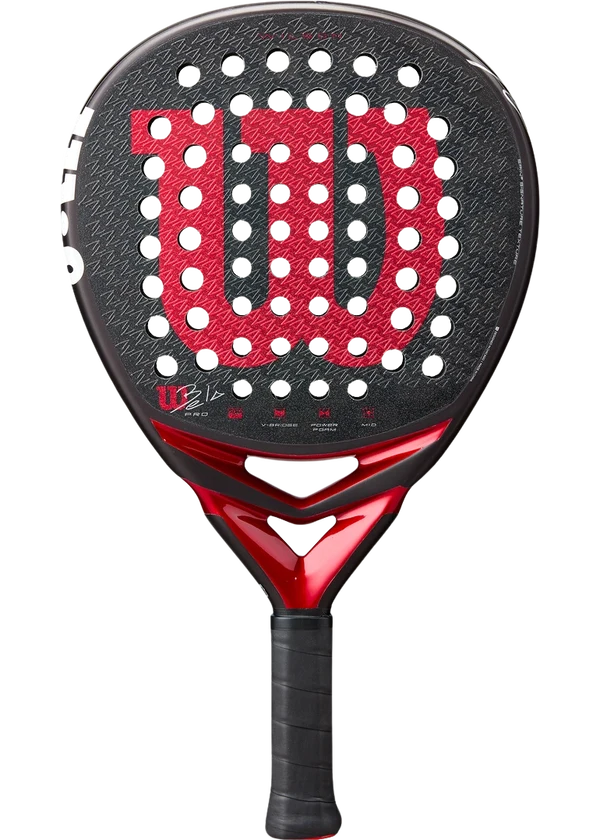


8 Parameters
Bela Pro V3 2025
On this page
Review
Wilson Bela Pro V3 2025 Review: Is This the Most Complete Attacking Racket of the Year?
The classic tension in advanced padel rackets sits between raw power and the control that makes power usable. Most manufacturers pick a side. The Wilson Bela Pro V3 2025 is engineered around the claim that you do not have to — that a drop-shaped frame, the right foam density, and a multi-zone holes pattern can deliver attacking punch without sacrificing the precision that keeps points alive. That is a bold promise at 370 grams. Whether the racket earns it is what this review addresses.
The Wilson Bela Pro V3 is the flagship of Wilson’s 2025 Bela line, co-developed with Fernando Belasteguín and positioned above both the standard Bela V3 (3K carbon, 365g) and the Bela LS V3 lightweight edition. The Pro version runs a 24K carbon face with Spin2 rough texture for enhanced ball grip, a Power Foam high-density EVA core rated at RA 68, and a C2 tubular carbon frame construction. The V-Bridge reinforcement geometry reduces torsional flex under heavy impact, the Duo Grid pattern staggers hole sizes — larger at the top for power generation, smaller at the base for control and spin retention — and a Stability Channel runs the perimeter to stiffen the frame under load. Declared weight is 370g with a balance point of 265mm.
Stability at 8.7 is the highest single parameter in this racket — not Power, not Spin. That number tells you everything about how Wilson prioritized structural discipline over raw aggression, and why this is an attacking tool with genuine hybrid capability rather than a one-dimensional power frame.
Performance Breakdown
How the Wilson Bela Pro V3 2025 Plays
STABILITY 8.7
The Frame Does the Heavy Work Before You Do
Stability is the defining number here, and it tells a more interesting story than Power alone. The C2 tubular construction and V-Bridge geometry combine to resist torsional movement on off-axis contact, meaning the 8.6 Power score is accessible — not just on pure center strikes, but on the attacking volleys and overheads where alignment is rarely perfect. That structural discipline is what pushes Stability to 8.7. The practical effect: overhead smashes feel explosive without the frame twisting under load, and the energy return from the Power Foam core feels consistent across the hitting surface rather than concentrated in a narrow band.
CONTROL 8.4
Spin Generates Pressure; Control Converts It
The 24K carbon surface and Spin2 texture produce a ball-grip character that scores 8.5 — genuinely high for a racket that also prioritizes power output. The counterintuitive finding here is how well Control holds at 8.4 despite RA 68 stiffness; the Duo Grid pattern’s variable hole sizing keeps the lower hitting zone compliant enough for touch shots and service returns without blunting the top-zone aggression. Specialist sources noted the racket plays softer than the material combination suggests — the Power Foam absorbs enough transient vibration that control under fatigue degrades more slowly than in comparable stiff attackers. The C2 tubular construction contributes positively to the long-term structural profile.
PLAYABILITY 7.6
The Margin for Error Is Real — But Not Unlimited
Sweetspot Size at 7.8 is solid for a drop-shaped racket at this stiffness level — the Stability Channel perimeter reinforcement pushes usable contact area beyond what a conventional diamond frame would offer. But Playability at 7.6 is honest about the ceiling: at 370g and RA 68, this racket asks for technique. Mis-hits don’t disappear; they telegraph immediately. For advanced players who can consistently find the hitting zone, that 7.6 is perfectly workable. For anyone still developing consistency, it is a warning signal — the racket will expose timing errors rather than forgive them.
COMFORT 7.0
370 Grams Costs Something — Know What You’re Paying
Maneuverability at 7.4 and Comfort at 7.0 are the lowest scores in the profile, and they connect directly to the Defender score of 7.78 — the lowest profile rating. The 265mm balance point is medium-low, which helps relative to a pure diamond, but 370g is still 370g; quick exchanges at the net and rapid directional changes under pressure will cost energy over the course of a match. Comfort at 7.0 is not a liability for players with clean mechanics and adequate physical conditioning, but it edges toward the threshold where players with any history of arm or elbow sensitivity should pay close attention. The Shock Shield Grip and C2 construction mitigate vibration meaningfully, yet they do not eliminate the stiffness signature of RA 68 at this weight class.
Technology
V-Bridge and Duo Grid: Engineering Coherence or Marketing Stack?
The Wilson Bela Pro V3’s technology stack is unusually coherent — each system addresses a specific performance variable rather than overlapping or competing. The V-Bridge is a structural geometry integrated into the frame’s throat area that stiffens the connection between handle and head, reducing the torsional rotation that typically bleeds power and accuracy on off-center contact. The practical output is the 8.7 Stability score: strikes that would destabilize a conventional frame hold their line here, which is why the Power score of 8.6 remains accessible rather than theoretical.
The Duo Grid pattern is the genuinely clever element. By increasing hole diameter in the upper face and reducing it toward the base, Wilson creates two distinct response zones within a single strung surface — the upper zone delivers the elastic snap behind the 8.6 Power score, while the lower zone’s tighter configuration supports the 8.4 Control and 8.5 Spin ratings on lower, more angled contact. This is not a common approach among all Wilson rackets, and it meaningfully separates the Bela Pro V3 from single-zone attacking frames that force a binary choice between aggression and precision.
The Spin2 24K carbon surface texture generates ball grip that translates to the 8.5 Spin score — the rough 3D finish creates more contact time between ball and surface on brushing shots, amplifying topspin and slice without requiring swing-speed compensation. The C2 tubular construction ties the frame and surface together structurally, contributing to the durability profile and dampening enough transient shock to keep the 7.0 Comfort score from sliding further. The Stability Channel perimeter reinforcement extends this stiffness discipline to the frame edges, which partially explains the 7.8 Sweetspot Size score — a number that outperforms what the RA stiffness alone would predict. Advanced attackers and technically complete hybrids are the direct beneficiaries; players who need the frame to compensate for timing gaps will find the technology works against them rather than for them.
Player Fit
Who Should Buy the Wilson Bela Pro V3 2025?
The Advanced Attacker Who Refuses to Trade Control for Power
If you’re the type who plays primarily from the right side or generates points through offensive ball striking — and you have the consistency to find the hitting zone under match pressure — this racket was built around your game. The 8.7 Stability and 8.6 Power mean your aggressive shots land with authority, while the 8.4 Control score means you’re not sacrificing precision to get there. The 8.5 Spin rating adds another attacking dimension on second balls and lob-pressure scenarios. You understand that a 7.0 Comfort score at RA 68 is a trade-off you’re making with clear eyes, and your physical conditioning supports that choice. If the Attacker profile score of 8.47 describes the player you see in the mirror, this racket will feel exactly right.
Developing Players and Anyone with Arm Sensitivity
The Defender score of 7.78 is the lowest profile rating, and it is telling. The 7.4 Maneuverability and 7.0 Comfort scores create a compounding problem for players who rely on quick net exchanges or who need the racket to absorb rhythm disruptions during long defensive rallies. At 370g and RA 68, this frame will not compensate for timing gaps — it will amplify them. The 7.6 Playability score is not forgiving. If you have any history of elbow or shoulder sensitivity, a Comfort score of 7.0 on a stiff attacking frame is a hard stop, not a caveat. The sharpest line here: the Bela Pro V3 rewards technique you already have, not technique you’re still building.
FAQ
Frequently Asked Questions
What is the PadelVerdict score for the Wilson Bela Pro V3 2025?
The overall PadelVerdict score is 8.6, incorporating a Consensus Modifier of +0.1. Profile breakdown: Attacker 8.47 | Hybrid 8.12 | Defender 7.78. The 0.35-point gap between Attacker and Hybrid confirms this is a specialist tool — compelling for offensive players, conditional for everyone else.
Is the Wilson Bela Pro V3 2025 good for advanced players?
Yes — with one condition. The Playability score of 7.6 means it rewards consistent ball-striking rather than compensating for it. Advanced players who can reliably find the hitting zone will unlock the full 8.6 Power and 8.5 Spin profile. Players at the upper-intermediate level still developing shot consistency should look at something with a higher Playability and Sweetspot before stepping up to this weight and stiffness class.
Is the Wilson Bela Pro V3 2025 good for attacking players?
Straightforwardly yes. The Attacker profile score of 8.47 is the highest of the three profiles, supported by Power 8.6, Stability 8.7, and Spin 8.5 — exactly the combination an attacking game demands. The V-Bridge geometry and Duo Grid pattern are both designed around offensive ball-striking, and the scores confirm it. If you’re looking for the best attacker rackets at the advanced level, this belongs in the conversation.
What is the actual weight of the Wilson Bela Pro V3 2025?
Declared weight is 370g with no independent measured weight available. Wilson’s own tolerance range is listed as 360–375g across some market documentation. No on-camera independent measurement exists to confirm or correct the declared figure. At the 370g declared figure, the weight is perceptible on court — particularly in quick net exchanges — and is a meaningful variable in the 7.4 Maneuverability and 7.0 Comfort scores.
How does the Wilson Bela Pro V3 2025 compare to the Wilson Bela LS V3 2025?
These are two fundamentally different player propositions. The Pro V3 is for the advanced attacker who needs maximum structural stiffness, power output, and stability at 370g — and accepts the Comfort and Maneuverability trade-off that comes with it. The LS V3 at approximately 355g uses a Comfort Flex face and softer construction to deliver easier handling and reduced arm stress, making it the better fit for players who prioritize playability and comfort over peak offensive output. Choose Pro if technique is locked in; choose LS if you’re still building it or have any arm sensitivity history.
Why does the Wilson Bela Pro V3 2025 have a Consensus Modifier of +0.1?
Specs are consistent across multiple sources with no implausible outliers — consistency alone, however, does not earn a positive adjustment. What moved the modifier from 0 to +0.1 is independent editorial alignment: specialist sources across multiple markets converge closely on the advanced-attacker character, the RA stiffness profile, and the Power Foam feel, without contradiction. The remaining component stayed neutral — no independent physical measurements of weight or balance exist to confirm the declared figures, and that gap prevents the modifier from going further. An on-camera independent measurement would be required to push it to +0.2.
Similar Rackets
Independent testing, funded by readers
No brand deals, no sponsored picks. If you found this useful, you can support the next round of tests with a small tip.

