
Metalbone Carbon 2026
The Power Racket That Refuses to Be One-Dimensional
The short verdict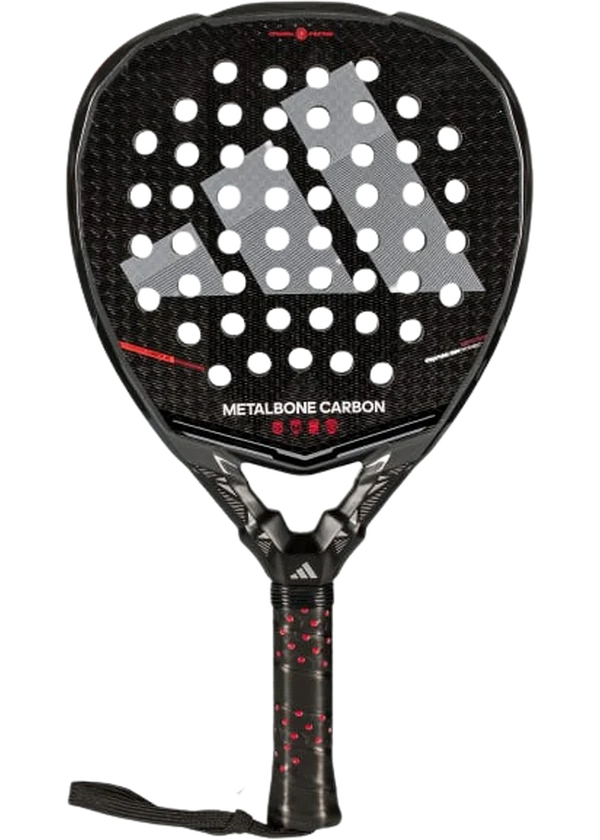


8 Parameters
Metalbone Carbon 2026
On this page
Review
Adidas Metalbone Carbon 2026 Review: The Power Racket That Refuses to Be One-Dimensional
The classic trap with diamond-shaped attackers is this: you get the power, and you pay for everything else. Sweetspot shrinks, control narrows, and comfort becomes an afterthought. The Adidas Metalbone Carbon 2026 steps into that tension deliberately — it is built around maximum offensive output, but it pulls in a Soft Performance EVA core, an extended power grip, and a stiffened octagonal frame to argue that the trade-off is smaller than the shape suggests. Whether it actually delivers on that argument is what this review tests.
The Metalbone Carbon 2026 is a diamond-shaped attacker built on a Soft Performance EVA core and a 6K carbon surface with Spin Blade Decal texture for added friction. The 38mm frame incorporates four proprietary systems: Octagonal Structure (an eight-sided profile that stiffens the frame and reduces torsion), Low Poly (a polyhedral core design for added rigidity), Power Groove (perimeter reinforcement), and an extended Extra Power Grip handle designed to maximize swing inertia. Declared weight is 368g with a 265mm balance point. Stiffness is rated at 68 — firmly in the stiff category. This is a racket positioned in the Adidas lineup for intermediate to advanced competitive players seeking aggressive, offensive performance.
Stability at 8.2 is the sleeper number here. Attacker: 8.0 · Hybrid: 7.65 · Defender: 7.33. The 0.35-point gap between Attacker and Hybrid tells a specific story: this racket is built for offensive dominance, but it hasn’t abandoned all-court players entirely.
Performance Breakdown
How the Metalbone Carbon 2026 Plays
STABILITY 8.2
Two Systems, One Outcome: The Frame Does the Work
The Octagonal Structure and Low Poly combination creates a frame stiff enough to transfer energy cleanly without flex absorbing the shot — and the numbers reflect it. Power lands at 8.4, which is among the stronger scores for an intermediate-level diamond, driven by the head-heavy 265mm balance and the 38mm reinforced profile. What earns particular attention is Stability at 8.2: the octagonal cross-section reduces torsional flex on off-center contact, meaning the frame holds its line even when the hit isn’t perfect. These two parameters together define the racket’s core identity as an offensive weapon that doesn’t punish moderate timing errors structurally.
SPIN 7.6
Control Holds Its Ground — Just Don’t Ask Too Much
A stiffness rating of 68 typically signals that control will suffer — the racket gives you no elastic feedback to shape the ball, so directional precision depends entirely on technique. Yet Control comes in at 7.8, which is respectable for a diamond this rigid. The reason is the Octagonal Structure’s torsion-reduction effect: when the frame doesn’t twist, the ball leaves at the angle you intended. Spin at 7.6 is similarly solid, the Spin Blade Decal texture generating reliable friction across groundstrokes and lift shots without requiring exaggerated technique. Neither score is the headline, but together they confirm this isn’t a racket where you simply swing and hope.
PLAYABILITY 7.2
368 Grams at 265mm — Speed Has a Cost
Maneuverability and Playability both score 7.2 — functional, but the lowest readings on this racket, and they tell the honest story about who this frame is designed for. At 368g with a high balance point, the swing arc is longer and slower than with a lighter or more centrist frame. The extended Extra Power Grip handle amplifies this: it increases inertia deliberately to add power, which means that same inertia works against you in rapid defensive exchanges or tight net play. These scores reflect the physical reality of the diamond format — this is connected to the Defender profile score of 7.33, which is the lowest profile reading precisely because fast reactive defense is where the weight and balance become liabilities.
SWEETSPOT 7.0
The EVA Core Earns Its Place — But Only Just
A stiffness of 68 on a diamond frame will transmit vibration — that is the physics of the format, and no core fully compensates for it. Comfort at 7.1 reflects what the Soft Performance EVA actually achieves: it softens ball exit, smooths impact feedback, and reduces the harshest feedback that a pure carbon-on-carbon construction would deliver. Sweetspot Size at 7.0 is the honest consequence of the diamond shape and top-biased balance — the effective hitting zone sits high in the head, and contact outside it is less forgiving than on a round or drop frame. Both scores sit above the floor threshold, but players with arm sensitivity should take note: the EVA helps, but the frame’s rigidity remains the dominant force on impact.
Technology
Octagonal Structure + Low Poly: Engineering for Rigidity, or Just Marketing Geometry?
The Octagonal Structure gives the frame an eight-sided cross-section rather than a conventional rounded profile. The mechanical consequence is real: more contact surface between the frame and any incoming force, which distributes stress across more material and reduces the torsional flex that typically causes off-center shots to veer offline. That effect is visible in the Stability score of 8.2 — the highest reading on this racket — and in the Control figure of 7.8, which holds up better than the stiffness rating alone would predict.
Low Poly works differently. Rather than shaping the outer profile, it applies a polyhedral geometry to the frame construction and core junction, increasing overall rigidity without adding material weight. The result is more efficient energy transfer — less flex means less energy absorbed by the frame, more delivered to the ball. This is the primary mechanical driver behind the Power score of 8.4, operating alongside the head-heavy 265mm balance that concentrates mass where swing speed translates most directly into shot force.
The Extra Power Grip handle extension is the most player-specific of the technologies. A longer handle increases the lever arm of the swing, which amplifies inertia and therefore power output — but only for players whose technique involves full body rotation and a long swing arc. For compact, reactive players working close to the net, it becomes a liability rather than an advantage, which maps directly onto the Maneuverability score of 7.2. The Spin Blade Decal texture on the diamond-shaped 6K carbon surface completes the picture: a three-dimensional surface pattern that increases contact friction for spin generation, producing the 7.6 Spin score without requiring the player to manufacture excessive wrist action.
The system as a whole is coherent. Each technology targets a specific parameter, and the scores confirm the targeting worked. Who benefits most: the intermediate-to-advanced player who has developed the swing technique to exploit a stiff, head-heavy frame, and who prioritizes offensive production over defensive reactivity.
Player Fit
Who Should Buy the Metalbone Carbon 2026?
The Intermediate Attacker With Something to Prove
If you’re the type who wins points through the shot rather than the rally — who lives for the put-away smash, the decisive bandeja, the aggressive cross-court winner — the Metalbone Carbon 2026 is built around your game. The Power score of 8.4 and Stability of 8.2 give you the offensive engine, while Control at 7.8 means you’re not spraying winners into the side fence. You need to be intermediate level or above: the stiffness of 68 and the 7.0 Sweetspot demand that you find the sweet zone consistently, and the head-heavy balance rewards players who generate swing speed through full rotation rather than arm-only strokes. This racket will make you feel exactly as dangerous as you’ve been trying to be.
Defensive Players and Anyone With Arm Sensitivity
The Defender profile score of 7.33 is the lowest reading on this racket, and it’s telling you something direct: if your game is built on retrieving, absorbing pace, and resetting rallies from the back, the 368g head-heavy frame will work against you on every fast exchange. The Maneuverability score of 7.2 confirms the problem — reactive net defense and quick counter-volleys require a racket that moves faster than this one does. And if you have any history of elbow or arm issues, a stiffness of 68 with a Comfort score of 7.1 is a risk not worth taking. The Metalbone Carbon Ctrl 2026 is the smarter call — same family, rounder shape, built for control and comfort over raw power.
FAQ
Frequently Asked Questions
What is the PadelVerdict score for the Adidas Metalbone Carbon 2026?
The PadelVerdict score is 8.1, adjusted to 8.1 after a Consensus Modifier of +0.1. Specs are consistent across multiple sources (Data Quality: neutral), specialist sources across multiple markets align on the 368g weight and 265mm balance with no contradictions found (Field Validation: positive), but no independent physical measurements exist to go further (Market Correction: neutral). That Field Validation component is what earns the +0.1. Profile breakdown: Attacker 8.0, Hybrid 7.65, Defender 7.33 — the 0.67-point gap between top and bottom profiles makes the attacker identity unambiguous.
Is the Adidas Metalbone Carbon 2026 good for intermediate players?
Yes — but only the right kind of intermediate. The stiffness at 68 and Sweetspot Size of 7.0 mean inconsistent contact will be punished. An intermediate player who has developed clean stroke mechanics and generates swing speed through rotation will unlock what this racket offers. An intermediate who still relies on arm-only shots or makes frequent off-center contact will find it punishing. If that’s your game right now, a more forgiving round-shaped alternative is the better investment.
Is the Adidas Metalbone Carbon 2026 good for attackers?
Yes, clearly. Attacker profile score is 8.0 — the highest of the three profiles by a meaningful margin. Power at 8.4, Stability at 8.2, and Control at 7.8 form exactly the combination an offensive player needs: force on the shot, frame integrity on contact, and enough directional precision to place it. If you’re looking for the best attacker rackets in this category, this one belongs in the conversation.
What is the actual weight of the Adidas Metalbone Carbon 2026?
The declared weight is 368g, confirmed by manufacturer data and consistent across multiple market sources. No independent on-scale measurement has been published for this model. The manufacturer lists a range of 360–375g across production tolerances. At 368g with a 265mm balance point, the felt weight in hand will be heavier than the number suggests — that high balance amplifies the perceived swing weight noticeably.
How does the Adidas Metalbone Carbon 2026 compare to the Metalbone Carbon Ctrl 2026?
These are two different player types in the same family. The Carbon is a diamond-shaped power attacker — head-heavy, stiff, built for players who finish points offensively. The Ctrl is round-shaped, more centered balance, designed for players who need more touch, comfort, and all-court consistency. Choose the Carbon if your game revolves around aggressive shot-making and you have the technique to use it. Choose the Ctrl if control, comfort, and defensive capability matter more than maximum power output.
Why does the Adidas Metalbone Carbon 2026 have a Consensus Modifier of +0.1?
Three components determine the modifier. Data Quality is neutral: specs appear consistently across multiple sources, but consistency alone doesn’t earn a positive. Field Validation is positive: specialist sources across multiple markets independently cite 368g and 265mm balance with no contradictions — that cross-market alignment without prompted agreement is what tips this component. Market Correction is neutral: no independent physical measurement has confirmed the declared figures. The positive Field Validation component moves the modifier from 0 to +0.1. An independent on-scale measurement would support a further positive adjustment.
Similar Rackets
Independent testing, funded by readers
No brand deals, no sponsored picks. If you found this useful, you can support the next round of tests with a small tip.

