
Hyper Pro Plus 2.0 2026
Power With a Purpose
The short verdict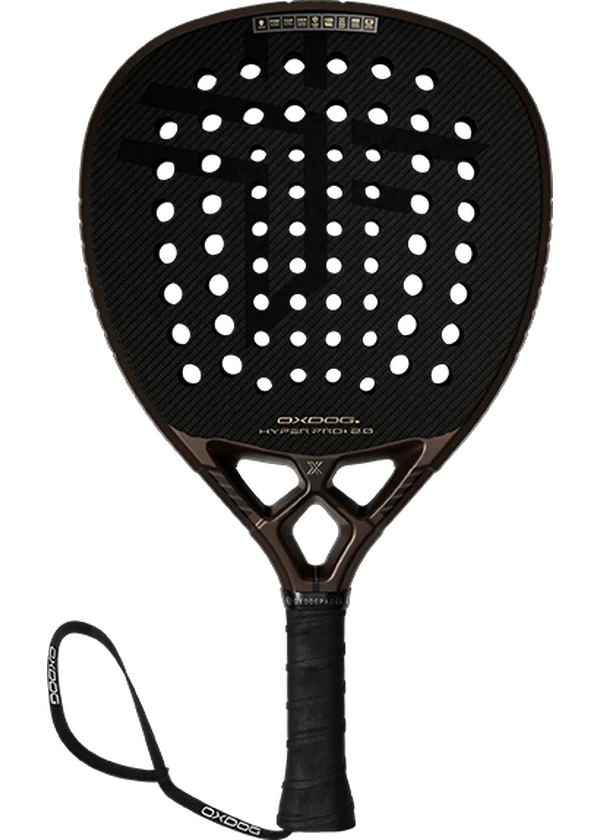
8 Parameters
Hyper Pro Plus 2.0 2026
On this page
Review
Oxdog Hyper Pro Plus 2.0 2026 Review: Power With a Purpose
At the top end of the attack-oriented market, the trade-off usually goes like this: you gain power, you lose feel. Manufacturers have been trying to thread that needle for years, and most drop-shaped rackets still land on one side of the line. The Oxdog Hyper Pro Plus 2.0 2026 wants to be the exception — a drop-shaped weapon that punishes loose balls without turning precise play into guesswork.
Built around a hard EVA foam core and wrapped in HES-Carbon with a sandy, rough-textured surface, the Hyper Pro Plus 2.0 2026 packs in a full stack of Oxdog proprietary systems: PowerRibs for structural reinforcement and vibration management, DSH (Double Size Holes) to extend off-center playability, RBS (Racket Balance System) for an adjustable 8g weight at the cap, Vibradamp silicone inserts for arm protection, and Side Port technology to reduce air resistance. The declared weight sits at 370g with a balance point of 268mm — head-biased enough to confirm the offensive intent. Explore the full Oxdog lineup to see where this sits in context.
Comfort lands at 6.6 — the lowest score on the card. Attacker: 8.2 · Hybrid: 7.74 · Defender: 7.54. The 0.46-point gap between Attacker and Hybrid is the decision point: this racket rewards an offensive mindset, but the spread is narrow enough that aggressive all-court players won’t feel out of place.
Performance Breakdown
How the Hyper Pro Plus 2.0 2026 Plays
STABILITY 8.3
The Drop Shape Earns Its Weight
A head-heavy balance at 268mm, combined with the stiffness of HES-Carbon and a hard EVA core, generates the kind of inertia that makes smashes feel decisive rather than effortful — Power scores 8.4. What lifts this above generic drop-shaped attackers is the structural reinforcement from PowerRibs along the frame rails: Stability reaches 8.3, meaning the racket doesn’t twist on off-center contact. In a 370g frame, that combination is serious real-estate for attackers who live at the net.
SPIN 7.6
Precision That Survives Aggressive Play
Control at 8.1 on a stiff, head-heavy drop racket is the score that will raise eyebrows — most frames with this power profile concede 0.5–1.0 points in this category. The sandy HES-Carbon surface is doing real work here: it provides enough grip on the ball to keep trajectory consistent on aggressive shots, and the Spin score of 7.6 reflects the texture’s contribution to topspin and slice when technique demands it. The RBS adjustable weight system adds a further layer of personalization — shifting the balance toward the handle softens control sensitivity for players who want more feel on delicate exchanges.
PLAYABILITY 7.2
Forgiving Enough, Not Forgiving by Design
The Sweetspot Size at 7.4 is respectable for a drop-shaped frame, and the DSH hole pattern deserves credit for extending the usable hitting zone beyond what a standard layout would allow. Playability comes in at 7.2, which is honest rather than generous — this racket is calibrated for players who already have clean mechanics. Specialist sources describe the sweet spot as positioned high rather than large, which matches the score: it sits where an attacker needs it, not where a beginner looks for it. The DSH system mitigates errors at the margins, but it doesn’t turn the Hyper Pro Plus 2.0 into a do-everything drop-shaped racket.
COMFORT 6.6
The Price of Head-Heavy Commitment
Maneuverability at 7.2 is the honest cost of a 268mm balance point in a 370g frame — quick net exchanges require deliberate preparation rather than reactive flicks. Comfort at 6.6 is the lowest score on this card, and it’s the one that carries the most decision weight: Vibradamp silicone inserts and PowerRibs do reduce peak vibration transmission, but the hard core and stiff HES-Carbon frame mean this racket will fatigue arms that aren’t conditioned for it. One source notes mild arm fatigue after extended sessions — that signal aligns with the 6.6 reading. If you carry any elbow or shoulder history, this number matters more than any other on the sheet.
Technology
HES-Carbon + PowerRibs: Does the System Justify the Stack?
HES-Carbon is Oxdog’s proprietary carbon specification — a material that combines high reactivity with structural rigidity. In practice, it means the frame transfers energy back to the ball with minimal flex-based loss, which is what keeps Power at 8.4 without requiring a diamond shape to do it. The rough, sandy surface texture is integral to the material’s function: it creates the friction that generates the 7.6 Spin score and, critically, contributes to the 8.1 Control figure by keeping ball contact predictable through aggressive trajectories.
PowerRibs are structural rails running along the frame’s inner face. They serve three measurable functions: adding torsional resistance (Stability 8.3), reducing vibration transmission to the handle, and distributing mass evenly along the frame perimeter. This is what separates the Stability score from being purely a product of frame weight — the ribs are doing architectural work, not just mass management. They’re also the primary reason Comfort lands at 6.6 rather than lower: without them, the hard EVA core and stiff HES-Carbon would transmit more shock to the wrist on off-center hits.
DSH (Double Size Holes) enlarges the apertures in the hitting zone, which widens the effective sweet spot without requiring a softer core. The result shows in the 7.4 Sweetspot Size score — meaningful for a frame this stiff. The RBS system adds an 8g removable weight at the cap, giving players a rare and genuine choice: leave it in for maximum head-heavy power, or remove it to move toward a slightly more maneuverable, handle-biased feel. That 8g shift is perceptible at 370g base weight — it affects Maneuverability in a way that a printed spec cannot communicate.
The system as a whole works best for players who already strike cleanly and want to amplify that precision into offensive output. The technology stack is not designed to compensate for timing errors — it’s designed to reward players who don’t make them.
Player Fit
Who Should Buy the Hyper Pro Plus 2.0 2026?
The Intermediate-Advanced Attacker Who Plays With Intent
If you’re the type who dictates rallies from the net, looks for the smash on second ball, and has the technique to hit consistently on the upper third of the face — this racket was built for you. Power at 8.4 and Stability at 8.3 confirm that it won’t punish decisive shots; it rewards them. The Control score of 8.1 means you don’t have to sacrifice placement to get pace. You’ve been playing regularly for at least two years, your arm is conditioned, and you want a racket that matches your ambition on the court. The Attacker score of 8.2 is the number, but the 8.1 Control is what makes this choice feel safe rather than reckless.
Beginners, Arm-Sensitive Players, and Defensive Specialists
Comfort at 6.6 is the number that ends the conversation for three types of players. If you’re just building your game, the Playability score of 7.2 tells you the margin for error is narrower than you need. If you have any history with tennis elbow or shoulder problems, a stiff HES-Carbon frame on a hard EVA core will likely aggravate it regardless of what Vibradamp promises. And if your game is built around the back court and defensive consistency, the Defender score of 7.54 — the lowest of the three profiles — tells the story directly: this frame is not where your skills will shine.
FAQ
Frequently Asked Questions
What is the PadelVerdict score for the Oxdog Hyper Pro Plus 2.0 2026?
The PadelVerdict score is 8.3, with a Consensus Modifier of +0.1 applied. Specs are consistent across multiple markets (Data Quality: neutral), specialist sources across multiple markets align on the key parameters with no contradictions found (Field Validation: positive), but no independent physical measurements exist to go further (Market Correction: neutral). That Field Validation component is what earns the +0.1. Profile breakdown: Attacker 8.2 · Hybrid 7.74 · Defender 7.54. The 0.46-point gap between Attacker and Hybrid is real — this is an offensive racket, but not a punishing one.
Is the Oxdog Hyper Pro Plus 2.0 2026 good for intermediate players?
Conditionally yes — but only for upper-intermediate players with clean mechanics. The Playability score of 7.2 and Comfort at 6.6 are the limiting factors: if your technique is still developing, a stiffer frame at this weight will expose timing errors rather than cover them. Early intermediates should look at something with a higher Sweetspot Size and softer core first. If you’re already playing competitive club padel and your body handles firm frames, this is a legitimate step up.
Is the Oxdog Hyper Pro Plus 2.0 2026 good for attackers?
Yes. The Attacker profile scores 8.2 — the highest of the three — supported by Power at 8.4 and Stability at 8.3. The drop shape positions the sweet spot where attackers need it, and the HES-Carbon surface keeps smashes accurate rather than just powerful. If this is your profile, browse the best attacker rackets to see how it compares to the full category.
What is the actual weight of the Oxdog Hyper Pro Plus 2.0 2026?
The declared weight is 370g, but sourced figures range from 360g to 375g across multiple retail channels — no independent measurement has confirmed the exact figure. That 15g variance is perceptible on court: at the heavier end of the range, Maneuverability at 7.2 will feel earned; at the lighter end, the racket will feel more reactive in net exchanges. Factor the RBS removable weight (8g) into your calculation if you’re sensitive to balance shifts.
How does the Oxdog Hyper Pro Plus 2.0 2026 compare to the Hyper Pro 2.0 2026?
The Pro Plus is the premium offensive variant: harder core, stiffer frame, higher balance point. The standard Hyper Pro 2.0 is the more approachable option — less power ceiling but more comfort margin. If you want maximum output and your arm can handle it, the Plus is the choice. If you prioritize consistency across longer sessions or transition rallies, the standard Pro 2.0 gives you room to breathe. Think of it as the difference between playing to your peak versus playing to your average.
Why does the Oxdog Hyper Pro Plus 2.0 2026 have a Consensus Modifier of +0.1?
The +0.1 reflects a process that separates consistency from validation. Specs appearing uniformly across sources is the starting point — it earns neutral, not credit. What moves the modifier is specialist-level convergence: sources across multiple markets align on shape, core density, surface material, and performance profile with no contradictions identified. That cross-market alignment without outliers is the condition for a positive adjustment. The ceiling stays at +0.1 because no independent physical measurements exist to go further — those would be the condition for any additional upward movement.
Similar Rackets
Independent testing, funded by readers
No brand deals, no sponsored picks. If you found this useful, you can support the next round of tests with a small tip.

