
Unum+ H1
Aerospace Carbon Meets Padel’s Toughest Trade-Off
The short verdict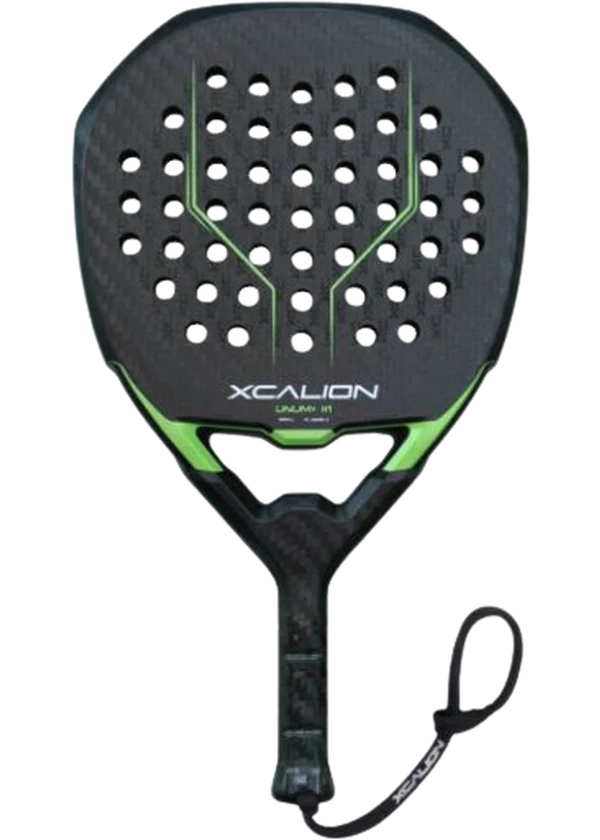
8 Parameters
Unum+ H1
On this page
Review
Xcalion Unum+ H1 2026 Review: Aerospace Carbon Meets Padel’s Toughest Trade-Off
The hardest trade-off in attacking padel isn’t between power and spin — it’s between power and the ability to stay on the court without paying for it physically. A diamond-shaped carbon monocoque built for stiffness will win the first battle emphatically. Whether your elbow agrees after three sets is a different question entirely. That tension sits at the exact centre of what the Xcalion Unum+ H1 2026 is asking you to accept.
The Unum+ H1 is built on a full-carbon monocoque structure using ALMA material — an aerospace-grade carbon developed in collaboration with the European Space Agency and Carlos III University of Madrid, engineered for extreme stiffness and structural rigidity. The surface runs 3K carbon with a 3D rough texture finish at 250 microns, designed to grip the ball and generate spin. At 321g with a 262mm balance point, it sits firmly in diamond territory: high balance, stiff frame, and a profile that makes no apologies for what it is. Positioned at the top of the Xcalion lineup, the Unum+ H1 targets experienced offensive players who want a racket that responds rather than absorbs.
Comfort at 5.8 is the score that defines everything here — a floor penalty applied. Attacker: 8.00 / Hybrid: 7.52 / Defender: 6.95. The gap between profiles isn’t enormous, but the Comfort penalty makes it irreversible: this racket has one direction.
Performance Breakdown
How the Xcalion Unum+ H1 2026 Plays
STABILITY 7.6
The ALMA Promise Delivers Where It Has To
Aerospace-grade carbon and a stiffness-oriented monocoque frame exist for one reason: to transfer energy without absorbing it. At Power 8.3, the Unum+ H1 achieves exactly that — shots feel explosive off the face, with minimal energy lost to frame flex. Stability at 7.6 is respectable for a diamond frame at this weight, meaning off-centre strikes don’t collapse the head as dramatically as some competitors at this balance point. The stiff structure that generates power is also what holds the frame together under pace. These two scores are not coincidental — they are the same engineering decision expressed in two different ways.
PLAYABILITY 7.1
Lighter Than Its Balance Point Should Allow
Maneuverability at 8.6 is the Unum+ H1’s most counterintuitive score. High-balance diamond rackets are typically sluggish to swing — that’s the standard trade-off. At 321g, the monocoque construction sheds enough total mass that the 262mm balance feels less punishing than equivalent head-heavy frames from larger brands. The racket moves quickly, which means attacks can be prepared late and counter-punching is viable. Playability at 7.1 is the honest correction: that swingspeed advantage doesn’t fully translate into shot-making comfort under pressure, particularly on defensive exchanges where timing windows are tighter. The frame responds fast when you initiate — it’s less forgiving when you’re forced to react.
SWEETSPOT SIZE 7.0
Texture Does Work, But Physics Has Limits
The 250-micron 3D rough texture on the carbon surface does contribute to Spin at 7.2 — more than an equivalent smooth-faced diamond would achieve at the same stiffness level. It’s not a spin specialist, but the texture gives experienced players enough bite for kick serves and cross-court angles. Sweetspot Size at 7.0 is adequate rather than generous for a diamond: the high balance concentrates energy toward the top of the frame, but the monocoque structure keeps deformation consistent across a workable hitting zone. Neither score is a weakness on its own — together they define a racket that rewards precision rather than compensating for imprecision.
COMFORT 5.8
The Score That Ends the Conversation for Some Players
Control at 7.4 is solid for a diamond-profile attacker — the high balance doesn’t destroy placement precision the way fully uncontrolled diamond rackets do. But Comfort at 5.8 is the number that demands attention: a score below 6.0 carries automatic weight in our scoring system, and it reflects the inevitable cost of extreme stiffness. The ALMA carbon monocoque structure absorbs almost no vibration, sending impact shock directly into the wrist and elbow. For players with clean technique who hit through the ball, this is manageable. For anyone with a history of arm discomfort, this score is not a caution — it’s a hard stop. Control degrades further as physical fatigue sets in, making the 7.4 a ceiling rather than a floor across a long session.
Technology
ALMA Carbon: Does Aerospace Engineering Actually Change How a Padel Racket Feels?
ALMA — Aerospace Lightweight Material Application — is Xcalion’s proprietary carbon material developed with the European Space Agency and Carlos III University of Madrid. The claim is structural: a carbon with higher carbon content at the microstructural level, engineered for maximum stiffness-to-weight ratio. In padel terms, that translates to a frame that can be built lighter than conventional carbon constructions while maintaining equivalent rigidity. The 321g target weight and the monocoque single-piece mould are both downstream consequences of what ALMA makes possible.
The connection to performance scores is direct. Power at 8.3 reflects the energy return of a structure that doesn’t flex under impact — stiffness means the ball leaves fast and predictably. Maneuverability at 8.6 is where the lightweight engineering earns its keep: a 262mm balance point that swings faster than equivalent high-balance diamond rackets because the monocoque removes mass that traditional layered frames carry. Stability at 7.6 is the structural integrity score — the single-piece construction resists torsional twist better than multi-component frames at the same weight class.
The honest limitation is also structural. ALMA’s stiffness is not selective — it doesn’t absorb vibration in some zones while transmitting energy in others. The entire frame behaves as one rigid unit, which is exactly why Comfort scores 5.8. The technology works for power and swing speed. It works against comfort and forgiveness. Players who benefit most are those with developed technique and physical resilience: the ALMA system amplifies what good mechanics already produce, and penalises whatever those mechanics don’t cover.
Player Fit
Who Should Buy the Xcalion Unum+ H1 2026?
The Technically Sound Attacker Who Plays to Win Points
If you’re the type who takes the net, finishes overhead, and expects your racket to respond rather than compensate — the Unum+ H1 was designed for you. Power at 8.3 and Maneuverability at 8.6 mean your offensive game gets amplified, not diluted. Control at 7.4 is sufficient for an experienced player who already has placement mechanics in place. You play four to five times a week, your technique is established, and you’ve never had an arm problem that lasted more than a day. The Attacker score of 8.00 isn’t an accident — it reflects a racket that knows exactly what role it’s playing and commits to it without hedging. If that sounds like your game, this racket will feel immediately right.
Developing Players and Anyone Who Values Longevity Over Output
The Defender score of 6.95 tells one story, but the Comfort score of 5.8 tells a worse one. If you’re still building your technique, this racket will punish every imperfect strike directly into your forearm — there is no vibration dampening to catch you. If you play recreationally and your body needs some margin for error, Comfort at 5.8 is not a number to negotiate with. Intermediate players who want attacking performance without the physical cost should look at rackets built around softer cores and more forgiving frame profiles before committing to full-carbon monocoque construction at this stiffness level.
FAQ
Frequently Asked Questions
What is the PadelVerdict score for the Xcalion Unum+ H1 2026?
The Xcalion Unum+ H1 2026 scores 7.6 overall, with a Consensus Modifier of -0.1 applied. Specs appear in retail listings across multiple markets (Data Quality: neutral), but no specialist expert reviews exist for this exact model (Field Validation: negative), and no independent physical measurements were conducted (Market Correction: neutral). That Field Validation gap is what pulls the modifier below zero. Profile breakdown: Attacker 8.00 / Hybrid 7.52 / Defender 6.95. The gap is clear — this is a single-role racket, and the Attacker score is the one that matters.
Is the Xcalion Unum+ H1 2026 good for intermediate players?
Conditionally. Intermediate players with established attacking mechanics and no arm history can handle it — Power 8.3 and Maneuverability 8.6 will feel rewarding. But Comfort at 5.8 is the real filter: intermediate players who are still refining stroke mechanics will feel every off-centre contact physically. If you’re genuinely intermediate, a racket with a softer core and more vibration absorption is a smarter long-term investment.
Is the Xcalion Unum+ H1 2026 good for attackers?
Yes — straightforwardly. An Attacker score of 8.00 backed by Power 8.3 and Maneuverability 8.6 puts it firmly in the top tier for offensive play. If you want to browse the full best attacker rackets for comparison, the Unum+ H1 holds up well — provided your body can handle a stiff full-carbon frame over extended sessions.
What is the actual weight of the Xcalion Unum+ H1 2026?
The declared weight from Spanish and Italian retail listings is 321g. One private seller reported 353g, but that figure included two head covers, a grip, and the lacet — the discrepancy is accessory-related rather than a unit variance issue. The 321g figure is the reliable working weight. It’s light enough for a high-balance diamond that the swing speed advantage is genuine.
How does the Xcalion Unum+ H1 2026 compare to the Xcalion Unum H1?
The Unum H1 sits below the Unum+ H1 in the lineup and is priced approximately €50 lower. The “+” designation signals a step up in carbon grade and structural rigidity — more stiffness, more power output, and correspondingly less forgiveness. Choose the Unum H1 if you want attacking performance with a small margin of comfort. Choose the Unum+ H1 if you are confident your mechanics are clean enough to not need it.
Why does the Xcalion Unum+ H1 2026 have a Consensus Modifier of -0.1?
The modifier reflects a specific gap in the validation chain. Retail presence across multiple markets establishes that the racket exists and is priced consistently — that’s the baseline, and it’s neutral on its own. What pulls the modifier into negative territory is the absence of any specialist expert engagement with this exact model. No independent review, no technical breakdown, no on-camera measurement exists for the Unum+ H1 specifically. Retailer descriptions are promotional, not analytical. The -0.1 is the honest editorial position given what the data does and doesn’t include.
Similar Rackets
Independent testing, funded by readers
No brand deals, no sponsored picks. If you found this useful, you can support the next round of tests with a small tip.

