
Unum H1 2026
Aerospace Carbon Meets the Attacker’s Dilemma
The short verdict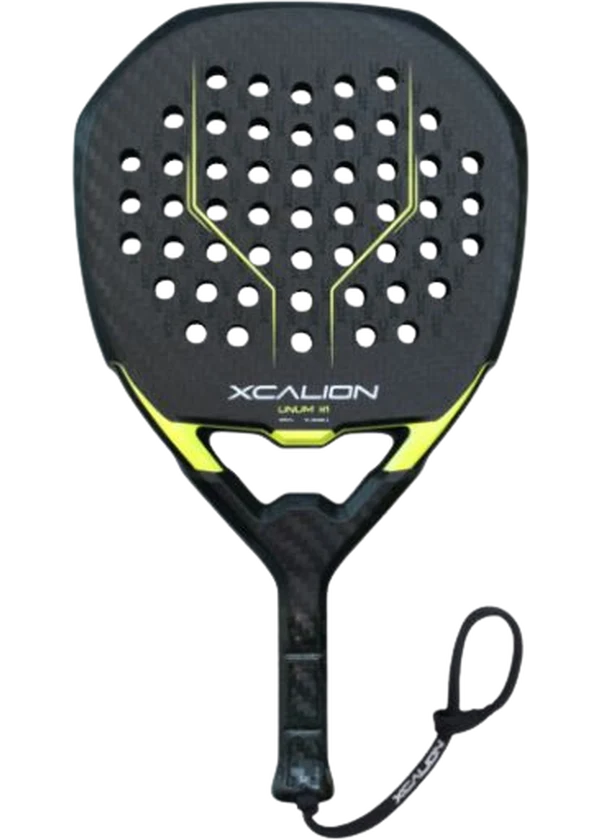
8 Parameters
Unum H1 2026
On this page
Review
Xcalion Unum H1 2026 Review: Aerospace Carbon Meets the Attacker’s Dilemma
The hardest question in padel equipment isn’t “how much power can I get?” — it’s “how much comfort am I willing to sacrifice for it?” Diamond-shaped rackets built around stiff carbon construction have always sat at that fault line, and the Xcalion Unum H1 2026 lands squarely on it. This is a racket that has made a clear, intentional trade-off: structural rigidity and high-balance power delivery in exchange for comfort scores that will stop some players entirely. Whether that trade is right for you is the decision this review resolves.
The Unum H1 is built on a monocoque carbon construction using 12k T700 aerospace-grade carbon — Xcalion calls this the ALMA architecture (Aerospace Lightweight Material Application), developed in partnership with research institutions. The result is a diamond-shaped frame with a 3D rough-textured carbon surface, EVA foam medium-density core, a stiffness rating of 72 RA, and a play-ready balance of 279mm fully mounted. That stiffness figure places it as the hardest racket in the Xcalion lineup, achieved through specific laminate thickness and carbon weave choices rather than different materials. At roughly 352g mounted, it plays noticeably heavier than its bare weight of 321–337g suggests. It sits in the advanced attacker segment at approximately €260.
Comfort lands at 5.8 — a floor penalty that carries automatic weight in our scoring system. The gap between the attacker and defender profiles is the widest signal on this card: this racket has a very specific role, and playing outside it costs you significantly.
Performance Breakdown
How the Xcalion Unum H1 2026 Plays
STABILITY 8.1
The Diamond Does What It Promises
High-balance diamond frames generate power by moving mass above the hitting zone — and at a 279mm mounted balance point, the Unum H1 commits to that geometry completely. The 8.4 Power score reflects genuine energy transfer on overhead smashes and drive volleys, not just frame stiffness alone. Stability at 8.1 is the underrated number here: the monocoque carbon construction resists torsion on off-center contacts better than most rackets at this price point, meaning even imperfect smashes carry through with authority. These two scores together explain why advanced attackers describe this racket as feeling “locked in” at the net — there is almost no flex absorbing your shot energy.
SPIN 7.4
Faster in the Hand Than the Balance Point Suggests
The most counterintuitive number on this racket is the Maneuverability score of 8.0. A high-balance diamond at 352g mounted should feel sluggish in transition — and yet the ALMA construction’s weight reduction across the frame means the swing weight stays manageable. This is not a quick-wrist racket for low-block defenses, but for the net exchanges and positioning movements an attacker actually faces, it responds faster than the specs predict. The 3D rough-textured carbon surface adds genuine spin capacity at 7.4 — not a dominant spin weapon, but enough to shape lobs and add margin on cross-court volleys. Among diamond-shaped rackets in this stiffness range, that spin number is a legitimate differentiator.
SWEETSPOT SIZE 7.0
Precise When You’re On — Punishing When You’re Not
Control at 7.2 is respectable for a racket this stiff, and the 3D surface texture does contribute to directional feedback on placement shots. But this is an honest number, not a generous one: the high balance point makes fine control on defensive passes and low-set positions genuinely difficult. Sweetspot at 7.0 means the reward zone is present but not forgiving — miss it and the rigid carbon frame will broadcast the error immediately. The combination of Control and Sweetspot scores tells a consistent story: this racket performs well when you’re positioned correctly and hitting with intention, and exposes you quickly when you’re not. For advanced players who own their positioning, that’s acceptable; for anyone still developing consistency, it accelerates mistakes.
PLAYABILITY 6.9
The One Number That Changes Everything
Comfort at 5.8 is the score this entire review orbits. A score below 6.0 carries automatic weight in our scoring system — and here it triggered the floor penalty that pulled the overall Verdict Score down from what the other parameters would have produced. The 72 RA stiffness rating combined with the monocoque construction and high mounted weight creates a vibration profile that places real stress on the elbow and shoulder over extended sessions. The medium-density EVA core absorbs some shock, but it cannot compensate for the structural rigidity at 72 RA. Playability at 6.9 reflects that this racket requires a technically sound swing to extract its value — compensation mechanics and partial swings amplify the shock transmission. If you have any prior elbow sensitivity, this is a disqualifying score, not a caveat.
Technology
ALMA Architecture: Does Aerospace Carbon Actually Earn Its Name?
ALMA — Aerospace Lightweight Material Application — is Xcalion’s core structural patent, developed in collaboration with research institutions including the European Space Agency and Universidad Carlos III de Madrid. What it does concretely: it distributes 12k T700 carbon fiber in specific laminate thicknesses and weave orientations across the monocoque frame to achieve structural stiffness without proportional weight gain. The result is a racket that measures stiffer than its category competitors without adding mass in the areas that would most increase swing weight.
The connection to scores is direct. The 8.1 Stability score comes from torsional resistance built into the monocoque — there are no joints or bonded sections to flex under stress, so the frame returns a consistent response on every contact. The 8.4 Power score comes from the high-balance geometry that ALMA enables: by keeping the upper frame light while maintaining rigidity, the racket positions meaningful mass above the sweet zone without requiring the player to swing a heavy total weight. Maneuverability at 8.0 is the most technically interesting outcome — the weight distribution is managed well enough that what feels heavy in static measurements feels notably quicker in dynamic swing.
The 3D rough-textured carbon surface operates independently of ALMA and targets Spin specifically. The surface microtexture increases contact friction at ball impact, adding edge to topspin lobs and shaping capacity on angled volleys — which is where the 7.4 Spin score comes from. It is not a primary feature, but it is a real one.
The honest limitation of ALMA is what it cannot fix: a 72 RA stiffness figure that reflects a deliberate engineering choice. ALMA achieves remarkable things with weight distribution, but structural rigidity at this level means vibration transmission remains high. The 5.8 Comfort score is not a failure of the technology — it is a consequence of its priorities. ALMA is designed for advanced attackers who hit with full swing mechanics repeatedly, not for players managing fatigue or arm sensitivity. The Xcalion lineup includes lower-stiffness variants (the S1 and M1) for players who want the ALMA construction without the H1’s vibration profile.
Player Fit
Who Should Buy the Xcalion Unum H1 2026?
The Advanced Net Attacker With Clean Mechanics
If you’re the type who controls points from the net, hits your volleys with full intention rather than reaction, and has never had an elbow or shoulder issue that forced you to reconsider a racket — this was built for your game. The 8.4 Power and 8.1 Stability scores mean that when you’re positioned correctly and swinging with technique, the Unum H1 delivers with unusual consistency and authority. The 8.0 Maneuverability number means you won’t be late to shots you own. You play at an advanced level, you understand your game well enough to know when a comfort score of 5.8 is a dealbreaker versus an acceptable trade, and you’ve decided it isn’t one. That specific, self-aware player will extract everything this racket has to give.
Anyone With Arm Sensitivity or a Defensive Game
The defender profile and Comfort score of 5.8 together tell the story clearly. If you play from the back of the court, rely on extended baseline rallies, or manage fatigue over multi-set matches, both scores work against you — the high balance makes defensive positioning harder, and the 72 RA stiffness will make itself felt in your elbow long before the second set ends. The Playability score of 6.9 reinforces this: the Unum H1 requires you to be technically correct on every swing, not to compensate. If you have any existing elbow or shoulder sensitivity, this is not a “try it and see” situation — the Comfort floor penalty is a hard signal. A round or drop-shaped racket with softer core construction is a categorically different experience for that player profile. If you want the ALMA construction at a more forgiving stiffness, the Xcalion Unum S1 2026 is the lower-risk entry point within this lineup.
FAQ
Frequently Asked Questions
What is the PadelVerdict score for the Xcalion Unum H1 2026?
The PadelVerdict score is 7.9, with a Consensus Modifier of 0. Specs appear consistently across multiple sources (Data Quality: neutral), field measurements from a single video source confirm a mounted weight of ~352g and high balance point (Field Validation: neutral — single-source only), and no independent lab or multi-market validation exists to go further (Market Correction: neutral). Profile breakdown: Attacker 8.16 / Hybrid 7.47 / Defender 7.00. The gap between the attacker and defender profiles is large — this is a role-specific racket, and the scores confirm it.
Is the Xcalion Unum H1 2026 good for advanced players?
Yes — but only for advanced attackers with clean swing mechanics and no arm sensitivity. The 6.9 Playability score is the parameter that matters most here: this racket does not compensate for technical gaps. An advanced player who dominates from the net with full swing technique will find the Power and Stability scores genuinely rewarding. An advanced player still refining consistency or coming back from injury should look at a softer, rounder alternative instead.
Is the Xcalion Unum H1 2026 good for attackers?
Yes, directly and unambiguously. The attacker profile is supported by Power at 8.4, Stability at 8.1, and Maneuverability at 8.0 — everything an attacker needs to own the net is present in this racket. The only qualifier is physical: Comfort at 5.8 means long-session attackers need to be honest about their arm health. If that’s clear, browse the best attacker rackets to see where the Unum H1 sits in context.
What is the actual weight of the Xcalion Unum H1 2026?
Declared bare weights range from 321–337g depending on the source, which is a notable variance. The play-ready mounted weight measured at approximately 352–353g with grip and cord. That 15–30g gap between bare and mounted is perceptible on court — players evaluating this racket by its listed weight alone will find it swings noticeably heavier than expected. Our scoring uses the mounted figure as the accurate play-ready reference.
How does the Xcalion Unum H1 2026 compare to the Xcalion Unum S1?
The H1 and S1 are the same ALMA carbon construction aimed at opposite ends of the attacker spectrum. The H1 is the stiffest in the Xcalion lineup — maximum power transfer, maximum vibration. The S1 trades that stiffness for control orientation and a more comfortable feel. The choice is not between good and better: it’s between a player who wins points by hitting through the opponent, and one who wins points by placing the ball precisely. If you’re still deciding which describes you, the S1 is the lower-risk starting point within this lineup.
Why does the Xcalion Unum H1 2026 have a Consensus Modifier of 0?
Consistent data without independent validation earns neutral, not positive. The weight and balance figures for the Unum H1 appear in a single measured video source — useful and directionally reliable, but not multi-source confirmation. Specs from manufacturer and retail channels align without contradictions, which keeps the data clean, but clean manufacturer data is the baseline expectation, not an achievement that earns an upward adjustment. That is the honest position for a racket at this stage of its market life.
Similar Rackets
Independent testing, funded by readers
No brand deals, no sponsored picks. If you found this useful, you can support the next round of tests with a small tip.

