
Canyon Pro Attack Soft 2026
Does the Soft Core Compromise the Attack?
The short verdict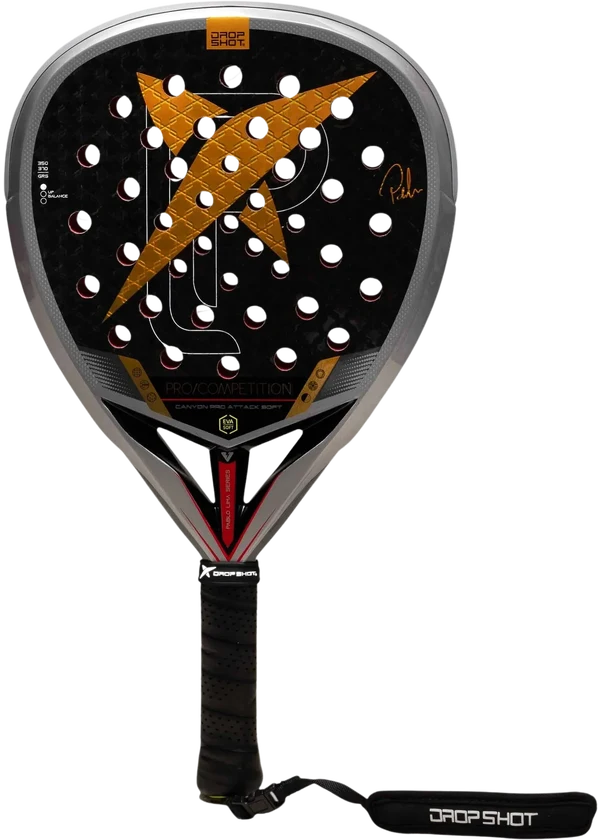

8 Parameters
Canyon Pro Attack Soft 2026
On this page
Review
Drop Shot Canyon Pro Attack Soft 2026 Review: Does the Soft Core Compromise the Attack?
There is a persistent assumption in diamond-shaped rackets that softening the core means surrendering something in attack — that comfort and power occupy opposite ends of a spectrum. The Drop Shot Canyon Pro Attack Soft 2026 is built as a direct challenge to that assumption, pairing a high-balance diamond silhouette with EVA Soft Low Density foam to keep the arm in the game during long sessions without asking the player to dial back aggression.
The specs tell a coherent story. A declared 368g weight with a 268mm balance point sits in standard attack territory. The 12K Textreme Carbon surface with the 3D Face System roughness texture handles spin generation, while Twin Tubular and Power Beam Heart frame construction provide structural integrity at impact. Vibra Tech vibration absorption and Angles Technology for handling optimization round out a tech stack that is clearly engineered for offensive players who need sustained playability — part of the Drop Shot lineup for 2026.
Comfort sits at 8.0 — the second-highest parameter score in this racket. Attacker: 7.88 · Hybrid: 7.54 · Defender: 7.35. The 0.53-point gap between Attacker and Defender is meaningful: this is a committed offensive tool, not a versatile all-courter.
Performance Breakdown
How the Canyon Pro Attack Soft 2026 Plays
STABILITY 7.8
The Diamond Does Its Job
High balance in a diamond frame concentrates mass in the upper zone, and the Canyon Pro Attack Soft translates that physics directly into the power number: 8.1. Smashes and volleys carry genuine weight without demanding exceptional swing speed. The 7.8 Stability score reflects the Twin Tubular and Power Beam Heart construction holding up at contact — there is no looseness on off-center strikes, which matters when attacking from mid-court. Together these numbers confirm an instrument built for decisive offensive play from the net.
SPIN 7.6
The Surprising Number Is 8.0
Comfort at 8.0 is the genuine standout here — not because it is a tacked-on feature but because it sits higher than any other parameter except Power. The EVA Soft Low Density core absorbs vibration at a level that is perceptible after a two-hour session, providing meaningful joint protection without introducing the dead-ball feeling some soft cores carry. The 3D Face System roughness texture on the 12K Textreme Carbon surface delivers a Spin score of 7.6 — enough to angle serves and finish points at the net with directional variety.
PLAYABILITY 7.3
Where the Trade-Off Lives
Control at 7.4 and Playability at 7.3 represent the honest cost of a high-balance diamond geometry. Precision shot-making under pressure — particularly in defensive transitions and low dipping volleys — asks for more intentionality than a round or drop shape allows. These are not weak scores for this profile, but they tell an intermediate attacker exactly where the work lies. The Angles Technology helps compensate in handling, but it cannot fully offset what the shape and balance naturally take away from control at the margins.
SWEETSPOT SIZE 7.2
The Weight Tells the Full Story
Maneuverability at 6.8 is the lowest score in the set, and it connects directly to the Defender profile score of 7.35. At 368g with a high balance, quick reactive exchanges — defensive lobs, scramble volleys, rapid net transitions — are where the racket shows its limits most clearly. This is not a racket that forgives passive footwork. Sweetspot Size at 7.2 reflects the diamond’s trade-off: power concentration comes at the cost of a smaller effective hitting area compared to round-shaped rackets, which puts a floor on how easily this tool transfers across game situations.
Technology
Vibra Tech and 3D Face System: Engineering Comfort Without Betraying Power
The Vibra Tech system addresses a real structural problem in high-balance diamond rackets: the combination of head-heavy geometry and firm impact can transmit significant vibration into the arm, making long sessions punishing for players with any history of elbow or shoulder strain. Vibra Tech dampens that transmission at the frame level, which is reflected in the Comfort score of 8.0 — a figure that is notably high for a racket with Power at 8.1. The two scores coexisting without a larger gap between them is the practical proof that the system is doing genuine work.
The Twin Tubular and Power Beam Heart frame technologies serve a different function: they maintain structural rigidity at impact, which underpins the Stability score of 7.8. A soft-core racket risks feeling inconsistent on hard strikes if the frame itself flexes under load — these two systems are the reason that risk is contained here. Power does not leak unpredictably because the outer structure holds its geometry.
The 3D Face System Roughness texture on the 12K Textreme Carbon surface generates friction at contact rather than relying solely on swing mechanics for spin. At 7.6, the Spin score benefits from this surface more than the raw EVA Soft core would deliver alone — it is the texture doing the rotation work when the ball dwell time is already extended by the soft foam beneath it. For intermediate attackers who want spin variety at the net without long technical development curves, this surface is the relevant detail.
The Angles Technology is the smallest piece of the stack in terms of measurable on-court impact, contributing to the Maneuverability score where it can — but 6.8 shows it cannot fully counteract what 368g with high balance imposes on quick-exchange handling. It matters most for players already moving efficiently to the ball, where it adds a refinement to wrist mechanics rather than compensating for positional errors.
Player Fit
Who Should Buy the Drop Shot Canyon Pro Attack Soft 2026?
The Intermediate Attacker With a History of Arm Strain
If you are the type who commits to the net, hits overhead with intent, and has been looking for a way to keep playing longer without paying for it the next morning — this racket was built for your exact situation. Power at 8.1 and Comfort at 8.0 are not often found this close together in a diamond frame; the soft EVA core and Vibra Tech combination genuinely earn that Comfort score during extended sessions. Stability at 7.8 means you are not sacrificing structural integrity for softness. You play at intermediate level, you want to build toward a more aggressive game, and you cannot afford another week off with an inflamed elbow. That player is the precise target here.
The All-Court Player Who Defends First
The Defender profile score of 7.35 — the lowest of the three — is the clearest signal this racket sends. If your game is built on reading the point from the back, absorbing pressure, and constructing rallies before attacking, the Maneuverability score of 6.8 will cost you on rapid exchanges and defensive scrambles. At 368g with high balance, this racket punishes passive positioning and slow transitions. The sweetspot is not forgiving enough to cover for the footwork the geometry demands. If your identity is defensive or hybrid with a defensive tendency, the
Drop Shot Canyon Pro Attack 2.0 2026 offers a harder-feeling alternative, or explore the full hybrid racket category for more versatile options.
FAQ
Frequently Asked Questions
What is the PadelVerdict score for the Drop Shot Canyon Pro Attack Soft 2026?
The overall Verdict Score is 7.9, with a Consensus Modifier of 0. Specs are consistent across multiple sources (Data Quality: neutral), declared figures show no implausible outliers (Field Validation: neutral), but no independent measurements exist to confirm them (Market Correction: neutral). Profile breakdown: Attacker 7.88, Hybrid 7.54, Defender 7.35. That 0.53-point spread between top and bottom tells you this is a committed offensive tool — not a racket trying to serve everyone.
Is the Drop Shot Canyon Pro Attack Soft 2026 good for intermediate players?
Yes, with a condition: it is good for intermediate players who already have an attacking tendency and move well to the ball. Playability at 7.3 means this racket rewards players building offensive habits, not those still developing foundational technique. If you are intermediate but primarily defensive in your game style, the Maneuverability score of 6.8 will expose positional weaknesses more than help you develop.
Is the Drop Shot Canyon Pro Attack Soft 2026 good for attackers?
Yes. The Attacker profile score of 7.88 is the highest of the three for a reason. Power 8.1, Stability 7.8, and Comfort 8.0 form a core combination that covers everything an attacking player needs: force, structural integrity at impact, and the ability to sustain that attack over a long session. If you are already thinking like an attacker, this racket confirms the instinct. Browse the full best attacker rackets for comparison options.
What is the actual weight of the Drop Shot Canyon Pro Attack Soft 2026?
The declared weight is 368g, with manufacturer ranges citing 360–375g across sources. No independent on-camera measurements exist for this model. The declared 368g sits toward the upper end of the published range, so production variance could put individual units as low as 360g. At any point in that range, this is a standard attack weight — perceptibly heavier than lightweight beginner models, as expected for this profile.
How does the Drop Shot Canyon Pro Attack Soft 2026 compare to the Canyon Pro Attack 20 2026?
The Canyon Pro Attack 20 2026 uses a teardrop shape and sits closer to a balanced power-control profile. The Soft version trades some of that shape’s inherent control accessibility for a higher Comfort ceiling and a more committed diamond geometry. If you prioritize arm protection and explosive overhead play above everything else, the Soft is the choice. If you want a more versatile offensive tool that transitions across game situations, the Attack 20’s teardrop shape is the more practical option.
Why does the Drop Shot Canyon Pro Attack Soft 2026 have a Consensus Modifier of 0?
The data picture here is consistent but thin. Technical specs — shape, core material, surface, frame technology, weight range — appear uniformly across multiple markets with no contradictions. That consistency is the baseline, not a bonus. What would move the modifier upward is independent physical measurement confirming declared figures, or convergent specialist-level field analysis beyond promotional descriptions. Neither exists for this model. Consistent promotional data without independent validation earns neutral, not positive — and that is exactly what 0 reflects here.
Similar Rackets
Independent testing, funded by readers
No brand deals, no sponsored picks. If you found this useful, you can support the next round of tests with a small tip.

