
FX Team 2026
The Diamond That Doesn’t Force a Choice
The short verdict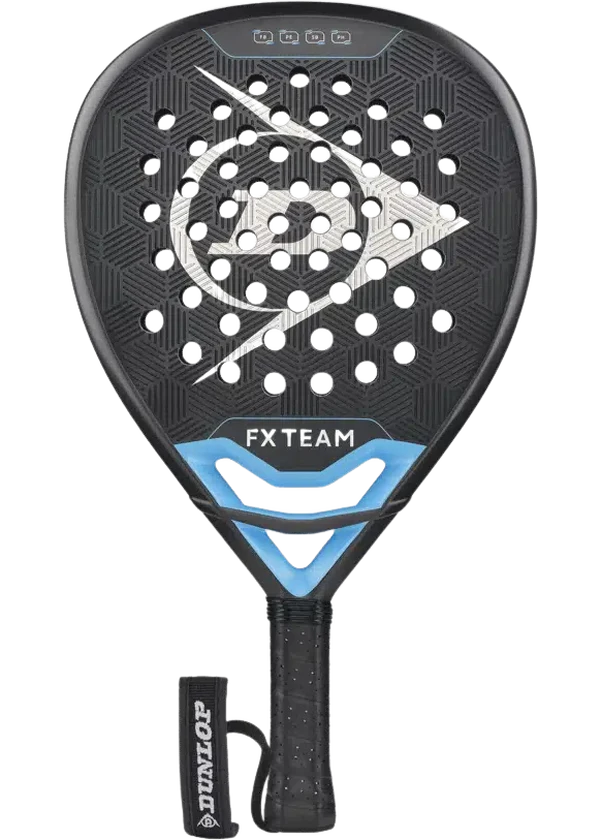

8 Parameters
FX Team 2026
On this page
Review
Dunlop FX Team 2026 Review: The Diamond That Doesn’t Force a Choice
Diamond-shaped rackets carry a reputation: maximum power, minimum forgiveness. The racket punishes off-center shots and demands technical consistency in return for weapons-grade punch. The Dunlop FX Team 2026 accepts part of that deal — but not all of it. Its medium balance point and Pro EVA core quietly soften the contract, offering genuine attacking intent without the full penalty that pure diamond geometry usually extracts from control and comfort.
The FX Team sits in the mid-tier of the Dunlop lineup, positioned below the FX Pro and above the entry-level FX Start. It runs a Pro EVA foam core — the same responsive compound found in the FX Pro — inside a 38mm premium carbon frame. The surface carries a raised spin-boost texture rather than a raw woven finish, and the frame integrates Force Bridge reinforcement for structural stability, a V-Energy Channel at the frame edge for stiffness, and Sonic Core with Infinergy inserts at 3 and 9 o’clock designed to manage rebound and reduce vibration at impact. Manufacturer-declared weight is 365g with a balance point of 260mm.
Stability leads at 7.5, Power follows at 7.8 — but the story is the profile gap. Attacker scores 7.62, Hybrid 7.27, Defender 7.12. A 0.35-point spread between Attacker and Defender is meaningful — this racket has a clear direction — but it’s not so wide that it locks out versatile players entirely.
Performance Breakdown
How the Dunlop FX Team 2026 Plays
STABILITY 7.5
Diamond Geometry Doing Its Job
The head-heavy bias of a diamond shape concentrates mass at the hitting zone, and the FX Team translates that physics into a Power score of 7.8 — the highest in the range. What keeps this from feeling like a one-trick tool is stability at 7.5, which the Force Bridge and V-Energy Channel frame tech actively support: the frame holds its shape under contact, which means power delivery stays consistent rather than dispersing through frame flex. For attacking players who hit through the ball rather than brushing it, this combination is the core argument for choosing the FX Team over something softer.
PLAYABILITY 7.1
Where the Medium Balance Earns Its Keep
A 260mm balance point is what separates the FX Team from the higher-strung attacking diamonds that sit further up the range. The result is a Maneuverability score of 7.4 that should not surprise anyone who has handled a top-heavy rival — the swing is noticeably quicker through the air. Playability at 7.1 reflects the accessible end of intermediate-level diamonds: the racket tolerates slightly mis-timed shots with more grace than a pure attack weapon, though it still rewards clean mechanics. This is not a racket you pick up without preparation, but it won’t punish every small error the way a 270mm+ balance point would.
COMFORT 7.0
Decent Compromises, Not Hidden Strengths
Control at 7.2 and Comfort at 7.0 are respectable numbers for a diamond-shaped attacking racket, and both owe something to the Pro EVA core — a compound known for dampening vibration and generating a livelier, more manageable response at impact than harder foam alternatives. These are not scores that place the FX Team in defender or hybrid territory; they simply mean the attacking package comes with reasonable arm-friendliness. Players managing elbow sensitivities should approach cautiously — the Sonic Core with Infinergy inserts provide measurable vibration absorption, but a stiff carbon frame at 55 RA will still transmit more than a softer round-shaped alternative.
SWEETSPOT SIZE 6.9
The Scores That Define the Ceiling
Spin at 6.8 is the lowest score in the profile and the honest limitation of the FX Team’s raised spin-boost texture. The surface generates adequate bite but doesn’t compete with rough-weave or extreme 3D textures found on dedicated spin-oriented diamond rackets at higher price points. Sweetspot at 6.9 is similarly honest — diamond geometry concentrates the hitting zone toward the crown, which rewards technically consistent ball-striking and penalizes off-center contact. Neither score is a flaw given the racket’s design intent, but together they confirm that the FX Team’s ceiling belongs to attackers who can place the ball, not to players looking for forgiveness or topspin as primary weapons.
Technology
Sonic Core + Force Bridge: Engineering That Manages the Diamond’s Downside
The FX Team’s proprietary technology stack is built around a single problem: diamond rackets are powerful but can be uncomfortable and unstable on off-center contact. Dunlop addresses this through three interlocking systems. Sonic Core with Infinergy places BASF’s expanded thermoplastic polyurethane foam inserts at 3 and 9 o’clock in the frame. These absorb vibration at the moment of impact — directly supporting the Comfort score of 7.0, which is above average for this shape category. The inserts also improve rebound consistency, meaning the ball leaves the frame more predictably across the hitting zone.
Force Bridge reinforces the frame’s structural connection between the throat and the head, resisting torsional flex under lateral loads. This is the engineering behind the Stability score of 7.5 — the frame does not twist on cross-court shots or hard exchanges, which keeps the power output consistent rather than variable. The V-Energy Channel runs along the frame edge, adding longitudinal stiffness that contributes to the 7.8 Power score without requiring an extreme balance point. The Power Holes pattern — drilled into the hitting surface — reduces dead weight and keeps the swing speed accessible, a direct contributor to Maneuverability at 7.4.
The technology benefits attackers at the intermediate-to-advanced threshold most. Players who generate pace through flat drives and smashes will feel the Sonic Core’s vibration management and the Force Bridge’s stability on repeat aggressive shots. Players who rely on spin generation or wide sweetspot coverage will find the texture and geometry limiting regardless of the technology stack — the frame systems cannot compensate for what the diamond shape does to Spin (6.8) and Sweetspot Size (6.9).
Player Fit
Who Should Buy the Dunlop FX Team 2026?
The Intermediate Attacker Building a Reliable Smash Game
If you’re the type who plays 3–4 times a week, hunts for the smash at every opportunity, and wants genuine power from the baseline without graduating to a racket that punishes every mistimed shot — this is your racket. The 7.8 Power and 7.5 Stability deliver the attacking credentials, while Maneuverability at 7.4 means you won’t feel like you’re swinging a hammer. You’ve built enough technique to work with a diamond shape, but you’re not yet at the level where an extreme balance point makes sense. The FX Team sits exactly at that crossover point — and it knows it.
Defensive Players and Spin-First Tacticians
The Defender profile score of 7.12 is the lowest in the range, and it’s not close enough to the Attacker score to suggest versatility at the back of the court. If your game is built on retrieving, redirecting, and controlling pace rather than generating it, a Spin score of 6.8 and a Sweetspot Size of 6.9 will work against you on exactly the shots that define your style. Players who rely on heavy topspin to stay in rallies will find the raised texture underwhelming. If control and retrieval define your game, a round or drop-shaped alternative will serve you far better than any diamond in this range.
FAQ
Frequently Asked Questions
What is the PadelVerdict score for the Dunlop FX Team 2026?
The overall score is 7.6 with a Consensus Modifier of 0, meaning the final published score stays at 7.6. The modifier breaks down as follows: specs are consistent across multiple sources (Data Quality: neutral), declared figures show no implausible outliers (Field Validation: neutral), but no independent physical measurements exist to confirm them (Market Correction: neutral). Profile scores: Attacker 7.62, Hybrid 7.27, Defender 7.12. The 0.35-point gap between Attacker and Defender is clear enough to make this a genuine attacking recommendation, not a hedge.
Is the Dunlop FX Team 2026 good for intermediate players?
Yes — with a condition. The FX Team is designed for intermediate players who already attack and want to upgrade their power output without picking up a racket that demands advanced technique on every shot. Playability at 7.1 and Maneuverability at 7.4 make the diamond shape accessible. If you’re intermediate and still developing your consistency from the baseline, a round or drop-shaped racket will serve you better — the 6.9 Sweetspot Size will cost you too many points.
Is the Dunlop FX Team 2026 good for attacking players?
Yes. The Attacker profile score of 7.62 leads the range, backed by Power 7.8 and Stability 7.5. If your instinct is to look for the overhead and win points at the net, the FX Team is built around that exact game. Browse all attacker rackets to see how it ranks against the full category.
What is the actual weight of the Dunlop FX Team 2026?
Dunlop declares 365g. No independent on-camera measurements exist to confirm or challenge that figure. A 365g racket at a 260mm balance point is on the heavier side for an intermediate attacking diamond, but the medium balance distributes that weight in a way that avoids feeling sluggish through the swing. If actual weight precision matters to your decision, this is a racket to handle in a store before buying.
How does the Dunlop FX Team 2026 compare to the Dunlop FX Pro 2026?
These are two different player propositions, not just two levels of the same proposition. The Dunlop FX Pro 2026 is positioned above the FX Team in the lineup and targets advanced players who can fully exploit a more demanding attacking setup. The FX Team trades some of that ceiling for more accessible Maneuverability and Playability — you get most of the power package with a shorter skill requirement. If you’re questioning which one to choose, the answer is almost always the FX Team until your level clearly outgrows it.
Why does the Dunlop FX Team 2026 have a Consensus Modifier of 0?
The FX Team’s specs — shape, core, frame construction, balance point, weight — appear consistently across multiple markets without contradiction. That consistency earns a clean data baseline, but it doesn’t move the modifier above zero on its own. What would push the modifier to +0.1 is independent physical validation: an on-camera measurement of the actual weight, an RA stiffness reading from a tester, or convergent specialist-level analysis beyond manufacturer descriptions. None of that exists for this racket yet. Consistent data without independent confirmation earns neutral, and neutral is zero.
Similar Rackets
Independent testing, funded by readers
No brand deals, no sponsored picks. If you found this useful, you can support the next round of tests with a small tip.

