
Technical Veron 3.0 2026
Does It Deliver Power Without the Punishment?
The short verdict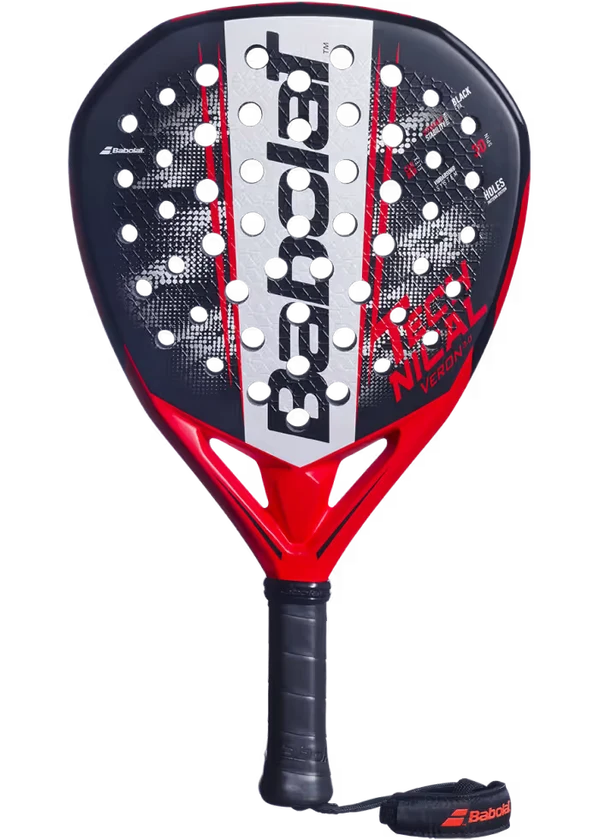


8 Parameters
Technical Veron 3.0 2026
On this page
Review
Babolat Technical Veron 3.0 2026 Review: Does It Deliver Power Without the Punishment?
The promise of a diamond racket is always the same: more power, further up the sweetspot, harder to recover from when you miss. The question every attacking intermediate has to answer is whether they can actually handle that trade-off — or whether they end up fighting the racket more than their opponent. The Babolat Technical Veron 3.0 2026 positions itself as the answer in the middle: a head-heavy offensive tool that doesn’t demand perfection on every ball.
Built around a Black EVA foam core — an elastic medium-density compound that absorbs vibration while retaining snap — the Technical Veron 3.0 pairs that with Carbon Flex on the surface: a woven carbon and fibreglass hybrid with a 3D textured finish designed to generate spin without sacrificing feel. The frame is full carbon, 38mm thick, with a declared balance of 270mm and a stiffness index of 68. Supporting systems include the Dynamic Stability System for structural rigidity in the heart of the frame, a Vibrabsorb anti-vibration mechanism, and a Smart Buttcap for strap customisation. It sits in Babolat’s 2026 lineup between the stiffer Viper 3.0 and the more forgiving Vertuo — positioned squarely at the technical striker who wants offensive output with something left in reserve.
Power leads at 8.6 — the highest single parameter in this profile and the number that makes the attacker case. Attacker: 8.12 · Hybrid: 7.82 · Defender: 7.60. That 0.52-point drop from Attacker to Defender is the racket telling you exactly what it is: a specialist tool, not a do-everything option.
Performance Breakdown
How the Technical Veron 3.0 2026 Plays
STABILITY 8.2
When the Smash Actually Goes In
Head-heavy balance at 270mm and a carbon frame with a stiffness of 68 create the conditions for explosive output — that much is expected from a diamond shape. What’s less obvious is the Stability score of 8.2, which outperforms what you’d typically get from a racket relying on EVA foam at this stiffness level. The Dynamic Stability System reinforces the heart of the frame, which means the racket stays controlled through off-axis strikes rather than twisting away. Power lands at 8.6 — the highest single parameter here — and it’s the engine of the entire Attacker profile score of 8.12.
MANEUVERABILITY 7.2
The Surface Does Work, But the Frame Sets Terms
Carbon Flex’s 3D textured surface earns a Spin score of 7.6 — solid for an attacker-oriented racket, where texture grip translates into kick on topspin attacks and added bite on smash finishes. Maneuverability at 7.2 is the racket’s most honest constraint: at 362g with a high balance, this is not a quick-exchange racket at the net. It’s built for players who set up the attack, not those who improvise at pace. That 7.2 is also the primary reason the Defender profile scores a relatively modest 7.60 — defensive recovery depends on fast transitions, and this frame is not optimised for them.
COMFORT 7.4
SWEETSPOT 7.3
More Forgiving Than the Stiffness Suggests
A stiffness of 68 in a diamond frame would normally push Comfort into punishing territory, but the Black EVA core and Vibrabsorb system pull that number back up to a respectable 7.4. Control at 7.8 is genuinely strong for the attacker category — directional precision is preserved even when the power output is high. Sweetspot Size at 7.3 is the honest caveat: this is not a large hitting zone, and timing matters. Players stepping up from a rounder or softer racket will notice the margin is tighter here.
Intermediate-Ready, Not Beginner-Safe
Playability at 7.4 is a precise signal about where this racket sits in the skill ladder. It’s accessible enough for developing intermediates with a clear attacking game plan, but the combination of a tighter sweetspot and lower maneuverability means it punishes inconsistency. Players who already know how to generate their own pace will find the Technical Veron 3.0 amplifies their game. Those who are still building that consistency will find it amplifies their mistakes instead.
Technology
Carbon Flex and Dynamic Stability System: More Than a Marketing Stack?
Carbon Flex is Babolat’s answer to a real problem in diamond rackets: carbon is stiff, and stiff means uncomfortable. By weaving carbon fibre with fibreglass in the face, the surface layer retains enough flex to soften the impact sensation and extend dwell time slightly — which is what drives both the Comfort score of 7.4 and the Spin score of 7.6. The 3D textured finish on the surface adds physical bite, not just cosmetic roughness. On attacking shots with topspin or slice, that grip creates meaningful ball rotation. Among diamond-shaped rackets in this weight class, the surface contribution to spin is a genuine differentiator.
The Dynamic Stability System reinforces the structural heart of the frame — the area most likely to flex or deform under heavy lateral contact. This directly underpins the Stability score of 8.2, which is the number that sets the Technical Veron 3.0 apart from softer options in the Babolat range. When you make contact near the edge of the sweetspot, the frame doesn’t give way; direction is preserved, and energy transfer remains consistent. That structural integrity is also why Power reaches 8.6 — a frame that twists loses energy, and this one doesn’t.
Vibrabsorb sits underneath all of this as the comfort safety net — reducing the shock that travels into the arm on mis-hits. It’s not a substitute for good technique, but for an intermediate player logging long sessions, it’s the difference between arm fatigue that accumulates gradually and discomfort that sets in mid-match. The result is a 7.4 Comfort score that is genuinely higher than the stiffness rating alone would predict. The system works because the components address different parts of the impact equation: Carbon Flex handles the surface sensation, Dynamic Stability handles the structural response, and Vibrabsorb handles the residual shock.
Player Fit
Who Should Buy the Technical Veron 3.0 2026?
The Attacking Intermediate Who Knows Their Game
If you’re the type who plays from the back third, relies on the smash and the bandeja to close points, and already generates your own pace — this racket is built around you. Power at 8.6 and Stability at 8.2 reward players who swing with intent, and Control at 7.8 means the direction is there even on the harder balls. You don’t need to be an advanced player, but you need to be consistent enough that a Sweetspot Size of 7.3 doesn’t penalise every third shot. If you’ve outgrown forgiving round rackets and want something that turns good technique into decisive shots, this is where you step up.
Defensive Players and Anyone Still Building Consistency
A Defender score of 7.60 and a Maneuverability score of 7.2 are not opinions — they’re the frame telling you it wasn’t designed for fast net exchanges or reactive defensive recovery. If your game depends on quick transitions, resets, and keeping the ball in play rather than ending points, this racket will work against you, not with you. Beginners and developing players should also note the Sweetspot Size of 7.3: the margin for error here is narrow, and inconsistent ball striking will be felt in both direction and comfort. The gap between the Attacker (8.12) and Defender (7.60) profiles is the whole story. Read the Babolat Viper 3.0 2026 review if you want the harder, more demanding alternative.
FAQ
Frequently Asked Questions
What is the PadelVerdict score for the Babolat Technical Veron 3.0 2026?
The overall PadelVerdict score is 8.1, with a Consensus Modifier of 0. Specs are consistent across multiple markets, but no independent physical measurements exist to validate declared figures — consistent data without independent confirmation earns neutral, not positive. Profile breakdown: Attacker 8.12 · Hybrid 7.82 · Defender 7.60. That 0.52-point gap between Attacker and Defender is the clearest signal in the data — buy it as an attacker’s racket, not a versatile one.
Is the Babolat Technical Veron 3.0 2026 good for intermediate players?
Yes — but specifically for intermediates with an established attacking game. The Playability score of 7.4 and Comfort of 7.4 make it manageable for this level, and the Vibrabsorb system protects the arm during longer sessions. The caveat is Sweetspot Size at 7.3: if your ball striking is still inconsistent, you’ll feel that tighter margin quickly. Players still in the consistency-building phase would be better served by a rounder, more forgiving frame first.
Is the Babolat Technical Veron 3.0 2026 good for attacking players?
Yes, that’s exactly what it’s built for. The Attacker profile score of 8.12 is driven by Power at 8.6 and Stability at 8.2 — the two parameters that matter most when you’re playing from the back and trying to end points. Spin at 7.6 adds variety to the attack. If you’re looking at the best attacker rackets in this category, the Technical Veron 3.0 belongs in that conversation.
What is the actual weight of the Babolat Technical Veron 3.0 2026?
The manufacturer declares 360g ±10g across most sources, with one source noting 365g ±10g. No independent on-court or on-camera measurements are available for this 2026 model. In practical terms, expect a unit somewhere between 355g and 370g. That variance is worth noting at this balance point — a frame that comes in at the heavy end of the tolerance range will feel meaningfully different in fast exchanges than one at the lighter end.
How does the Babolat Technical Veron 3.0 2026 compare to the Babolat Viper 3.0?
The Viper 3.0 is stiffer, more explosive, and less forgiving — built for advanced players who can consistently find the sweetspot and want maximum power transfer. The Technical Veron 3.0 gives up a fraction of raw power ceiling in exchange for Carbon Flex’s surface compliance, a more elastic EVA core, and the Vibrabsorb system. The choice comes down to player type: if your technique is already consistent and you want to extract every watt of power, the Viper 3.0; if you want serious offensive output with more margin and arm protection, the Technical Veron 3.0.
Why does the Babolat Technical Veron 3.0 2026 have a Consensus Modifier of 0?
Specs are consistent across multiple markets — no contradictions, no implausible figures. But consistency alone doesn’t move the modifier above zero. No independent physical measurements exist to confirm the declared weight, balance, or stiffness values for this 2026 model. Consistent data without external validation earns neutral. An independent weight or balance measurement would be the clearest path to a positive adjustment.
Similar Rackets
Independent testing, funded by readers
No brand deals, no sponsored picks. If you found this useful, you can support the next round of tests with a small tip.

