Shark 2024
Review
QUAD Shark 2024 Review: Does a Drop-Shape Racket Have Any Business Hitting This Hard?
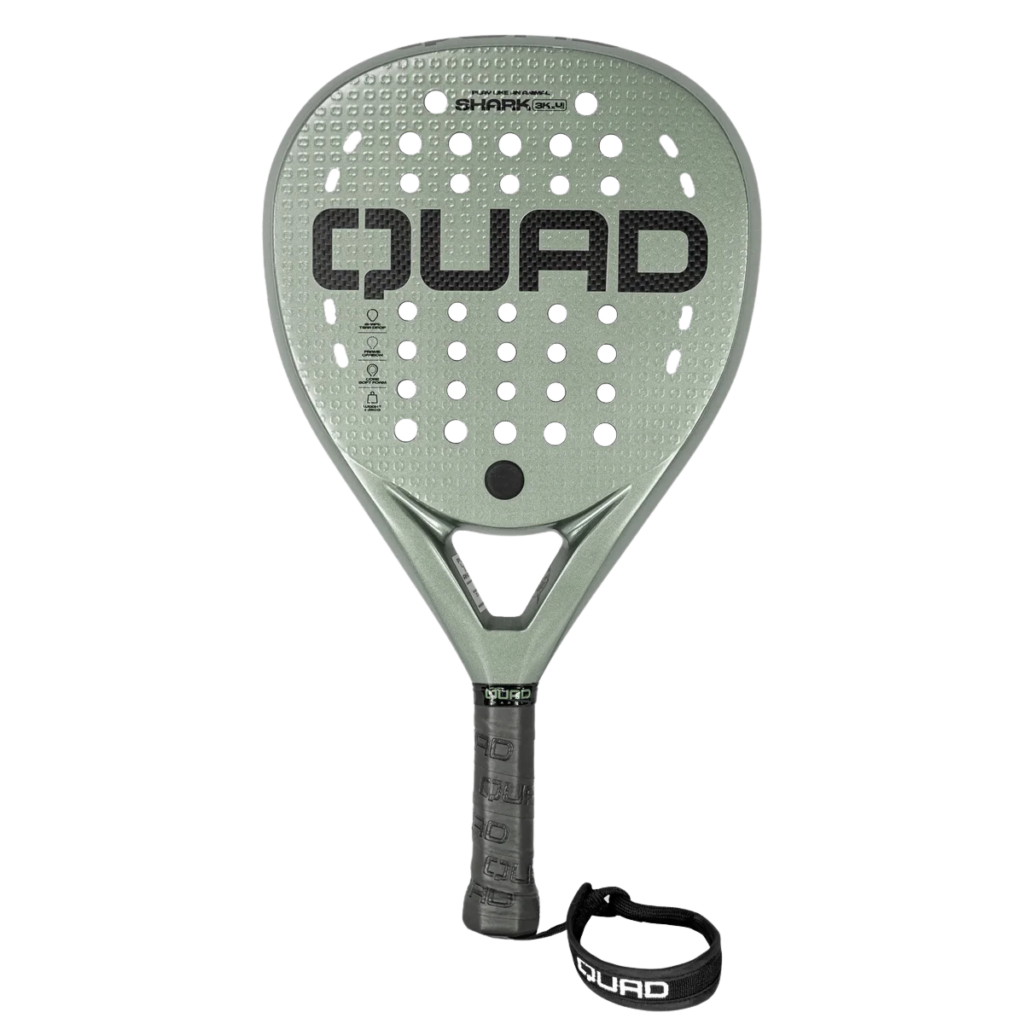
The conventional wisdom in padel is that you pay for power with touch — that a racket built to punish from the back of the court will make net play feel like a negotiation. The QUAD Shark 2024 tests that assumption directly. It is a drop-shape racket built on an explicitly offensive profile, with head-heavy balance and a spin-first surface — and yet the design decisions underneath the carbon layers are clearly trying to preserve more ball feel than a pure power weapon would allow. Whether it succeeds depends on who is swinging it.
The Shark is built around a Hyper Soft Foam core at medium density — QUAD’s own formulation, developed entirely in-house — encased in four layers of 3K carbon weave. The frame uses the Bionic Carbon Frame system, which reduces frame inflation to create a single integrated structure between face and core, with the stated goal of enlarging the sweetspot and dampening vibration without softening the response. The rough-textured surface pairs with Speed-Up Tech, a slot pattern near the frame designed to increase air passage and reduce drag, which QUAD claims delivers around 30% more racket acceleration. Balance sits at 280mm — firmly head-heavy — and declared weight is 360g. Worth noting: the stock grip is unusually thin and light, which shifts the effective balance point even further toward the head than the declared figure suggests. This is a factory-tested, handmade Portuguese build, developed over six months alongside professional player Antonio Luque.
Spin leads this profile at 8.6 — the highest single parameter score and the clearest signal of what this racket is built around. Attacker: 8.22 – Hybrid: 7.98 – Defender: 7.72. The 0.50-point gap between Attacker and Defender is meaningful: this racket has a direction, and it points toward the left side of the court.
Performance Breakdown
How the QUAD Shark 2024 Plays
POWER 8.4
The Offensive Engine Is Not Subtle
Spin at 8.6 is the headline number, and it is earned by the combination of a rough 3K carbon surface and the Speed-Up Tech slot geometry near the frame that increases swing velocity. Power at 8.4 follows directly — this is what a head-heavy drop shape with 4 sheets of 3K carbon produces when the racket is moving fast through the strike zone. Reviewers across markets consistently describe overhead power as arriving with minimal effort, and vibora snap as the Shark’s most defining on-court moment. These are not independent strengths; the speed increase from the slot system amplifies both parameters simultaneously, which is why the gap between Spin and the next-highest score is the most structurally honest signal in this dataset.
SWEETSPOT 7.8
The Bionic Frame Earns Its Keep on Hard Contact
Head-heavy balance and four carbon layers should, in theory, make frame stability a strength — and Stability at 8.0 confirms that logic holds. What is less obvious is the Sweetspot score of 7.8 on a 280mm-balance drop shape, which would normally trend lower. The Bionic Carbon Frame’s reduced-inflation construction integrates the frame and core into a single structure, and the evidence suggests it genuinely expands the effective hitting area. The drop shape category rarely produces this combination, which is why it stands out.
PLAYABILITY 7.7
Better at the Net Than It Has Any Right to Be
Control at 7.8 is the most counterintuitive result in this profile for a racket with an 8.4 Power score. Expert reviews specifically call out drop shot placement and net volley precision as strengths, which typically signals that the Hyper Soft Foam core is absorbing enough energy to give the player a moment of feel before the ball departs. Playability at 7.7 reflects a racket that functions across court phases without breaking down, though it is most comfortable in fast, aggressive exchanges rather than slow, constructed rallies. No durability concerns reported at this stage. This section updates as long-term data becomes available — typically 60+ days post-launch.
COMFORT 7.2
The Price of the Power Profile Is Paid Here
Maneuverability at 7.6 and Comfort at 7.2 are the Shark’s lowest scores, directly connected to each other and to the 280mm balance point. The stock grip compounds this further — it is unusually thin and light by design, shifting the effective balance even further toward the head than the declared figure implies. Speed-Up Tech partially compensates by pushing swing acceleration beyond what the weight class alone would produce, but 7.6 is an honest ceiling for a head-heavy drop shape. Comfort at 7.2 is where the Defender profile finds its explanation: players who rely on extended defensive rallies will feel the stiffness and mass accumulate before attackers do. Italian reviewer Fabio Ferro rated comfort at 7/10 independently, aligning closely with this figure. For the target player finishing points rather than extending them, neither score is disqualifying. For anyone else, both numbers are the honest warning.
Technology
Speed-Up Tech and Bionic Carbon Frame: Two Systems, One Coherent Argument
Speed-Up Tech operates through elongated slots positioned near the frame edge, increasing air passage during the swing and reducing aerodynamic drag. The result is approximately 30% greater racket acceleration on the same player input — a figure that maps directly onto Spin at 8.6 and Power at 8.4. Faster racket head speed at contact means more brush time on the ball and more energy transferred at impact. The slot geometry is also what pushes Maneuverability to 7.6 despite the 280mm balance — without it, that number would be lower on a racket of this construction.
The Bionic Carbon Frame works on a different axis. Conventional carbon frames are inflated outward during construction, creating a slight gap between frame and core. QUAD’s approach reduces that inflation, fusing frame and core into a single integrated unit. The structural consequence is increased rigidity across the frame-core boundary — which supports Stability at 8.0 — and a wider zone of consistent ball response across the face, which explains Sweetspot at 7.8 on what should geometrically be a tighter hitting area for a head-heavy drop shape.
Together, these systems are built for one player type: advanced attackers who need both power and enough precision to direct the ball, not just launch it. Speed-Up Tech serves the left-side offensive specialist who lives on viboras and smashes. Bionic Carbon Frame serves the same player when they step into the net game and need structural consistency on fast volleys. Neither system benefits a player building rallies from the baseline or absorbing pace defensively — and the Comfort and Maneuverability scores confirm exactly that.
Player Fit
Who Should Buy the QUAD Shark 2024?
The Left-Side Finisher Who Ends Points, Not Extends Them
If you are the type who considers a rally unfinished until the vibora has been attempted, the QUAD Shark 2024 was built around your game. Spin at 8.6 and Power at 8.4 are the twin engines here, and the Attacker profile score of 8.22 is the highest of the three. Sweetspot at 7.8 means your off-center contact during fast exchanges is covered, and Stability at 8.0 means the racket does not wander when you commit fully to an overhead. You need to be technically capable enough to benefit from the 280mm balance — this is a racket that rewards swing mechanics, not one that compensates for their absence. If you are that player, and you have been using something more forgiving while waiting for the right weapon, this is it.
Defensive Players and Anyone Still Building Their Game
The Defender profile score of 7.72 is the lowest of the three, and the Comfort score of 7.2 tells you exactly why: this racket is not built to absorb extended defensive load. Intermediate and developing players should not mistake a high Spin score for accessibility — the Shark’s spin output is contingent on the swing speed and technique to generate it. Without both, you have a stiff, head-heavy racket at this price point that punishes your mistakes rather than softening them. The sharpest line here: the racket performs exactly as advertised, and that advertisement was never addressed to you.
FAQ
Frequently Asked Questions
What is the PadelVerdict score for the QUAD Shark 2024?
The overall PadelVerdict score is 8.1. The Consensus Modifier is 0 — manufacturer specs are consistent across all markets, but no independent measurements or community validation exist to move the score in either direction. Profile breakdown: Attacker 8.22, Hybrid 7.98, Defender 7.72. The 0.50-point gap between Attacker and Defender is the whole story: this is a specialist racket, and the score reflects how well it executes that specialism.
Is the QUAD Shark 2024 good for intermediate players?
Probably not. Comfort at 7.2 and Maneuverability at 7.6 are manageable for advanced players who generate their own pace — but intermediate players will find the 280mm head-heavy balance tiring and the stiffness unforgiving. Sweetspot at 7.8 helps, but not enough to compensate for technique gaps. Look at the hybrid racket category for options that offer more forgiveness without sacrificing development potential.
Is the QUAD Shark 2024 good for left-side offensive players?
Yes — unambiguously. Spin 8.6, Power 8.4, Stability 8.0. That combination is the left-side offensive toolkit: generate rotation on the vibora, finish with authority overhead, hold your shape on fast volleys. Multiple independent reviewers across different markets reached the same conclusion without coordination. If that is your position and your game, trust the Attacker score of 8.22.
What is the actual weight of the QUAD Shark 2024?
Declared weight is +-360g. No independent on-camera measurement exists in any of the markets reviewed. QUAD uses a +- qualifier suggesting a tolerance range around that figure. The head-heavy balance at 280mm means the racket will feel heavier in play than the declared number suggests — factor that into the Maneuverability and Comfort scores.
How does the QUAD Shark 2024 compare to a control-oriented alternative like the QUAD Fiesta?
A choice between two player types, not two spec sheets. The Shark is built for someone who ends points; a control-oriented sibling is built for someone who constructs them. If your game revolves around creating angles and waiting for the right moment, the Shark’s 8.4 Power will feel like it works against your instincts. Choose by game style, not by score proximity.
Why does the QUAD Shark 2024 have a Consensus Modifier of 0?
Because neither the data nor the absence of data gives us a reason to move. Manufacturer specs are identical across all five language markets — no inconsistencies to penalize. But no independent lab measurements, no community sentiment, and no long-term ownership reports exist to validate or push those specs upward. A score of 0 is the honest result when the evidence is consistent but incomplete.

Similar Rackets