
Fuji 2026
The All-Court Case for Staying in the Middle
The short verdict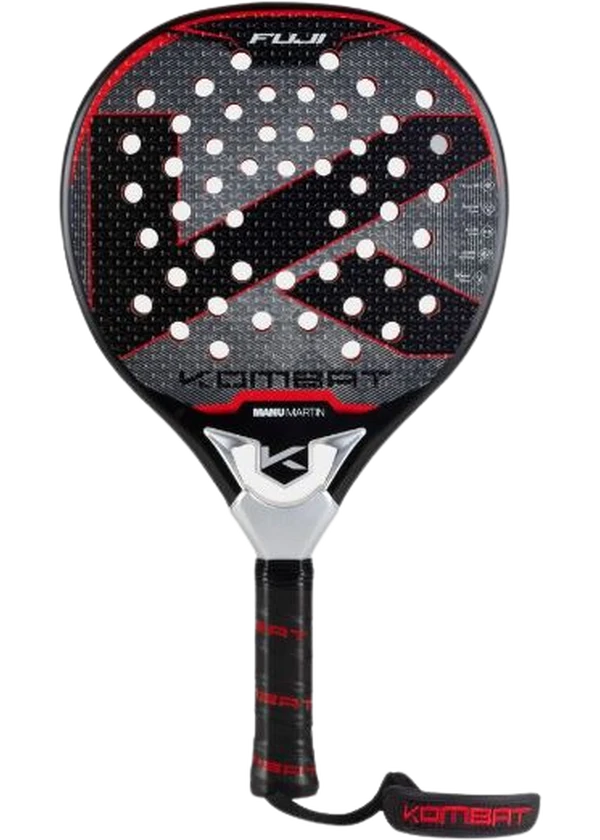

8 Parameters
Fuji 2026
On this page
Review
Kombat Fuji 2026 Review: The All-Court Case for Staying in the Middle
The specialist trap in padel equipment is real: most players buy a tool optimized for one role, then spend three months compensating for what it can’t do. The Kombat Fuji 2026 makes a different bet — that a racket calibrated to serve every part of your game equally well is more valuable than one that excels narrowly. That’s the tension this racket is designed to resolve, and whether it works depends entirely on whether you’re actually the player it’s built for.
The Fuji 2026 is part of Kombat’s Vulcano collection, associated with Manu Martín. It’s built around a medium-hardness EVA foam core — a deliberate choice for feel and comfort — paired with a textured 18K carbon fiber surface that prioritizes grip on the ball over raw pace. The drop shape sits at a 260mm balance point, keeping it out of full-attack territory and anchoring it firmly in control positioning. Frame construction is 100% carbon with a 38mm profile. Declared weight sits at 362g.
Sweetspot at 8.5 is the number that defines this racket’s identity. Defender: 7.88 / Hybrid: 7.81 / Attacker: 7.79. The three profiles sit within 0.09 points of each other — but the Defender score leads, and Control 8.0 and Stability 8.0 are the reason why.
Performance Breakdown
How the Kombat Fuji 2026 Plays
PLAYABILITY 7.6
Where This Racket Actually Earns Its Pay
Control at 8.0 is the anchor of the Fuji 2026’s identity. The combination of drop shape, medium-hardness EVA core, and a 260mm balance point that keeps the head from pulling the shot creates a platform for players who want placement over pace. The ball comes off the face with a predictability that lets you work angles and dictate rallies from the back. Playability at 7.6 confirms this isn’t a punishing specialist frame: it adapts to different stroke types without demanding technical perfection. Control at this level is the primary driver of the Defender profile score leading — it is the parameter that carries most weight for back-court players, and the Fuji delivers it consistently. For a drop-shaped racket at this price tier, that combination is genuinely useful.
STABILITY 8.0
More Structural Integrity Than the Profile Suggests
Power at 7.8 is honest for a control-oriented drop frame — enough pace to threaten, not enough to dominate. The number that surprises here is Stability at 8.0: for a 260mm balance point, this level of frame rigidity under impact is not a given. The 100% carbon construction earns its keep — off-centre strikes in fast exchanges don’t unsettle the frame the way lower-balance hybrid rackets often do. For a defender or all-court player regularly absorbing pace from opponents at the net, Stability at 8.0 is a practical advantage that shows up over the course of a long match rather than on any single shot. These two scores together mean the Fuji handles power exchanges with more confidence than its control positioning might suggest.
MANEUVERABILITY 7.6
The Forgiveness That Makes Defence Sustainable
Sweetspot Size at 8.5 is the most significant number in this profile. Defensive play generates more off-centre contact than attacking play — you are retrieving, stretching, and reacting rather than setting up and striking. A sweetspot this generous means those imperfect contacts still come back usable and controlled rather than punishing you for a recovery shot. Maneuverability at 7.6 holds pace: one measured example came in at 355g, which sharpens this slightly, but the frame moves well for its weight class and the 260mm balance keeps wrist load manageable. Together these scores describe a racket that is forgiving by design — and in a defensive context, forgiveness is not a consolation prize. It is the feature.
SPIN 7.2
Arm-Friendly by Design, Spin-Limited by Choice
Comfort at 7.7 is the EVA core performing as intended — vibration absorption is solid, and there is nothing here to concern players with arm sensitivity. This is a racket you can play long sessions with without accumulating forearm fatigue, which matters particularly for defenders who spend extended rallies absorbing hard balls. Spin at 7.2 is the lowest score in the set and the most honest signal about where the Fuji 2026 sits competitively: the textured 18K carbon surface generates grip, but the 260mm balance point and drop geometry don’t add the whip that dedicated spin-oriented frames produce. If you build your game around heavy topspin or slice as primary weapons, this ceiling will feel limiting. It confirms the Fuji 2026 is a control-first, consistency-focused frame — and that is precisely its argument.
Technology
18K Carbon + EVA Core: Does the Material Stack Actually Deliver?
The Kombat Fuji 2026 doesn’t rely on a proprietary branded system — it relies on material quality and calibration. The 18K carbon fiber surface with a textured rough finish is the primary differentiator on ball contact: the weave density creates a grippier face than standard carbon at this price point, contributing meaningfully to the Control score of 8.0 and providing the surface-level spin bite that pushes Spin to 7.2. That gap between the two scores tells you something important — the surface grips, but the frame’s geometry doesn’t amplify that grip into heavy rotation.
The medium-hardness EVA foam core is the comfort and feel engine. Unlike harder foam cores that maximize ball exit speed at the expense of touch, the EVA specification here is tuned for dwell time — the ball sits on the face fractionally longer, which translates directly into Playability at 7.6, Comfort at 7.7, and the generous Sweetspot Size of 8.5. That last score is where the EVA contribution is most visible: the core’s energy absorption behaviour keeps the hitting zone consistent across a wide impact area, which is the mechanical explanation behind a sweetspot score that directly serves the back-court game — where contact is rarely perfect and consistency matters more than peak output.
The 38mm 100% carbon frame profile completes the picture. At stiffness 52, the frame is firm enough to deliver Power at 7.8 and Stability at 8.0 without becoming a liability under fatigue. The 260mm balance point is a deliberate choice: low enough to keep the frame maneuverable at 7.6, structured enough to hold Stability at 8.0 under pace. The construction is calibrated for a player who wants tools built around consistency and control — not compromises toward power. Browse the full Kombat lineup to see where this frame sits in their range.
Player Fit
Who Should Buy the Kombat Fuji 2026?
The All-Court Player Who Wins Rallies Through Consistency, Not Power
If your game is built on keeping the ball in play, working angles from the baseline, and wearing opponents down rather than blasting through them — the Kombat Fuji 2026 was calibrated for exactly that approach. Control at 8.0 and Sweetspot at 8.5 mean placement stays precise and off-centre contact stays usable across a long match. Stability at 8.0 means hard balls coming back at you don’t unsettle the frame. The Defender score of 7.88 leads the three profiles, but with Hybrid at 7.81 and Attacker at 7.79 within 0.09 points, this racket doesn’t actively resist any court position — it simply rewards the player who values consistency over aggression. Comfort at 7.7 means you can play for two hours without your arm having an opinion about it.
The Spin-Reliant Attacker or the Power-First Baseliner
If your game lives and dies on spin — heavy topspin drives, biting slice, rotational smashes — Spin at 7.2 is the ceiling you’ll keep hitting. That’s the lowest parameter in the entire set, and no amount of textured carbon surface fully compensates for a balance point and geometry not optimised for rotation. Similarly, if you’re an aggressive player who needs maximum Power output and prefers a high-balance diamond frame, the Fuji’s 260mm balance point and drop shape won’t deliver that profile. The Kombat Vulcano collection includes a diamond-shaped attacker model for that player type — look across the attacker category before deciding.
FAQ
Frequently Asked Questions
What is the PadelVerdict score for the Kombat Fuji 2026?
The overall PadelVerdict score is 8.0, with a Consensus Modifier of 0. Specs are consistent across multiple sources (Data Quality: neutral), a single independent measurement confirmed 355g measured weight with no contradictions found (Field Validation: neutral), but no independent balance or stiffness measurements exist across any market to validate declared specs further (Market Correction: neutral). Profile breakdown: Defender 7.88 / Hybrid 7.81 / Attacker 7.79. The 0.09-point spread across all three profiles is the defining data point — but the Defender score leads, and Control 8.0 and Stability 8.0 are the structural reason why.
Is the Kombat Fuji 2026 good for intermediate players?
Yes — and across a broader range of intermediates than a typical drop-shaped frame. Sweetspot Size at 8.5 means the forgiveness margin is genuinely wide: off-centre contact returns a usable shot rather than punishing the player. Combined with Comfort at 7.7 and Playability at 7.6, the Fuji 2026 is well-suited to intermediates at most stages of development. If you are a complete beginner still building fundamentals, a rounder frame remains the better starting point — but for anyone past that stage, this racket is a comfortable and consistent fit.
Is the Kombat Fuji 2026 good for defensive players?
Yes — it’s the profile the data points to most clearly. The Defender score of 7.88 leads all three profiles, driven by Control 8.0, Sweetspot 8.5, Maneuverability 7.6, and Comfort 7.7 — the four parameters that matter most for back-court play. Stability at 8.0 adds structural reliability when absorbing pace from opponents. If you play primarily from the right side and want a frame that keeps working under defensive pressure, the Fuji is a direct fit. Browse the full defender racket category for further comparisons.
What is the actual weight of the Kombat Fuji 2026?
Kombat declares 360-370g, with 362g as the nominal spec. One independently measured example came in at 355g — a 7g difference from the declared figure. On court, 7g is perceptible to experienced players but unlikely to change how an intermediate player assesses the frame’s weight class. It’s worth noting this is a single measurement, and frame-to-frame variation within a production run is normal.
How does the Kombat Fuji 2026 compare to other Kombat models?
The Fuji is the control-oriented model in the Vulcano collection — drop-shaped, 260mm balance, built for a player who values placement, consistency, and arm comfort over aggressive power output. Other models in the Kombat Vulcano range carry higher balance points and harder frame profiles oriented toward offensive play. The Fuji sits at the control end of that spectrum. If maximum power output or a pure attacking tool is the brief, look at higher-balance options in the Kombat lineup.
Why does the Kombat Fuji 2026 have a Consensus Modifier of 0?
The modifier reflects what the data can and cannot confirm. Shape, core, surface, and weight appear consistently across multiple markets — that earns a neutral baseline, not a positive adjustment. One on-camera weight measurement exists, which confirms the declared weight range without contradicting it, but a single data point on a single parameter isn’t sufficient for a positive modifier. No independent balance or stiffness measurements exist anywhere. Consistent data without multi-parameter physical validation stays at 0.
Similar Rackets
Independent testing, funded by readers
No brand deals, no sponsored picks. If you found this useful, you can support the next round of tests with a small tip.

