
Pure Pro Plus 2026
The Control-First Round Racket That Punches Above Its Weight
The short verdict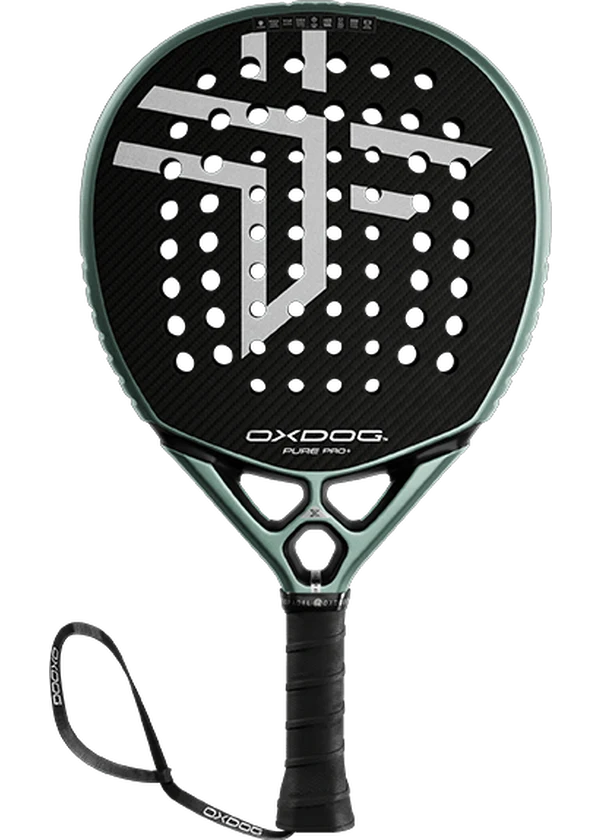
8 Parameters
Pure Pro Plus 2026
On this page
Review
Oxdog Pure Pro+ 2026 Review: The Control-First Round Racket That Punches Above Its Weight
Round-shaped rackets built for control have one persistent problem: they tend to reward patience but punish ambition. The moment you want to do something aggressive with the ball, the shape fights back. Oxdog’s answer with the Pure Pro+ 2026 is to load the round mold with the kind of specs you’d expect on an attacking diamond — hard EVA foam, a head-heavy balance at 268mm, and a stiffness rating of 68 — and then ask whether control and power really need to be opposites. That tension is precisely what makes this racket interesting.
The Oxdog Pure Pro+ 2026 is built around a high-density EVA Hard foam core, a Sandy HES Carbon surface for bite and spin, and a frame processed through Oxdog’s Dural Moulded construction. Proprietary systems include PowerRibs (structural rails along the frame for stability and power transfer), Side Ports (air channels that reduce swing weight), DSH Double Size Holes (enlarged holes to expand the sweetspot and off-center forgiveness), and Vibradamp (a three-layer vibration absorption system beneath the grip). The result is a 370g round-shape racket that sits in the Oxdog lineup as the control-anchored mid-tier of the Pure series, priced at €299.
Sweetspot Size hits 8.6 — the single highest parameter in this profile. Defender: 8.37 · Hybrid: 8.14 · Attacker: 7.79. That 0.58-point gap between defender and attacker tells you everything about the trade-off: this is a racket built to never punish your positioning, but it won’t manufacture power for you.
Performance Breakdown
How the Oxdog Pure Pro+ 2026 Plays
PLAYABILITY 8.1
Forgiveness Is the Foundation
The DSH Double Size Holes do measurable work here — the sweetspot score of 8.6 is the highest parameter in the entire profile, and it’s not close. What that translates to on court is a striking face that stays consistent well outside the geometric center, meaning your third ball when slightly out of position still produces a clean, directed response. Playability at 8.1 reflects how well this forgiveness compounds with the round shape’s natural dwell time, making structured net play and defensive retrievals feel unusually reliable. For round-shaped rackets, this is among the more complete packages in the playability category.
STABILITY 7.9
Precision That Holds Under Pressure
Control at 8.8 is the second-highest score and the parameter that defines the racket’s identity. The combination of stiff EVA Hard foam and PowerRibs along the frame means that directional intent transfers cleanly — there’s minimal deflection between what the player decides and what the ball actually does. Stability at 7.9 is solid rather than exceptional; the head-heavy balance adds inertia on impact but introduces a small cost in cross-court exchanges when the racket face must reposition quickly. The frame holds well on hard exchanges, and nothing in the data suggests durability concerns.
SPIN 7.6
The Head-Heavy Compromise
Here’s the counterintuitive part: a 370g head-heavy racket hitting 7.8 in maneuverability isn’t a contradiction — it’s the Side Ports doing their job. The air channels carved into the frame reduce swing resistance enough to keep the racket nimble on short backswings and quick volleys, even at this weight and balance. Spin at 7.6 is respectable, driven by the Sandy HES Carbon surface texture, though the stiff core limits the ball-pocket time that generates maximum rotation. Neither parameter is a liability; both are slightly constrained by the same stiffness that makes control so reliable.
COMFORT 7.4
Power Is Earned, Not Given
Power at 7.4 is the lowest score and the most honest signal in the profile. The hard foam and head-heavy setup generate solid ball speed when technique is clean, but this racket does not amplify passive or defensive mechanics into penetrating shots — the player provides the energy. Comfort matches power at 7.4, which is adequate rather than impressive for a stiff 68 RA construction; the Vibradamp system reduces vibration effectively at the handle but cannot fully offset the firmness of the core on repeated hard impacts. Players with arm sensitivity should treat this as a moderate-comfort racket, not a joint-protection specialist.
Technology
PowerRibs + DSH: Does Loading a Round Frame With Attack Specs Actually Work?
PowerRibs are structural carbon rails integrated into the frame rather than added to the surface — they redistribute flex energy back into the ball rather than absorbing it into the frame walls. The practical result is the stability score of 7.9: the frame face resists twisting on off-center contact, which is what lets a round racket at 370g feel composed rather than floppy on aggressive exchanges. Without PowerRibs, a head-heavy round frame of this weight would lose directional precision under hard impact; with them, Control holds at 8.8.
DSH (Double Size Holes) enlarges the apertures near the frame perimeter, which softens the response in those zones and pulls the effective sweetspot outward. This is why Sweetspot Size scores 8.6 while the core material remains hard — the forgiveness comes from hole geometry, not foam compliance. The two systems work in opposite directions: PowerRibs stiffen the frame, DSH softens the hitting zone at the edges. The net effect is a racket that feels precise in the center and forgiving at the margins, which is a genuinely useful combination for intermediate-to-advanced players who need reliability without sacrificing intent.
Side Ports cut air channels into the frame profile, reducing the swing-weight penalty of a top-heavy 370g construction. Without them, the head-heavy balance would suppress Maneuverability below 7.5; the channels keep it at 7.8, which is the difference between a racket that feels sluggish in quick net exchanges and one that simply demands intent. Vibradamp sits beneath the grip as a three-layer silicone system — it contributes to the 7.4 Comfort score, a figure that’s adequate but confirms the stiff core remains the dominant sensory signal on hard contact. The RBS removable weight at 8g allows minor balance customization, though for most players the declared 268mm balance is the configuration worth keeping.
Who benefits? Players who run structured control games from both wings — right-side builders who construct with lobs and precise volleys, left-side players who finish selectively rather than forcefully. The technology stack is coherent: it maximizes the parameters this player type values (Control, Sweetspot, Playability) and accepts measured trade-offs in the parameters they’re less reliant on (Power, Comfort).
Player Fit
Who Should Buy the Oxdog Pure Pro+ 2026?
The Patient Technician Who Builds Every Point
If you’re the type who wins points by making your opponent hit one ball too many rather than by outpowering them, this racket is built around your game. Control at 8.8 and Sweetspot at 8.6 mean your positioning doesn’t need to be perfect for your shot selection to be — the racket consistently translates intention into placement. Playability at 8.1 makes it reliable across the full range of structured net play, lob construction, and disciplined baseline exchanges. This is a defender or hybrid player at intermediate-to-advanced level who has good technique, doesn’t rely on the racket to generate pace, and needs a tool that never introduces uncertainty when the rally gets long. You’ll pick up this racket after a tough session and wonder why it felt easy. For the alternatives, see our intermediate player guide with real scores — every option ranked on data.
The Aggressive Baseliner Who Wants Effortless Pace
Power at 7.4 is the lowest score in the profile and the clearest signal here: if your game depends on generating pace without perfect mechanics — smashing winners from mid-court or driving balls flat and hard — this racket will feel like it’s working against you. The Attacker score of 7.79 is the lowest of the three profiles, and that gap isn’t cosmetic. The stiffness that makes control so precise also means the foam doesn’t assist passive or rushed swings. If you’re also managing arm sensitivity, the 7.4 Comfort score won’t reassure you on a high-volume session. A diamond-framed racket with a softer power-oriented core will serve that game better.
FAQ
Frequently Asked Questions
What is the PadelVerdict score for the Oxdog Pure Pro+ 2026?
The PadelVerdict Verdict Score is 8.6, which includes a Consensus Modifier of +0.1. Specs are consistent across multiple markets (Data Quality: neutral), specialist sources across multiple markets align on the control-focused profile with no contradictions on key parameters (Field Validation: positive), but no independent physical measurements exist to go further (Market Correction: neutral). That Field Validation component earns the +0.1. Profile breakdown: Defender 8.37 · Hybrid 8.14 · Attacker 7.79. The 0.58-point gap between defender and attacker is the decision-making signal — this racket has a clear orientation, not a generic one.
Is the Oxdog Pure Pro+ 2026 good for intermediate players?
Yes, conditionally. The Sweetspot at 8.6 and Playability at 8.1 make it accessible, but Power at 7.4 and a stiffness of 68 RA mean it rewards consistent technique. An intermediate player with clean mechanics who prioritizes control and reliability will thrive. An intermediate who is still developing swing efficiency may find the racket honest to the point of being unforgiving — a softer-core round racket will be more forgiving in that scenario.
Is the Oxdog Pure Pro+ 2026 good for defenders?
Yes. The Defender profile score of 8.37 is the highest of the three, and it’s backed by the right parameters: Control 8.8, Sweetspot 8.6, and Playability 8.1 are the three scores that matter most for a structured back-court game. The racket stays composed under pressure and keeps placement consistent when your positioning isn’t perfect. If you identify as a defender or strategic player, browse the defender racket category — this one belongs near the top of that list.
What is the actual weight of the Oxdog Pure Pro+ 2026?
Declared weight is 370g. No independent on-camera measurements exist for this model, so we cannot confirm a measured figure. One retailer acknowledges that manufacturing variance exists and offers a weighing service, which signals that unit-to-unit differences are possible. At 370g with a head-heavy balance, the swing weight is perceptible — if you’re sensitive to that, the lighter variant Oxdog mentions is worth considering before purchase.
How does the Oxdog Pure Pro+ 2026 compare to the Oxdog Ultimate Pro+?
Different tools for different games. The Ultimate Pro+ is a diamond-framed racket positioned as Oxdog’s top-tier attacker — it prioritizes power generation and sits above the Pure series in pricing. The Pure Pro+ trades that attacking ceiling for a wider sweetspot, more reliable control, and better defensive structure. Choose the Pure Pro+ if you build points patiently and finish selectively. Choose the Ultimate Pro+ if you want to impose pace and close out rallies aggressively. They share a brand but serve genuinely different profiles.
Why does the Oxdog Pure Pro+ 2026 have a Consensus Modifier of +0.1?
TThe +0.1 reflects a process that separates consistency from validation. Specs appearing uniformly across sources earns neutral — that’s the baseline, not a reward. What moves the modifier is specialist-level convergence: sources across multiple markets independently align on the control-focused, defender-oriented profile with no contradictions found. That cross-market alignment is the condition for a positive adjustment. The ceiling stays at +0.1 because no independent physical measurements of weight, balance, or stiffness exist to go further.
Similar Rackets
Independent testing, funded by readers
No brand deals, no sponsored picks. If you found this useful, you can support the next round of tests with a small tip.

