
8 Parameters
Valkiria Pro HRD 2026
On this page
Review
Joma Valkiria Pro HRD 2026 Review — Is Patience a Strategy?
The tension at the heart of modern defender rackets is not between power and control — it is between forgiveness and precision. A round-shaped racket can absorb pressure and redirect the ball cleanly, but only if the core density and surface texture are calibrated for the player building points from the baseline rather than ending them at the net. The Joma Valkiria Pro HRD 2026 lands squarely in this space: a racket that asks you to play long, trust your placement, and let the match come to you.
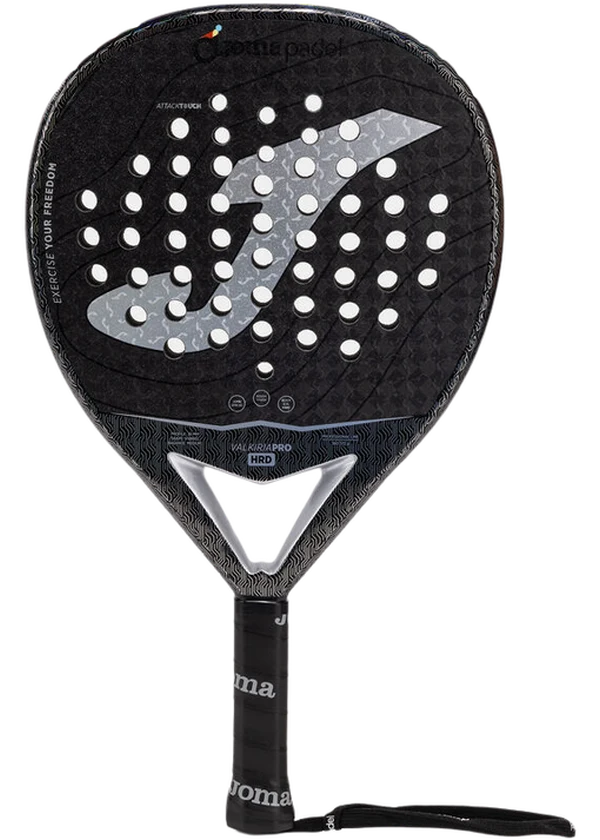
The Valkiria Pro HRD is built around a high-density Black EVA HRD foam core — the firmer variant in Joma’s Valkiria range, where the SFT version offers a softer feel. The frame is constructed via Joma’s DualTech Frame using 12K carbon, and the surface carries the Joma 3D Spin rough texture for extra grip on ball contact. Three proprietary systems are at work: AEROBUMP TECH (aerodynamic grooves in the frame profile), ATTACK TOUCH (a perforated pattern that redistributes weight and flex across the face), and JOMA 3D SPIN (the surface treatment that elevates topspin and slice potential). Declared weight sits at 365g, though manufacturer ranges vary across sources. This is a women’s model, positioned as the signature racket of Joma ambassador Carolina Navarro, designed for the technical, control-oriented player who dominates through precision and patience rather than pace. You can explore the full Joma lineup for context on where the Valkiria sits within the range.
Sweetspot Size of 8.0 is the headline — the highest parameter in the set. Profile breakdown: Defender 7.88 / Hybrid 7.66 / Attacker 7.1. That 0.78-point gap between Defender and Attacker tells you exactly who this racket is for — and who it will frustrate.
Performance Breakdown
How the Valkiria Pro HRD 2026 Plays
PLAYABILITY 7.8
The Forgiveness Architecture
Round shapes carry a natural sweetspot advantage, but the Valkiria Pro HRD earns its 8.0 through the combination of the DualTech Frame and ATTACK TOUCH system, which spreads the flex zone across a wider portion of the face. The result is a racket that does not punish off-centre contact the way a denser, diamond-shaped head would. Playability at 7.8 confirms what the sweetspot score suggests — this is a racket that returns consistent feedback rally after rally. For a women’s defender model, that reliability under match fatigue is the entire value proposition. The round shape category as a whole sits here in our database if you want to benchmark it against peers.
COMFORT 7.4
Placement Over Pace, Every Time
Control at 8.1 is the highest parameter after Sweetspot Size, and the two scores are directly connected: when the sweetspot is wide, the player can direct the ball with intention rather than compensating for a mis-hit. The high-density HRD core plays a dual role here — it provides the firmness needed for clean directional feedback while the DualTech Frame and Black EVA damping layer moderate vibration transfer to the arm. Comfort at 7.4 is solid rather than exceptional, which is appropriate: HRD cores will always sacrifice a degree of absorption for the control they return. The HRD/SFT split in the Valkiria range exists for exactly this reason — players who prioritise feel over precision can step down to the softer version.
STABILITY 7.4
Light Enough to Recover, Planted Enough to Redirect
Maneuverability at 7.6 is higher than you might expect for a women’s defender racket — this is where AEROBUMP TECH earns its keep, shaping the frame profile to reduce drag on quick defensive exchanges. Stability at 7.4 sits slightly lower, which reflects the trade-off inherent in round shapes at this weight: the low balance point aids recovery speed but gives up some resistance to hard-struck balls at the frame edge. For a defender, though, this balance is intentional. The racket is built to move fast and reset cleanly, not to absorb the most aggressive attacking shots without any deflection.
POWER 6.2
The Honest Bottom Line on Pace
Spin at 7.2 is functional — the 3D Spin surface texture adds grip on topspin and slice, which matters for defensive lobs and cross-court passing shots. The gap to look at, however, is Power at 6.2. This is the lowest parameter in the profile and the direct explanation for the Attacker score of 7.1. The HRD core is dense enough to control the ball, but at this balance point, it simply does not generate the launch speed that attacking play demands. That is not a flaw in design — it is the design. The Valkiria Pro HRD 2026 is explicitly built around precision over pace, and the Power score makes that promise concrete rather than just a marketing claim.
Technology
DualTech Frame + ATTACK TOUCH: Three Systems, One Role
Joma deploys three proprietary technologies on the Valkiria Pro HRD 2026 — DualTech Frame, ATTACK TOUCH, and AEROBUMP TECH — and they are not competing for attention. Each one addresses a specific performance variable, and together they create a system that is more coherent than the sum of its parts.
DualTech Frame combines 12K high-modulus carbon in a construction that layers tubular, flat, and EVA-filled sections across the frame. The variation in frame geometry controls how flex is distributed across the face — concentrating rigidity where stability is needed at the edges, and allowing more flex at the centre of the hitting zone. This is the primary driver of both the Control score of 8.1 and the Sweetspot Size of 8.0. You get a large, reliable contact zone that still returns clean directional feedback.
ATTACK TOUCH works through a specific hole pattern in the face that redistributes weight and flex, effectively shifting the bending point of the surface to support precise control at contact rather than maximum spring. It is a refinement on top of DualTech, and the two together explain why the Valkiria Pro HRD plays more precisely than its Sweetspot score alone would suggest — the wide sweetspot does not come at the cost of directional clarity. AEROBUMP TECH — aerodynamic grooves along the frame profile — reduces drag on quick arm movements, directly supporting the Maneuverability score of 7.6. For a women’s defender working under time pressure in a defensive exchange, faster arm speed without changing grip or intent is a genuine on-court advantage.
What none of these technologies change is the fundamental balance point of the racket. The low balance and dense HRD core are physics, not marketing — and they are why Power sits at 6.2 regardless of how sophisticated the frame engineering is. These three systems are built for one player type: technically skilled, patient, and comfortable directing the match from behind the baseline.
Player Fit
Who Should Buy the Joma Valkiria Pro HRD 2026?
The Technical Women’s Player Who Wins Through Structure
If you are a woman at intermediate-to-advanced level who builds points deliberately — moving the ball, waiting for the right moment, exploiting angles rather than pace — this racket is designed specifically around your game. The Control score of 8.1 and Sweetspot Size of 8.0 mean your well-placed shots arrive where you intended them, even when you are moving under pressure. The Maneuverability of 7.6 means you are not stuck after a defensive scramble. This is the model Carolina Navarro plays — a professional who embodies exactly this style of technical, precision-first padel. If that description sounds like your game plan, the Valkiria Pro HRD 2026 will feel like it already knows your intentions.
Anyone Who Wants to Finish Points at the Net
The Attacker score of 7.1 is not close — it is 0.78 points below the Defender score, and Power at 6.2 is the reason. If you play aggressively, attack the net frequently, or want the racket to generate pace on smashes and volleys, this is the wrong tool regardless of how technically polished your game is. The dense HRD core and low balance point are in direct opposition to what attacking play demands. Women looking for round-shape forgiveness with more offensive punch should look at options with a higher balance point and softer core. The Joma Valkiria Pro HRD 2026 does not compromise on its identity — and neither should you.
FAQ
Frequently Asked Questions
What is the PadelVerdict score for the Joma Valkiria Pro HRD 2026?
The overall PadelVerdict score is 7.9, with a Consensus Modifier of 0. Specs are consistent across multiple sources (Data Quality: neutral), declared figures contain no implausible outliers (Field Validation: neutral), but no independent physical measurements exist to validate them (Market Correction: neutral). Profile breakdown: Defender 7.88 / Hybrid 7.66 / Attacker 7.1. That 0.78-point gap between Defender and Attacker is the decision — this racket has a clear primary identity and does not pretend otherwise.
Is the Joma Valkiria Pro HRD 2026 good for intermediate players?
Yes, with one condition: you need to already be playing with tactical intention rather than relying on pace to win points. The Sweetspot Size of 8.0 and Playability of 7.8 are genuinely forgiving at this level, but the Power score of 6.2 means intermediate players who are still developing their positioning will find it limiting. If your game is already built around precision and placement, this is a strong intermediate choice. If pace is still your primary tool, it will feel restrictive.
Is the Joma Valkiria Pro HRD 2026 good for defenders?
Yes, directly. The Defender profile score of 7.88 is the highest of the three, and the supporting parameters confirm it: Control 8.1, Sweetspot Size 8.0, Maneuverability 7.6. You can retrieve, redirect, and reset with confidence. If you identify as a defender and want to see how it stacks up against the full category, browse all defender rackets in our database.
What is the actual weight of the Joma Valkiria Pro HRD 2026?
Declared weight is 365g, but manufacturer ranges vary notably, with figures across multiple markets ranging from 350g to 370g. No independent on-camera measurements exist to resolve this. A 15–20g variance is perceptible on court — particularly relevant for a women’s racket where arm feel and swing speed matter. Until independent measurements appear, treat the declared 365g as a midpoint estimate rather than a confirmed figure.
How does the Joma Valkiria Pro HRD 2026 compare to the Valkiria Pro SFT?
Same shape, same frame architecture, different core. The HRD is for players who want clean directional control and can tolerate a firmer feel — control and precision are the priority. The Valkiria Pro SFT is for players who want more arm-friendly response and a softer touch on the ball, accepting slightly less directional sharpness in return. The choice is really between precision-first and comfort-first within the same defensive profile. If wrist or elbow sensitivity is a factor, the SFT is the safer starting point.
Why does the Joma Valkiria Pro HRD 2026 have a Consensus Modifier of 0?
Because consistent data without independent validation does not earn a positive modifier — it earns neutral. Specs for this racket appear coherently across multiple commercial sources and markets, which confirms the baseline but does not go beyond it. No specialist-level field validation exists across multiple markets, and no independent physical measurements have been published to confirm the declared figures. Consistent data without independent confirmation earns 0. Confirmed physical measurements or convergent specialist validation would be required to move the modifier above neutral.
Similar Rackets
Independent testing, funded by readers
No brand deals, no sponsored picks. If you found this useful, you can support the next round of tests with a small tip.

