
Radical Motion 2026
The Control Frame That Doesn’t Ask You to Slow Down
The short verdict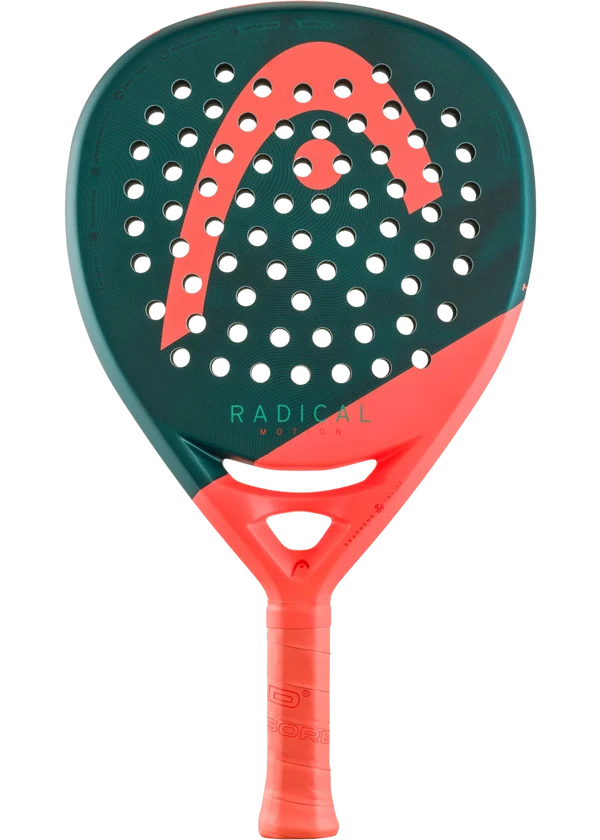


8 Parameters
Radical Motion 2026
On this page
Review
Head Radical Motion 2026 Review: The Control Frame That Doesn’t Ask You to Slow Down
Most drop-shaped rackets make you choose: you get control or you get pace, but rarely both without compromise. The lighter, lower-balance builds that enable quick hands at the net tend to bleed power from the back court; the stiffer, heavier alternatives buy stability at the cost of the very agility that makes the front position work. The Head Radical Motion 2026 stakes a specific position in that argument — it is a drop-shaped defender’s tool engineered to move fast enough that the distinction almost stops mattering. The question this review answers is whether that engineering holds up across the full range of what a tactical, all-court player actually demands.
The Radical Motion 2026 pairs a Control Foam core — lighter and stiffer than the previous generation — with a Double Carbon 3K surface in a 38 mm drop-shaped frame. Balance sits at 261 mm, declared weight at 355 g. Frame technology draws on two proprietary systems: Graphene Inside, distributed through the shaft and into the head for structural rigidity and energy transfer, and Auxetic 2.0, which allows the carbon structure to flex and return on impact for cleaner feedback. Soft Butt Cap+ adds a vibration-dampening handle finish with an exchangeable cord system. Head positions this as the agility-focused counterpart to the heavier Head Radical Pro 2026, aimed at intermediate-to-advanced players who prioritize speed and placement over raw output.
Control leads at 8.6 — the highest single parameter on the sheet. Profile breakdown: Defender 8.31 / Hybrid 8.08 / Attacker 7.53. The 0.78-point gap between Defender and Attacker is the whole story: this racket has a clear identity, and it belongs at the net and in the back court, not finishing overhead rallies with brute force.
Performance Breakdown
How the Radical Motion 2026 Plays
PLAYABILITY 8.2
The Ceiling Is Placement, Not Power
The Radical Motion 2026’s defining characteristic is directional precision — the kind that makes volleys and defensive redirects feel deliberate rather than reactive. The Control Foam core’s stiffer, lighter composition produces a dry, direct impact feel that telegraphs ball placement without muddying the signal with excess dwell. A Control score of 8.6 is the highest on this sheet, and Playability at 8.2 reflects how accessible that precision is across skill levels: you don’t need elite timing to benefit from it. The combination pushes this racket firmly toward all defender rackets territory, where feel and consistency matter more than output.
SWEETSPOT SIZE 8.1
Speed Is the Product of Design, Not Luck
A Maneuverability score of 8.4 on a drop-shaped frame is genuinely unusual — most teardrop designs trade some swing speed for the extra power their higher balance generates. Here, the 261 mm balance point and 355 g declared weight do the work that lighter round frames usually achieve by different means. The result is a racket that prepares quickly at the net and recovers fast enough in defensive exchanges to keep rally rhythm. Sweetspot Size at 8.1 means off-center contact is forgiving rather than punishing — an expanded drilling pattern in the face amplifies tolerances across the hitting surface, so the margin for error stays wide even under pressure.
STABILITY 7.5
Adequate Armor, Not Full Protection
Comfort at 7.8 is solid for a carbon-surface racket of this stiffness — the Soft Butt Cap+ handle system absorbs vibration meaningfully at the grip, and the Auxetic 2.0 structure in the frame distributes impact energy rather than concentrating it. The impact feel is described consistently as dry and firm, which suits players who want direct feedback rather than cushioned softness. Stability at 7.5 is the racket’s relative weak point: it holds up well on centered contact and at the net, but pace-loaded balls from the back court can expose some torsional flex. This is the score that connects most directly to the Attacker profile gap — when the contact point shifts from controlled to contested, the frame doesn’t have the mass to resist twist the way heavier alternatives do.
SPIN 7.3
Enough Output to Attack, Not Enough to Finish
Power at 7.2 and Spin at 7.3 are the honest limits of this racket’s offensive capability. The Double Carbon 3K surface produces reliable spin and usable power on overheads and accelerated smashes, but players who make their living finishing points from aggressive positions will notice the ceiling. These scores are not a flaw for the intended profile — a tactical defender or hybrid player rarely needs more power than 7.2 delivers. The surprise here is that the scores aren’t lower: the Auxetic 2.0 system recovers energy on impact efficiently enough that ball rebound feels livelier than the balance point alone would suggest.
Technology
Auxetic 2.0 and Graphene Inside: Two Systems, One Clear Goal
Auxetic 2.0 is placed strategically in the frame’s bridge and central bar. The mechanism is structural: carbon fibres in this zone are engineered to expand on impact rather than resist it, then contract as the ball leaves the surface. The effect is a more complete energy return cycle compared to conventional unidirectional carbon layups. In practice, this connects directly to the Power score of 7.2 — which reads higher than the balance point and weight would traditionally justify — and to the Comfort score of 7.8, since distributed energy return reduces the sharp shock load that fatigues the arm over a long session.
Graphene Inside runs from the shaft into the head, reinforcing the frame structurally where torsional forces are highest. This is the technology doing the most work behind the Stability score of 7.5 — it prevents that score from dropping further on off-axis contact, though it cannot fully compensate for the lower overall mass relative to the Radical Pro. The combination of both systems is what separates the Motion from a generic lightweight control frame: it is not simply a lighter version of a heavier design, but a distinct structural philosophy. Among drop-shaped rackets at this weight, this level of energy management is uncommon.
Soft Butt Cap+ addresses comfort at the grip end with a soft handle cap and exchangeable cord system that absorbs vibration before it travels up the arm. It is a meaningful addition for players who use the racket in extended defensive rallies where handle feedback accumulates. The expanded drilling pattern in the face — the engineering behind the Sweetspot Size score of 8.1 — completes the picture: the Motion’s technology stack is coherent and internally consistent, each component solving a specific problem rather than simply adding to a spec list. The player who benefits most is the one who wants a fast, precise, forgiving frame and can live with the power and stability ceilings that come with it.
Player Fit
Who Should Buy the Radical Motion 2026?
The Tactical Intermediate Who Wins With Placement
If you’re the type who builds points methodically — probing with precise volleys, redirecting pace rather than generating it, making your opponents move rather than trying to finish with force — this frame was built around your game. Control at 8.6, Maneuverability at 8.4, and a Sweetspot Size of 8.1 mean your reads translate directly into shot outcomes without demanding perfect technique on every contact. The speed of preparation at the net is real: you’ll get the racket where it needs to be. At intermediate-to-advanced level, this is a racket that rewards players who already know where the ball is going before it arrives — and gives them the precision tools to execute it consistently.
The Power Attacker Who Needs the Frame to Finish
If your game depends on generating pace from aggressive positions and finishing overhead exchanges with authority, the Attacker score of 7.53 is the number that disqualifies this racket. Power at 7.2 and Stability at 7.5 are the structural evidence: the frame lacks both the mass and the torsional rigidity to convert high-speed contact into consistent output under pressure. Heavier players who swing hard will feel the torsional limit before long. The Radical Pro 2026 is the honest answer for that profile — more stability, more power, a frame that holds its shape when the ball arrives fast.
FAQ
Frequently Asked Questions
What is the PadelVerdict score for the Head Radical Motion 2026?
The PadelVerdict score is 8.5, with a Consensus Modifier of +0.1 applied. Specs are consistent across multiple markets, and specialist sources converge tightly on balance, weight, and core characteristics with no contradictions found — that cross-market alignment is what earns the positive adjustment. No independent physical measurements exist to push it further. Profile breakdown: Defender 8.31 / Hybrid 8.08 / Attacker 7.53. The 0.78-point gap between Defender and Attacker means this is a specialist frame, not a versatile all-rounder — choose accordingly.
Is the Head Radical Motion 2026 good for intermediate players?
Yes, with one condition: you need to play a control-oriented game. Playability at 8.2 and Sweetspot Size at 8.1 make this accessible rather than demanding — errors on off-center contact are forgiven more than on stiff diamond frames. The limiting factor is Power at 7.2: intermediate players who rely on the frame to generate pace rather than producing it themselves will find the output ceiling frustrating. If that’s you, a heavier hybrid frame will serve better.
Is the Head Radical Motion 2026 good for defenders?
Yes — definitively. Defender is the top profile score at 8.31, and the underlying parameters explain why: Control 8.6 for directional precision, Maneuverability 8.4 for fast recovery and preparation, Sweetspot 8.1 for tolerance under defensive pressure. This racket is purpose-built for the player who wins rallies rather than ends them. Browse all defender rackets if you want to compare alternatives at this profile level.
What is the actual weight of the Head Radical Motion 2026?
The declared weight is 355 g with a ±10 g manufacturer tolerance. No independent on-camera measurements exist to confirm or contradict that figure. At 355 g it sits at the lighter end of the teardrop category, and that lightness is load-bearing for the Maneuverability score — a 10 g variance toward the high end would be perceptible on quick-reflex exchanges at the net.
How does the Head Radical Motion 2026 compare to the Head Radical Pro 2026?
These are two different player profiles wearing the same badge. The Motion is for the tactical player who values quickness and placement — lighter, lower balance, higher Maneuverability. The Radical Pro adds 15–20 g, which buys more Stability and Power for players who want to finish rallies rather than extend them. If you regularly attack from the back court or hit pace-loaded smashes, the Pro is the right call. If you live at the net and win with redirects, the Motion is the better tool.
Why does the Head Radical Motion 2026 have a Consensus Modifier of +0.1?
The +0.1 adjustment reflects the consistency and depth of the available data. Declared specs are stable across multiple markets, and specialist sources across languages and regions converge on the same technical picture — balance, weight, core behaviour, maneuverability — with no material contradictions. That cross-market coherence is what moves the modifier from neutral to positive. What keeps it at +0.1 rather than higher is the absence of independent physical measurements: an on-court weight and balance verification would be the data needed to support any further adjustment.
Similar Rackets
Independent testing, funded by readers
No brand deals, no sponsored picks. If you found this useful, you can support the next round of tests with a small tip.

