
Aurora 2026
Does the All-Court Promise Hold Up?
The short verdict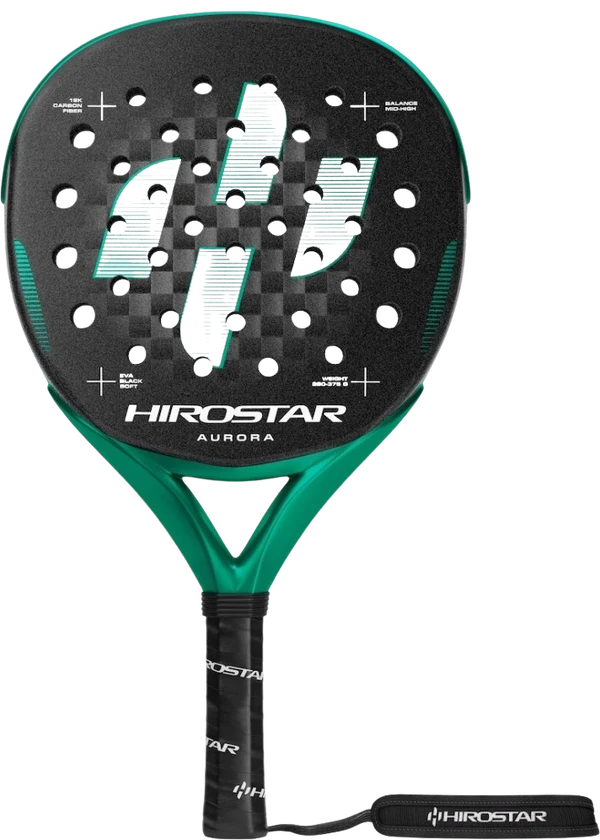
8 Parameters
Aurora 2026
On this page
Review
Hirostar Aurora 2026 Review — Does the All-Court Promise Hold Up?
The hardest sell in padel equipment is the all-court racket. It promises everything and, by definition, specialises in nothing — which means the buyer has to trust that the balance point genuinely works, rather than being a marketing default. The Hirostar Aurora 2026 enters exactly that conversation: a drop-shaped hybrid built for intermediate players who want competence across the whole court without committing to an attacker or defender identity.
The Aurora 2026 sits in Hirostar’s Precision collection — fourth iteration — and is built around an EVA Black Mid foam core at 38mm profile thickness, finished with a 12K carbon surface in a sandblasted matte texture. The frame is full carbon. A confirmed independent measurement placed weight at 361g with a balance point of 259mm, which puts it in medium-high balance territory. The aerodynamic mould design is Hirostar’s stated frame innovation, aimed at reducing air resistance through the swing arc.
Maneuverability leads at 7.8 — the highest single parameter. The gap between the Hybrid and Defender profiles is just 0.01, meaning this racket refuses to commit to a single role. That near-identical split is the whole story for the buyer.
Performance Breakdown
How the Hirostar Aurora 2026 Plays
PLAYABILITY 7.5
The Racket Moves Before You Do
At 259mm balance and 361g, the Aurora 2026 carries its weight low enough to generate genuine swing speed for an intermediate-level frame. Maneuverability at 7.8 is the single highest score in this profile, and it’s what makes a drop-shaped racket like this viable across positions rather than locked into one. Playability at 7.5 reinforces that: the racket responds intuitively rather than demanding precise timing on every contact. For a player still developing consistency, that combination is more useful than raw power.
SWEETSPOT SIZE 7.4
EVA Mid Does the Work You’d Expect
EVA Black Mid foam occupies the middle ground of padel core materials — firmer than soft EVA, softer than hard rubber — and the Aurora 2026 uses it well. Control at 7.6 reflects a core that gives a clear read on the ball without the deadness of harder compounds. The 12K carbon surface adds precision on directional shots without becoming punishing on off-centre contacts. Sweetspot Size at 7.4 is solid rather than exceptional, which is consistent with a drop shape at this balance point — the face geometry trades some forgiveness for feel. The surface texture reads as dry in sensation, which aligns with the control score over outright comfort.
STABILITY 7.0
The Floor This Racket Sets
Comfort and Stability are the profile’s weakest cards, and together they define the ceiling for aggressive players. At stiffness 55 — moderate for a carbon frame — the Aurora 2026 is not harsh, but it lacks the vibration absorption that softer EVA or thicker profiles provide. Comfort at 7.2 means extended sessions won’t be punishing, but players with arm sensitivity should factor this in. Stability at 7.0 is the lowest individual score: at 259mm balance with 361g, the frame generates adequate mass in contact situations but won’t dominate contested mid-court exchanges. This is where the attacker profile’s gap to the other two shows its logic — the racket’s weakest parameter directly caps its offensive ceiling.
SPIN 6.8
Adequate, Not Outstanding — Honestly
Power at 7.1 surprises given the medium-high balance and carbon construction — the EVA Mid core absorbs a meaningful portion of what the swing generates. That’s a deliberate trade: the foam prioritises feel and control over rebound energy. Spin at 6.8 is the lowest score in the set, which is notable for a sandblasted matte surface that would typically read higher. The 12K carbon weave’s tighter structure appears to limit the surface bite that coarser textures provide. Neither score is a flaw that warrants avoiding this racket — but they are clear signals that the Aurora 2026 is built to place the ball, not to attack with it.
Technology
Aerodynamic Mould Design: Engineering Efficiency or Marketing Language?
Hirostar’s aerodynamic mould system on the Aurora 2026 targets one specific problem: air resistance during the swing. The frame geometry is shaped to reduce drag through the contact arc, which in theory translates to faster swing speed with the same physical effort. On a racket where Maneuverability already scores 7.8 — the highest individual parameter — the mould design appears to be doing genuine functional work rather than serving as a spec-sheet differentiator. The 38mm profile thickness keeps the frame narrow enough to complement the aerodynamic claim.
The EVA Black Mid core operates in parallel: by sitting in the medium-firmness range, it allows the faster swing speed the mould enables to translate into feel rather than pure power. If the core were harder, the aerodynamic gain would push the ball harder but reduce controllability. The result is a Power score of 7.1 — the core deliberately moderates what the frame could otherwise produce, in favour of the Control score of 7.6. That’s a coherent design decision, not a compromise made by accident.
The integrated head protector is a functional addition for intermediate players who are more likely to clip walls and court surfaces during developing-stage rallies. It doesn’t affect performance parameters directly, but it extends frame longevity in the use cases this racket is designed for. The player who benefits most from these combined technology choices is one who wants swing efficiency and placement accuracy above all — not maximum exit velocity. Browse the full Hirostar lineup to see where the Aurora 2026 sits relative to the Blackstone and Redstone series.
Player Fit
Who Should Buy the Hirostar Aurora 2026?
The Intermediate All-Court Builder
If you’re the type who plays equally from the back and the net, switches positions within a rally, and still has more to gain from improving placement than from adding raw power — this racket was built for you. Maneuverability at 7.8 gives you the swing speed to cover the whole court without fatigue; Control at 7.6 and Playability at 7.5 mean you get readable, consistent feedback on every ball you put in play. The Hybrid and Defender scores landing at 7.52 and 7.53 — virtually identical — confirm that the Aurora 2026 genuinely doesn’t push you toward a single role. If you’ve been playing 6–18 months and still feel uncertain which style fits your game, the Aurora 2026 is the rare racket that lets you figure that out without penalising you for the process.
The Committed Attacker Looking for a Weapon
The Attacker score of 7.18 is a full 0.34 points below the other two profiles — and Stability at 7.0 tells you exactly why. If you play predominantly at the net, depend on smash power, or need a frame that holds its line through hard contact exchanges, the Aurora 2026 won’t satisfy you. The moderate power ceiling and low spin score compound the problem: aggressive players need a racket that amplifies their intent, not one that moderates it. The aerodynamic mould helps swing speed, but the EVA Mid core takes the edge off the exit. For an attacker-focused intermediate, the Hirostar Blackstone 2026 offers a higher balance point and harder core more suited to that role.
FAQ
Frequently Asked Questions
What is the PadelVerdict score for the Hirostar Aurora 2026?
The overall PadelVerdict score is 7.5, with a Consensus Modifier of 0. Specs are consistent across multiple sources (Data Quality: neutral), a single independent measurement confirmed 361g and 259mm balance (Field Validation: neutral — one source is not sufficient for a positive adjustment), and no additional physical verification exists (Market Correction: neutral). Profile breakdown: Attacker 7.18 / Hybrid 7.52 / Defender 7.53. The near-zero gap between Hybrid and Defender means this racket doesn’t favour a specialist — that’s a deliberate design outcome, not a limitation.
Is the Hirostar Aurora 2026 good for intermediate players?
Yes — this is specifically where the Aurora 2026 earns its score. Playability at 7.5 and Maneuverability at 7.8 are the two parameters that matter most for players still developing timing and court positioning. The racket is not technically demanding to use, which means intermediate players can focus on shot selection rather than fighting the frame. If you’re at advanced level and need more offensive punch, look at higher-balance options with harder cores.
Is the Hirostar Aurora 2026 good for hybrid players?
Yes. The Hybrid profile score of 7.52 is effectively tied with the Defender score — the Aurora 2026 is one of the more genuinely versatile frames in the intermediate bracket. Control at 7.6, Maneuverability at 7.8, and Playability at 7.5 all reinforce an all-court playing style without requiring the player to commit to a position. If you identify as a hybrid player, browse the full hybrid racket category to see how the Aurora 2026 stacks up against alternatives at this level.
What is the actual weight of the Hirostar Aurora 2026?
Hirostar declares a weight range of 360–375g. An independent measurement confirmed 361g on a single unit, which sits at the low end of the declared range. At 361g, the weight falls within normal variance for a frame of this construction — perceptible on court in terms of swing weight and stability, but not a meaningful discrepancy from what the manufacturer states. No multi-unit data exists to assess unit-to-unit consistency.
How does the Hirostar Aurora 2026 compare to the Hirostar Blackstone?
These are two different conversations. The Aurora 2026 is built for the intermediate all-court player who values feel, swing ease, and positioning flexibility. The Hirostar Blackstone 2026 sits higher in Hirostar’s range and targets more advanced, attack-oriented players who need greater stability and power output. If you’re choosing between them, the question isn’t which is better — it’s whether you’ve outgrown the all-court brief or whether you still need the Aurora’s forgiving, versatile profile to develop your game.
Why does the Hirostar Aurora 2026 have a Consensus Modifier of 0?
Consistent data without independent validation earns neutral, not positive. One measurement confirming 361g and 259mm balance is a signal — it removes uncertainty about the declared specs — but a single data point from a single source doesn’t constitute the multi-source, multi-market convergence that would move the modifier above zero. No community sentiment, no additional physical measurements, and no specialist-level cross-market agreement exist for this model. What would change the modifier: a second independent measurement, or alignment across specialist sources in multiple markets with no contradictions found.
Similar Rackets
Independent testing, funded by readers
No brand deals, no sponsored picks. If you found this useful, you can support the next round of tests with a small tip.

