
Coello Team 2026
The Diamond That Doesn’t Punish You
The short verdict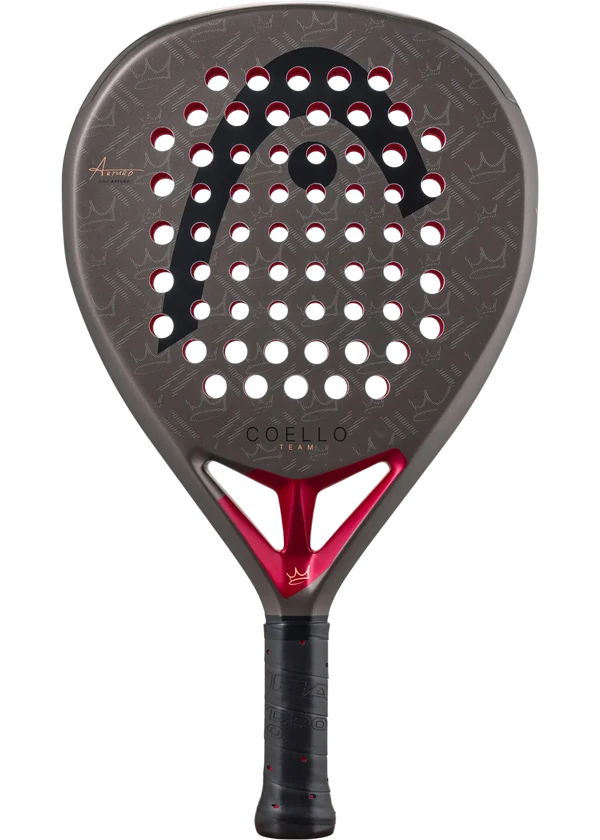


8 Parameters
Coello Team 2026
On this page
Review
Head Coello Team 2026 Review: The Diamond That Doesn’t Punish You
Diamond-shaped rackets have a reputation: rewarding at their best, brutal at their worst. The trade-off is usually binary — you accept the unforgiving nature of an attacking tool, or you reach for something more forgiving and sacrifice power. The Head Coello Team 2026 is built around the proposition that this is a false choice. It keeps the shape, raises the comfort floor, and asks whether an intermediate attacker really needs to suffer for their power.
At its core is Red Power Foam, surrounded by a fiberglass striking surface and a carbon frame reinforced with Graphene Inside. The beam runs 38mm, balance sits at 270mm, and the declared weight ranges from 360g to 375g across markets — Head lists ±10g tolerance, and no independent measurements exist to narrow that window further. The proprietary technology stack includes Auxetic 2.0, which uses fibers that widen under compression rather than narrowing, and is integrated into the carbon yoke and central bridge. This is a Head racket designed explicitly for the intermediate player who wants to attack without the physical cost typically associated with stiff, high-balance diamonds.
Comfort leads at 8.1 — the highest parameter in this profile. Attacker: 7.63 · Hybrid: 7.60 · Defender: 7.53. The gap between profiles is narrow (0.10 between top two), which matters: this racket is more versatile than its diamond shape implies, but the attacker story is the one to tell.
Performance Breakdown
How the Head Coello Team 2026 Plays
STABILITY 7.9
Trampoline Effect, Not Raw Force
The Red Power Foam generates ball exit speed through rebound energy rather than the rigid, high-momentum transfer of a stiff diamond. Independent specialist data on ball output aligns with this — reactive rather than explosive. Power lands at 7.8, which is honest: this is not a weapon-tier attacker, but it delivers sufficient pace at the net without demanding a full swing commitment. Stability at 7.9 is the more impressive figure — the graphene-reinforced carbon frame holds its plane through contact, and off-center strikes don’t bleed energy the way softer all-fiberglass constructions can.
SWEETSPOT SIZE 7.6
The Number That Changes the Story
Comfort at 8.1 is the highest single parameter in the profile — and on a diamond racket at this balance point, that is genuinely unusual. The fiberglass surface absorbs vibration that a full-carbon face would transmit, and the Auxetic 2.0 construction widens the effective response zone rather than concentrating it. Sweetspot size at 7.6 reflects this: the frame punishes pure mis-hits as any high-balance diamond will, but the tolerance window is broader than the shape suggests. Independent specialist data on contact tolerance is consistent with this picture. For players with arm sensitivity, the comfort score is the one to watch — it is the primary reason to choose this racket over its stiffer siblings in the Coello line.
SPIN 6.8
Where the Diamond Extracts Its Toll
Control at 7.4 and spin at 6.8 are the lowest scores in the profile, and they are connected. The fiberglass surface provides a softer feel but less textural grip than rougher carbon faces — the Extreme Spin technology is present, but the surface limits how much bite it can deliver. Spin at 6.8 is the weakest parameter, and it pulls the Defender score down relative to Attacker. For defending deep, generating heavy topspin, or controlling ball direction from mid-court exchanges, this racket asks more than it gives. Control at 7.4 is acceptable rather than outstanding — functional under normal conditions, but not a precision instrument for tight angle placement. That gap between Comfort (8.1) and Control (7.4) is the defining tension in this racket’s character.
PLAYABILITY 7.7
Heavier Than It Feels, Faster Than It Should Be
Maneuverability at 7.2 is the second-lowest score, which is expected given a declared weight range topping at 375g and a high balance point. Independent inertia data for this model sits at the lower end of the 2026 Coello range, which helps explain why playability lands at 7.7 despite moderate maneuverability: the frame moves more freely than heavier-hitting diamond rackets in its category. Fast exchanges at the net are manageable, though quick-reaction volleys against hard drives will reveal the balance point before comfort can compensate. Playability at 7.7 confirms that this is a usable, well-rounded instrument — not a specialist tool, but not a compromise either.
Technology
Auxetic 2.0: Does Widening Under Compression Actually Work?
Auxetic 2.0 is the structural centerpiece of the Head Coello Team 2026. Where conventional fibers compress and narrow at the point of impact, auxetic fibers expand laterally — getting wider precisely where the force is concentrated. The system is integrated into the carbon yoke and the central bridge of the handle, meaning the responsiveness benefit applies across the full contact area rather than being isolated to the throat or tip.
The on-court translation is measurable, not theoretical. Sweetspot size at 7.6 and comfort at 8.1 are both higher than the frame shape and balance point would typically produce. The lateral expansion behavior widens the effective hitting zone without requiring the foam density reduction that usually compromises stability — which is why Stability holds at 7.9 while Comfort remains the profile leader. The system earns its score separation.
The Red Power Foam works alongside Auxetic 2.0 rather than against it. Dense enough to generate rebound energy (Power: 7.8), but calibrated softer than the foam in the Coello Pro, it absorbs transmission shock before it reaches the wrist. The Extreme Spin surface texture is present in name, but the fiberglass construction places a ceiling on grip bite — which is exactly why Spin at 6.8 is the outlier in an otherwise tightly grouped profile. Auxetic 2.0 benefits the attacker and the hybrid player most; it cannot compensate for what the surface itself does not provide in spin generation. Players whose game depends on heavy rotation off the hitting face should look elsewhere.
Player Fit
Who Should Buy the Head Coello Team 2026?
The Intermediate Attacker Who Pays Physically for Power
If you’ve been drawn to attacking diamonds but walked away with a sore arm, this is where that conversation ends. The Comfort score of 8.1 on a high-balance diamond is not a marketing description — it reflects a genuine construction choice that reduces vibration transmission. You play net-forward, you initiate attacks, and you trust Stability at 7.9 to hold off-center volleys without rewarding you with elbow feedback. Control at 7.4 is enough for the patterns you actually play at intermediate level; you’re not threading the needle from the back glass, you’re closing points at the net. If you’ve been using a round or drop racket because diamonds hurt, the Head Coello Team 2026 is the first diamond that won’t ask you to make that trade.
Spin-Dependent Players and Back-Court Controllers
Spin at 6.8 is the lowest score in the profile and the clearest evidence of this racket’s limit. If heavy topspin off the wall, aggressive bandeja rotation, or slice control from deep are central to your game, the fiberglass surface cannot give you the bite you need — and no amount of Auxetic 2.0 changes what the face itself generates. The Defender score of 7.53 trails Attacker by 0.10, and that gap is almost entirely explained by this single parameter. Advanced players who already own a high-performance diamond and are looking to move up will also find the power ceiling disappointing — the Coello Pro exists for that conversation. This is not a racket for the back-court controller, the spin artist, or the advanced player ready to escalate.
FAQ
Frequently Asked Questions
What is the PadelVerdict score for the Head Coello Team 2026?
The PadelVerdict score is 7.9, with a Consensus Modifier of +0.05. Specs are consistent across multiple sources, and independent specialist data broadly aligns with manufacturer claims on comfort and ball output without simply echoing them — that partial validation is what earns the +0.05 rather than zero. No independent physical measurements exist to confirm declared weight or balance. Profile breakdown: Attacker 7.63 · Hybrid 7.60 · Defender 7.53. The 0.31 gap between Attacker and Defender tells you this is a positional choice, not an all-court neutral.
Is the Head Coello Team 2026 good for intermediate players?
Yes — it is specifically built for this level. Playability at 7.7 and Comfort at 8.1 mean the racket supports developing technique without demanding perfection on every contact. The parameter to watch is Spin at 6.8: if your game is still developing rotation mechanics and heavy topspin is important to your progression, a drop-shaped racket with a rougher face will serve you better at the same level.
Is the Head Coello Team 2026 good for attacking players?
Yes. The Attacker score of 7.63 leads the profile, supported by Power at 7.8, Stability at 7.9, and a Comfort floor that keeps attacking play sustainable across a full match. It is not the most powerful diamond available, but for the intermediate attacker who needs reliability over raw punch, the numbers confirm what the design promises. Browse all attacker rackets to compare alternatives at this level.
What is the actual weight of the Head Coello Team 2026?
The declared weight spans 360g to 375g across market sources, with Head’s own ±10g tolerance applied on top of that variance. The midpoint used for scoring is 365g. No independent measurements exist to narrow this window. A 15g swing across the declared range is perceptible on court — particularly relevant for players sensitive to maneuverability, where Maneuverability already sits at 7.2. Weigh your unit if precision matters to your game.
How does the Head Coello Team 2026 compare to the Coello Motion 2026?
Same shape, same balance, overlapping weight ranges — but a fundamentally different feel on contact. The Coello Motion is stiffer and targets players who want the control-power balance that a tighter face delivers. The Team trades some of that crispness for Comfort at 8.1 and a wider effective hitting zone. Choose the Motion if feedback and precision are the priority; choose the Team if you play long matches, have arm sensitivity, or are still building consistent contact mechanics.
Why does the Head Coello Team 2026 have a Consensus Modifier of +0.05?
The +0.05 adjustment reflects a data picture that is partially but not fully validated. Declared specs are stable across multiple markets, and independent specialist data on comfort and ball output broadly aligns with manufacturer claims without simply echoing them — that cross-source coherence is what moves the modifier above zero. What keeps it at +0.05 rather than higher is the absence of independent physical measurements for weight and balance: confirmed on-court figures would be the data needed to support a fuller positive adjustment.
Similar Rackets
Independent testing, funded by readers
No brand deals, no sponsored picks. If you found this useful, you can support the next round of tests with a small tip.

