
AT10 Genius 18K 2026
The Shape-Maker’s Weapon
The short verdict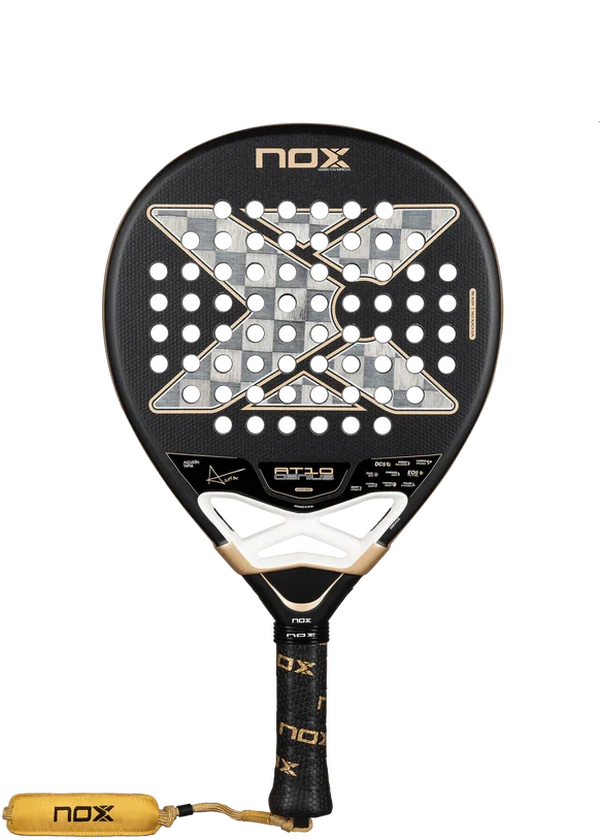


8 Parameters
AT10 Genius 18K 2026
On this page
Review
Nox AT10 Genius 18K Alum 2026 Review — The Shape-Maker’s Weapon
The debate between maximum power and all-court competence is one padel never fully resolves — but some rackets make the trade-off feel less like a sacrifice and more like a strategy. The racket that commits to neither extreme is the one worth examining most carefully, because it asks you to bring the intent: the stick will amplify whatever you put into it.
The Nox AT10 Genius 18K Alum 2026 is Agustín Tapia’s signature drop-shaped hybrid, built around a MLD Black EVA multilayer core with variable densities and a 100% carbon frame at 62 RA stiffness. The surface is 18K aluminized carbon with full-face Dual Spin 3D relief and silica sand finish — a double-texture system designed to grip the ball on contact. Proprietary tech includes the Weight Balance adjustable counterweight system (2g and 4g interchangeable pieces to tune balance and feel), the EOS Tunnel for aerodynamics, DCS frame reinforcement, and the Pulse System for vibration absorption. The declared weight range sits at 360–375g. Explore the full Nox lineup if you want to see how this model positions against its siblings.
Stability leads at 8.6 — the highest single score in the profile. Attacker 8.06 · Hybrid 8.12 · Defender 8.02. The spread is just 0.10 across all three profiles, making this one of the tightest profile gaps in its category. That’s not ambiguity — it’s a genuine all-court tool.
Performance Breakdown
How the Nox AT10 Genius 18K Alum 2026 Plays
POWER 7.8
Stability Is Doing the Heavy Lifting
Stability at 8.6 is the score that defines this racket’s personality before you look at anything else — the DCS reinforcement and refined 2026 mould keep contact clean even on off-center strikes. Power lands at 7.8, which might feel conservative for a Tapia signature, but that’s the point: the 18K aluminized carbon delivers excellent ball-exit speed in decisive shots without sacrificing structure. This is not a finisher’s bat; it rewards players who generate power through technique rather than brute acceleration. The drop shape adds leverage on high balls, which is where that stability score earns its place.
CONTROL 8.4
The Surface Is Not Window Dressing
Spin at 8.2 and Control at 8.4 arrive together for a reason — the full-face Dual Spin 3D relief combined with the silica sand finish creates genuine dwell time on contact, which translates directly into both topspin generation and directional precision. The spin improvement over the previous generation is a meaningful step, not a marginal uptick, and the scores reflect that directly. Control at 8.4 reflects a racket that rewards placement over pace: the multilayer EVA core with variable densities helps maintain feel even in transition, where point-shaping decisions are made under pressure.
SWEETSPOT 7.8
PLAYABILITY 7.8
Comfortable Enough to Last Five Sets
Comfort at 7.9 is where the 18K aluminized carbon earns its price premium over standard carbon — the surface dampens the harshness that stiffer 12K variants introduce, and the Pulse System handles residual vibration efficiently. The sweetspot at 7.8 reflects the refined 2026 mould, which produces a cleaner, more consistent contact window than the previous generation. Playability at 7.8 rounds out a cluster of scores that sit closely together — which tells you this racket is genuinely usable in every court zone, not just from the baseline. No durability issues have been reported across multiple markets.
The One Number That Tells You Who Shouldn’t Buy This
Maneuverability at 7.6 is the lowest score in the set — and it’s the quiet disqualifier for reactive net players who depend on fast-twitch wrist speed. The declared weight range of 360–375g is substantial, and while the Weight Balance system lets you tune the feel, you cannot make 370g feel like 355g. The EOS Tunnel improves aerodynamics meaningfully, but the drop-shaped geometry inherently prioritizes leverage over quickness. If your game is built on volley reflexes at the net, this score connects directly to the Defender profile sitting at 8.02 — the lowest of the three, and an honest indicator of where the design deprioritizes.
Technology
Weight Balance System: Gimmick or Genuine Advantage?
The Weight Balance system places 2g and 4g counterweight pieces inside the frame, letting you shift the balance point to suit your style — heavier toward the tip for more head weight on smashes, or neutralized for a more even swing. This is a real mechanical adjustment, not a marketing footnote. For a racket where Maneuverability sits at 7.6, the ability to pull weight toward neutral is meaningful: it partially compensates for the physical reality of a 360–375g frame, and it directly supports the Control and Stability scores by allowing each player to find their optimal swing arc.
The Dual Spin surface deserves scrutiny beyond the marketing copy. The combination of full-face 3D relief texture and silica sand finish creates two overlapping grip mechanisms on the ball — the raised geometry catches at angle, while the abrasive sand finish extends dwell time. The result is a Spin score of 8.2 and a Control score of 8.4 that are causally connected: spin and directional precision are not competing here, they reinforce each other.
The Pulse System and DCS reinforcement work at opposite ends of the contact event: Pulse absorbs vibration during impact (supporting the Comfort score of 7.9), while DCS maintains frame integrity under torque (the structural foundation behind the Stability score of 8.6). Neither technology is new to the AT10 line, but the 2026 mould refinement means both systems operate within a geometry that is more consistent than its predecessor. Players who shape points through varied spin and precise placement — rather than flat-power specialists — are the ones who extract the most from this technology stack.
Player Fit
Who Should Buy the Nox AT10 Genius 18K Alum 2026?
The Advanced Player Who Wants to Outthink, Not Outmuscle
If you’re the type who wins rallies by building angles and forcing errors rather than hitting winners from the back line, this is your racket. Stability at 8.6 means your structure holds under pressure; Control at 8.4 and Spin at 8.2 reward players who have the technique to use them. The Hybrid profile leading at 8.12 tells the story: you need to be effective in both attack and defense, and the profile gap of just 0.10 across all three profiles means you won’t be punished for switching roles mid-match. The Weight Balance system lets you tune the feel as your game evolves. If that sounds like the player you already are, this racket will feel like it was built for you. Want the wider context? See how it compares in our best padel rackets of 2026 against every top model on the market.
Hard Hitters and Pure Net Specialists
If your game is built on lethal smashes and finishing shots, Power at 7.8 will frustrate you — this racket delivers less maximum power on finishing shots than its 12K sibling by design. The Defender profile at 8.02 is the lowest of the three, and Maneuverability at 7.6 is the metric that explains it: reactive volley players who live on fast hands at the net will find this frame heavier than their instincts prefer. The AT10 Genius Attack 18K Alum 2026 with its diamond shape and head-heavy balance is the harder alternative if you genuinely want the extra firepower — no published review yet exists for that model on this site, but the comparison is straightforward: Attack for finishers, Genius for point-shapers.
FAQ
Frequently Asked Questions
What is the PadelVerdict score for the Nox AT10 Genius 18K Alum 2026?
The overall PadelVerdict score is 8.3, which includes a +0.1 Consensus Modifier. Commercial data and on-court descriptions across multiple markets broadly confirm the manufacturer’s specs — enough consistency to earn a small positive adjustment, though the absence of independent lab measurements caps it there. Profile breakdown: Hybrid 8.12, Attacker 8.06, Defender 8.02. The 0.10 spread across all three profiles is itself the headline: this is genuinely versatile, not just marketed that way.
Is the Nox AT10 Genius 18K Alum 2026 good for intermediate players?
Conditionally yes — but only for intermediates actively developing point-shaping skills. Playability at 7.8 and Sweetspot at 7.8 suggest reasonable forgiveness, but Control at 8.4 requires technique to fully unlock. If you’re still building your baseline consistency, the demands of this frame will outpace your current game. Look at something with a larger sweetspot and higher playability rating first, then come back to this one.
Is the Nox AT10 Genius 18K Alum 2026 good for hybrid players?
Yes — this is exactly the racket for hybrid players. The Hybrid profile leads at 8.12, backed by Stability 8.6 for structural consistency across court zones, Control 8.4 for precision in transition, and Spin 8.2 to generate variety on both offense and defense. The tight profile spread confirms it: you won’t feel underequipped at the net or at the baseline. It’s built for the player who does both.
What is the actual weight of the Nox AT10 Genius 18K Alum 2026?
The declared range across sources is 360–375g, with no independent measurements available to narrow that further. A 15g variance is perceptible on court — the difference between the light and heavy end of the range would noticeably affect swing feel and maneuverability. If you’re sensitive to weight, the Weight Balance system gives you some adjustment range, but you cannot verify which end of the spectrum your unit sits on without a scale.
How does the Nox AT10 Genius 18K Alum 2026 compare to the AT10 Genius 12K Alum Xtrem 2026?
The choice comes down to what you want to maximize. The 12K Xtrem is stiffer, delivers more raw power on finishing shots, and suits players who want an aggressive, attack-first tool. The 18K Genius trades that ceiling for a smoother feel, better vibration absorption, and more consistent comfort across a long match. If you close points at the net with smashes, the 12K. If you build points with spin and placement, the 18K. Read the full AT10 Genius 12K Alum Xtrem 2026 review to compare scores directly.
Why does the Nox AT10 Genius 18K Alum 2026 have a Consensus Modifier of +0.1?
On-court descriptions and commercial data across multiple markets broadly validate the manufacturer’s specifications — enough to support a small positive adjustment. However, no independent laboratory measurements exist for this model. Without verified balance point data or RA stiffness values from blind testing, a larger positive modifier isn’t warranted. Independent measurements would be required to support any further upward adjustment.
What is the best padel racket for hybrid players in 2026?
The Nox AT10 Genius 18K Alum 2026 is one of the strongest candidates in the hybrid category this year, with a Hybrid profile score of 8.12 and a profile spread tight enough to suit genuine all-court play. For the full picture, browse the hybrid racket category to compare it against other contenders scored on the same system.
Similar Rackets
Independent testing, funded by readers
No brand deals, no sponsored picks. If you found this useful, you can support the next round of tests with a small tip.

