
Prime Attack 2026
Power With a Price Tag
The short verdict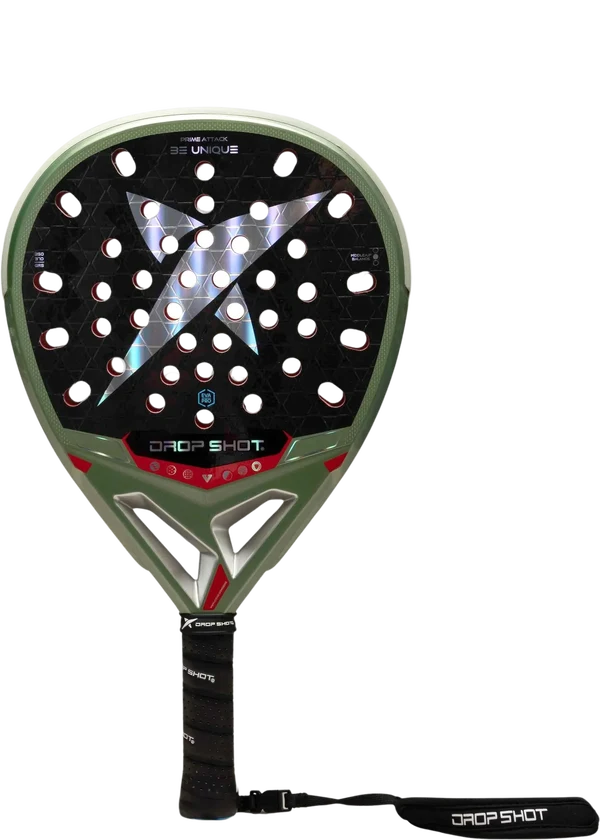

8 Parameters
Prime Attack 2026
On this page
Review
Drop Shot Prime Attack 2026 Review — Power With a Price Tag
The central dilemma for offensive padel players hasn’t changed: the harder and heavier a diamond racket hits, the more it punishes your body and your margin for error. The Drop Shot Prime Attack 2026 tries to resolve that tension — diamond shape, high-density EVA core, and a 68 RA stiffness rating — by leaning into power and stability without completely abandoning the control that keeps offensive play sustainable over a full match. Whether it succeeds depends on which side of that trade-off matters more to you.
The Prime Attack 2026 sits at the top of the Drop Shot lineup as a power-first proposition. Its diamond shape pushes the sweetspot high on the frame, while the EVA Pro High Density core absorbs impact energy before converting it into exit velocity. The 24K carbon surface runs the 3D Face System — a homogeneous three-dimensional texture across the hitting face — designed to increase friction for spin generation without sacrificing precision. Frame stiffness is declared at 68 RA, reinforced structurally to balance rigidity and flex. Declared weight range is 360–375g, with no independent measurements available to narrow that window further.
Stability at 8.0 is the quietest strength here. Attacker 7.92 / Hybrid 7.55 / Defender 7.22 — a 0.70-point gap from top to bottom that makes this unambiguously a role racket. The Comfort score of 6.8 is the number that earns attention: on a stiff 68 RA frame, it’s the limiting factor for extended play.
Performance Breakdown
How the Drop Shot Prime Attack 2026 Plays
STABILITY 8.0
The Offensive Engine Is Real
Diamond geometry concentrates mass above the hand — and on the Prime Attack, that translates into a Power score of 8.1 that feels earned rather than inflated. What makes the combination credible is the Stability score sitting at 8.0: structural reinforcements in the frame prevent the torsional flex that typically bleeds power from off-center contacts. The result is a racket that hits close to its ceiling on most strikes, not just perfectly centred ones. For attacking players who live at the net or look to finish points with smashes, this pairing is the core argument for buying it.
CONTROL 7.6
The 3D Face System Earns Its Keep
On a high-density EVA core with 68 RA stiffness, Spin at 7.4 and Control at 7.6 are notably respectable scores — most rackets with this level of rigidity sacrifice both in favour of raw exit velocity. The 3D Face System’s homogeneous surface texture creates enough friction to generate meaningful rotation on serve and topspin drives, while the structured core dampens errant vibration enough to keep directional precision manageable. Neither score is elite, but in context they represent a genuine mitigation of the usual stiff-diamond penalty. Control holds up well enough through volleys and bandeja shots that this doesn’t feel like a one-trick power weapon.
SWEETSPOT SIZE 7.0
PLAYABILITY 7.0
Where the Diamond Shape Demands Its Dues
Maneuverability at 7.2 is the honest reckoning with head-heavy geometry: this racket does not snap through the air. The declared weight sits inside a 360–375g range, and toward the upper end of that window, quick exchanges at the net will expose the head-heavy balance. Sweetspot Size and Playability both land at 7.0 — functional but unforgiving enough that intermediate players who don’t yet have consistent technique will feel the margin narrow. The diamond shape makes the sweetspot sit high, meaning slightly mistimed volleys drop off more sharply than on a round or drop frame. These three scores together explain the 0.37-point gap between the Attacker and Hybrid profiles.
Stiffness Has a Long-Session Cost
Comfort at 6.8 is the lowest score on this racket, and on a 68 RA stiffness frame it’s not surprising — but it requires an honest conversation. The EVA Pro High Density core absorbs some vibration on clean strikes, but on off-centre hits at higher head weight, the shock transmission to the arm is perceptible. This isn’t a racket for players managing elbow or shoulder issues, and over a two-hour session it asks more of the forearm than softer-cored alternatives at this weight class. It doesn’t cross the 6.0 threshold that would trigger our automatic floor penalty, but it sits close enough that arm sensitivity is a legitimate disqualifier, not a minor caveat.
Technology
3D Face System: Does Texturing a Stiff Frame Actually Add Spin?
The 3D Face System covers the 24K carbon hitting surface in a homogeneous three-dimensional texture — not a pattern of raised dots or grooves, but a continuous micro-roughness across the entire face. The function is straightforward: increase face-ball contact time and surface friction at the moment of impact to generate more rotation without requiring the player to consciously brush the ball harder. On a racket this stiff, that matters. Standard high-density EVA with carbon at 68 RA would typically shed spin potential because the ball dwell time is shorter — the face ejects the ball quickly rather than cradling it. The 3D texture partially compensates by maximising friction during that brief contact window.
The evidence for this working is in the Spin score of 7.4 — not elite, but meaningfully above what the core and stiffness profile would predict in isolation. Control at 7.6 follows the same logic: the textured face creates consistent friction across the hitting surface, reducing the variance between shots that catch different parts of the face. Neither score is exceptional, but both outperform what the raw specs would suggest, which is the practical argument for the technology being functional rather than cosmetic.
Who benefits most from this? Players with established offensive technique who generate their own swing speed — the system amplifies rotation that already exists in the stroke. For players whose swing mechanics are still developing, the stiffness will override the texture’s benefits on mistimed contacts, and the Sweetspot Size score of 7.0 will start to feel punishing before the spin advantage becomes consistent.
Player Fit
Who Should Buy the Drop Shot Prime Attack 2026?
The Established Attacker Who Plays to Finish
If you’re the type who lives at the net, looks to end points with smashes and sharp volleys, and already has the technique to centre the ball consistently — this racket was built around your game. Power at 8.1 and Stability at 8.0 mean it delivers on its offensive promise with the reliability needed for match play, not just practice rallies. You play at intermediate-to-advanced level, your arm is not an issue, and you prefer a racket that rewards aggression rather than cushions it. The 6.8 Comfort score will feel like a fair trade for the exit velocity you get on every clean strike.
Players Still Building Consistency — Or Managing Their Arm
If your technique isn’t yet reliable enough to centre the ball consistently, a Sweetspot Size of 7.0 and Maneuverability of 7.2 will punish you on every rally that pushes you out of position. The Defender score of 7.22 — the lowest of the three profiles — tells the story directly: this frame has no interest in helping you reset from a defensive position, and the head-heavy balance will feel heavy on quick reactive shots. And if you have any history with elbow or shoulder discomfort, 68 RA stiffness with a Comfort score of 6.8 is not a calculated risk — it’s a likely problem. A drop-shaped hybrid with a softer core would serve you significantly better.
FAQ
Frequently Asked Questions
What is the PadelVerdict score for the Drop Shot Prime Attack 2026?
The PadelVerdict score is 7.9, with a Consensus Modifier of 0. Specs are consistent across multiple sources (Data Quality: neutral), declared figures show no implausible outliers (Field Validation: neutral), but no independent measurements exist to confirm them (Market Correction: neutral). Consistent data without independent validation earns neutral, not positive. Profile breakdown: Attacker 7.92 / Hybrid 7.55 / Defender 7.22. That 0.70-point top-to-bottom gap confirms this is a specialist role racket — buy it knowing exactly what role you’re filling.
Is the Drop Shot Prime Attack 2026 good for intermediate players?
Conditionally yes — but only for intermediate players who already attack consistently and have solid net technique. The Sweetspot Size of 7.0 and Maneuverability of 7.2 are unforgiving enough that players still developing their court movement or volley timing will struggle. If you’re at the lower end of intermediate and still working on consistency, a drop-shaped racket with a softer core will accelerate your development far more effectively.
Is the Drop Shot Prime Attack 2026 good for attacking players?
Yes. The Attacker profile score of 7.92 is the highest of the three, and Power 8.1 plus Stability 8.0 back it up directly. If your game is built on net dominance and smash finishing, this racket delivers. Browse the best attacker rackets to see how the Prime Attack 2026 stacks up against the full field.
What is the actual weight of the Drop Shot Prime Attack 2026?
The manufacturer declares a range of 360–375g, with no independent measurements available to narrow it further. That 15g window is wider than typical and matters on court: a unit at 375g combined with a high diamond balance point will feel noticeably heavier through the swing than a 360g example. Until independent measurements confirm where production units actually land, treat the mid-range — around 368g — as the working assumption, not a guarantee.
How does the Drop Shot Prime Attack 2026 compare to the Canyon Pro Attack 20 2026?
Both sit in the Drop Shot 2026 power-offensive tier, but the choice comes down to where you want the emphasis. The Prime Attack is the higher-positioned model with the stronger spec sheet, designed for players who want a racket that demands technique and rewards aggression. The Canyon Pro Attack 20 sits lower in the lineup and typically at a lower price point, making it more accessible for players who want offensive characteristics without the full commitment the Prime Attack requires. No published PadelVerdict review exists for the Canyon Pro Attack 20 2026 at this time.
Why does the Drop Shot Prime Attack 2026 have a Consensus Modifier of 0?
Because the data does its job and stops there. The specs hold together across sources — shape, core, surface technology, and weight range tell a consistent story without contradiction. That consistency earns a clean baseline. What it doesn’t earn is a positive signal, because consistency alone isn’t confirmation: when no independent physical measurements exist to verify what the manufacturer declares, there’s no external reference point to reward. The modifier moves when something independently validates or challenges the declared figures. Until that happens, neutral is the accurate position — not a criticism of the racket, just an honest account of what the evidence can and cannot support.
Similar Rackets
Independent testing, funded by readers
No brand deals, no sponsored picks. If you found this useful, you can support the next round of tests with a small tip.

