
Drop Shot Furia Attack 2.0 2026
Does This Drop Shape Deliver on Both Ends?
The short verdict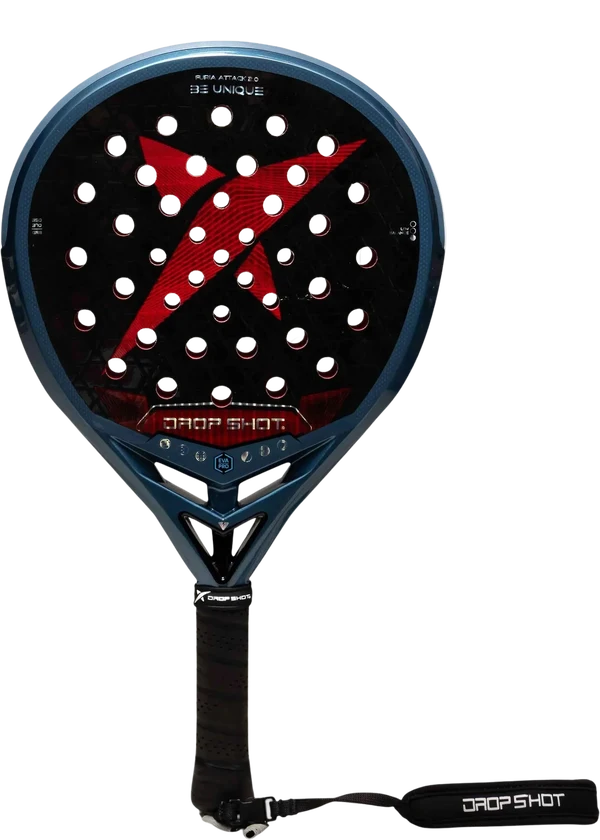

8 Parameters
Drop Shot Furia Attack 2.0 2026
On this page
Review
Drop Shot Furia Attack 2.0 2026 Review — Does This Drop Shape Deliver on Both Ends?
The perennial tension in drop-shaped rackets is this: you came for the power of a diamond, you stayed for the control of a round — and most rackets in this shape split the difference without excelling at either. The Drop Shot Furia Attack 2.0 2026 positions itself as the exception to that rule, landing in hybrid territory with scores that refuse to pick a lane. Whether that makes it versatile or merely average depends entirely on what you actually need from a racket.
The Furia Attack 2.0 is built around an EVA Pro High Density foam core, a 12K carbon surface with a 3D roughness Face System designed to enhance spin generation, and a 38mm profile frame with proprietary Vibra Tech vibration dampening and Angles Technology for structural response. Declared weight sits at 367g, though manufacturer ranges across markets span 350–375g — a spread wide enough to warrant attention. Balance point is listed at 260mm, placing it in mid-to-low territory for a drop shape at this weight. It targets intermediate-to-advanced players seeking controlled offensive output rather than raw power. Explore the full Drop Shot lineup for broader context.
Control leads at 7.9 — the highest individual score in the set. Attacker: 7.54 · Hybrid: 7.68 · Defender: 7.67. The 0.14-point gap between Hybrid and Defender is the story: this racket plays more complete than its “Attack” label suggests, with no single profile holding a commanding lead.
Performance Breakdown
How the Drop Shot Furia Attack 2.0 2026 Plays
PLAYABILITY 7.6
The Ceiling Is Built Around Precision
Drop-shaped rackets at this price point often sacrifice directional clarity for extra pop, but the Furia Attack 2.0 inverts that trade. Control at 7.9 is the highest score in the entire parameter set — a genuine top-of-card result that anchors the hybrid profile. The EVA Pro High Density core plays a direct role here: denser foam compresses less unpredictably, which translates to more consistent ball placement on both volleys and ground strokes. Playability at 7.6 confirms the racket responds well across a range of technical demands, not just in optimal conditions. This is a racket you can trust to be honest with your technique.
SPIN 7.2
Where the Balance Point Makes Its Choice
Power at 7.4 and Spin at 7.2 are the two lowest individual scores in the set, and the explanation sits in the geometry. A 260mm balance point on a drop shape pulls weight toward the handle, aiding control and maneuverability but moderating raw offensive exit velocity. That is a deliberate design position, not a shortfall — this racket was built to direct the ball, not to amplify it. The 3D roughness Face System generates useful topspin on lifts and bandejas without reaching the ball-grabbing levels of more aggressively textured surfaces. For players whose primary requirement is pace and heavy rotation, these scores are honest about the trade the frame has made.
STABILITY 7.5
Fast Enough to Transition, Solid Enough to Hold
Maneuverability at 7.6 and Stability at 7.5 is a pairing that defines the hybrid sweet spot: the racket moves quickly in defense-to-attack transitions without losing structural integrity on heavier contacts. The 38mm frame profile contributes to that stability score — thicker frames resist torque better under off-center hits. For players who operate from the middle of the court and need to switch between blocking volleys and aggressive overheads within the same point, this balance point is genuinely useful. Neither score is exceptional, but the consistency between them means you rarely have to choose one quality at the expense of the other.
SWEETSPOT SIZE 7.4
Forgiveness Lives in the Core, Not the Shape
Comfort at 7.5 is the direct output of the EVA Pro High Density core combined with the Vibra Tech system — impact energy is absorbed rather than transmitted into the arm, which matters across longer sessions and for players with any elbow sensitivity. Sweetspot Size at 7.4 is where the drop shape exerts its expected cost: the geometric distribution of a drop-shaped racket concentrates the hitting zone rather than spreading it, so precision is rewarded and off-center hits carry a penalty. That penalty is softened by the comfort score, but it isn’t eliminated — intermediate players moving up from more forgiving shapes will feel it.
Technology
Vibra Tech + 3D Face System: Engineering for the All-Court Game — Or Just Marketing?
The Furia Attack 2.0 carries three proprietary systems. Vibra Tech is the vibration dampening layer built into the frame structure — its purpose is to intercept and dissipate impact oscillation before it reaches the handle. The practical result shows in the Comfort score of 7.5: this isn’t a racket that punishes you for a hard block volley, and across a two-hour session the arm fatigue profile is lower than most carbon-dominant frames at this stiffness rating suggest. That score doesn’t appear by accident.
The 3D Roughness Face System — the textured 12K carbon surface — is positioned as the primary spin engine. It contributes to the Spin score of 7.2, which is functional but not exceptional. The texture creates meaningful ball-to-surface friction on topspin lifts and defensive lobs, but it stops short of the aggressive bite that higher-density surface treatments provide. Think of it as reliable rather than punishing: the spin is there when you shape the shot correctly, but the surface won’t compensate for poor swing mechanics.
Angles Technology addresses structural response — essentially how the frame distributes stress during off-center contacts. Its signal appears most clearly in the Stability score of 7.5: the racket doesn’t twist on heavy lateral shots the way thinner or less engineered frames do. Combined with the 38mm frame profile, this technology makes the Furia Attack 2.0 more suitable for players who generate their own power rather than relying on frame flex and rebound to do it for them.
Player Fit
Who Should Buy the Drop Shot Furia Attack 2.0 2026?
The Technical All-Court Intermediate Ready to Stop Choosing Between Power and Precision
If you’re the type who plays from mid-court, switches between defense and attack in the same point, and has grown frustrated with rackets that force you to pick one or the other — this is built around your game. The 0.14-point gap between Hybrid (7.68) and Defender (7.67) profiles tells you the racket doesn’t specialize; it adapts. Control at 7.9 validates your directional instincts on bandejas and volleys, while Maneuverability at 7.6 means you won’t be late on quick exchanges at the net. Comfort at 7.5 keeps your arm honest through longer sessions. You’ve been waiting for a racket that trusts your technique — this one does.
Power-First Attackers Who Need Maximum Exit Velocity
The Attacker profile score of 7.54 is the lowest of the three — and the gap between it and Hybrid (7.68) tells you where this frame’s priorities sit. Power at 7.4 and Spin at 7.2 are the two lowest individual scores in the set. If you play from the back left, rely on heavy topspin to create upward pressure, or need a racket that amplifies offensive output rather than channels it, this frame will ask more of your swing than it gives back. The 260mm balance point isn’t positioned to deliver the head-heavy punch that dedicated attackers require. Players in that category will find a better match in the Axion Attack 2.0 2026, built specifically for that role.
FAQ
Frequently Asked Questions
What is the PadelVerdict score for the Drop Shot Furia Attack 2.0 2026?
The overall Verdict Score is 7.7, with a Consensus Modifier of 0, leaving the published score at 7.7. Specs are consistent across multiple sources (Data Quality: neutral), declared figures show no implausible outliers (Field Validation: neutral), but no independent measurements exist to confirm them (Market Correction: neutral). Profile breakdown: Attacker 7.54 · Hybrid 7.68 · Defender 7.67. The 0.01-point gap between Hybrid and Defender tells a straightforward story — this racket suits complete, all-court players more than it suits specialists.
Is the Drop Shot Furia Attack 2.0 2026 good for intermediate players?
Yes — with a condition. Playability at 7.6 and Control at 7.9 create a genuinely accessible platform for intermediates developing their technique. However, Sweetspot Size at 7.4 means players still making frequent off-center contact will feel the limitation. If you’re solidly intermediate and building toward an all-court game, it fits. If you’re earlier in that journey and still developing consistent ball-striking, a more forgiving frame with a larger sweetspot will serve you better at this stage.
Is the Drop Shot Furia Attack 2.0 2026 good for hybrid players?
Yes. The Hybrid profile score of 7.68 leads the three profiles, and that result is supported by the underlying data: Control 7.9 for precision, Maneuverability 7.6 for quick transitions, Stability 7.5 for holding shape under pressure. If you play all-court and rotate between defensive and offensive roles in a single point, this racket is designed exactly for that style. Browse the full hybrid racket category to compare options at this level.
What is the actual weight of the Drop Shot Furia Attack 2.0 2026?
The declared weight is 367g, but manufacturer ranges across markets span 350–375g — a 25g spread that is wide enough to be genuinely perceptible on court. No independent measurements exist to confirm where production units actually land within that window. If exact weight matters to your game, treat 367g as an approximation rather than a guarantee, and if possible weigh your specific unit before purchase.
How does the Drop Shot Furia Attack 2.0 2026 compare to the Axion Attack 2.0 2026?
Both sit in the Drop Shot 2026 Attack lineup and target similar player profiles, but the choice between them is a question of emphasis. The Furia Attack 2.0 prioritizes Control and all-court versatility — a stronger choice for technical hybrid players. The Axion Attack 2.0 2026 is positioned toward power-dominant offensive output within the same range. If you primarily play offensively and generate your own pace, the Axion leans closer to that demand. If you want precision and adaptability across roles, the Furia is the stronger fit.
Why does the Drop Shot Furia Attack 2.0 2026 have a Consensus Modifier of 0?
Because consistent data without independent validation earns neutral — not positive. Specs for this model appear uniformly across multiple markets, with no contradictions in shape, core, surface, or positioning. That consistency establishes a clean baseline. The modifier reflects what the evidence can confirm, and stops where the evidence stops. Neutral is the accurate read — not a provisional one.
Similar Rackets
Independent testing, funded by readers
No brand deals, no sponsored picks. If you found this useful, you can support the next round of tests with a small tip.

