
Cyber Attack 2026
Is This the Balanced Mid-Game Upgrade You’ve Been Waiting For?
The short verdict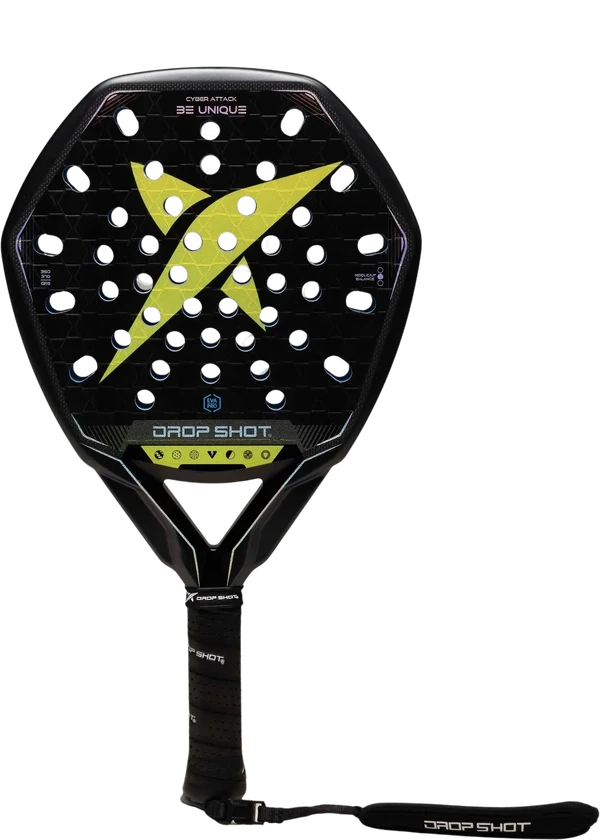

8 Parameters
Cyber Attack 2026
On this page
Review
Drop Shot Cyber Attack 2026 Review — Is This the Balanced Mid-Game Upgrade You’ve Been Waiting For?
The sharpest decision any intermediate player faces isn’t between power and control — it’s between a racket that genuinely balances both and one that merely claims to. Drop-shaped frames occupy that contested middle ground: too many promise versatility, deliver mediocrity, and end up parked in a bag corner after three months. The Drop Shot Cyber Attack 2026 is positioned squarely in that same territory, which makes scrutiny the only fair response.
The Cyber Attack 2026 is built around an EVA Pro High Density foam core — a material that sits on the firmer end of the comfort spectrum, prioritising response and rebound predictability. The drop-shaped frame sits at a medium-high balance point (260mm), splitting the difference between the low-balance control rackets and the high-balance power weapons in Drop Shot’s 2026 lineup. Surface treatment combines carbon with the 3D Face System, which textures the hitting face to enhance spin generation, and the Smart Holes System, which claims to expand the sweetspot through modified hole geometry. The 38mm profile is standard for this shape category. Declared weight range is 360–375g, with no independently measured figure available.
Control leads at 7.8 — the highest parameter in this set. Hybrid profile 7.55, Defender 7.53, Attacker 7.41. The gap between Hybrid and Attacker (0.14) is the defining signal: this racket covers more ground than its offensive positioning suggests, but it never fully commits to either end of the court.
Performance Breakdown
How the Drop Shot Cyber Attack 2026 Plays
SWEETSPOT 7.5
The Frame Does the Directing
Control at 7.8 is the highest individual score on the board, and for a racket marketed toward offensive play, that tells an interesting story. The drop shape and medium-high balance naturally moderate power transfer, redirecting energy toward placement precision — the result is a frame that rewards players who direct the ball rather than hit through it. The Smart Holes System adds meaningful sweetspot width (7.5), which keeps off-centre contacts from punishing you as severely as they would on a more demanding diamond. The EVA Pro High Density core contributes to consistent ball feel across the face without the harsh response associated with harder foams at this stiffness level.
STABILITY 7.2
Decent Pop, Not a Cannon
Power at 7.4 is functional rather than exceptional — the medium-high balance generates enough leverage for net attacks but won’t satisfy players whose game depends on outright pace. The counterpart to that is Stability at 7.2, which is the joint-lowest score alongside Maneuverability and Spin. At 38mm profile with a 260mm balance, the frame resists twisting reasonably well on centred contacts, but hard drives to the frame’s perimeter reveal its limitations in pure stability. The 0.6-point gap between Control and Stability is the widest in the parameter set — it is the most telling measure of where this racket succeeds and where it concedes ground.
SPIN 7.2
The 3D Face Isn’t Doing All the Heavy Lifting
The 3D Face System’s textured carbon surface is designed to bite the ball and generate additional rotation — and it does contribute, but Spin at 7.2 is the lowest parameter score on the card. The drop shape limits vertical mass distribution compared to a full teardrop optimised for topspin, meaning the technology helps but can only compensate so far for geometry. Maneuverability at 7.3 reflects a racket that moves quickly enough for baseline exchanges but doesn’t offer the wrist-quick responsiveness that pure defenders need under sustained pressure. Among drop-shaped rackets at this price level, these scores are consistent with the category average rather than distinctive within it.
PLAYABILITY 7.5
Firm but Liveable — If You’re Not Arm-Sensitive
Comfort at 7.0 is the score to watch if elbow health is on your radar. The high-density EVA core produces a firm, snappy response that suits intermediate-level attacking play — but firm cores accumulate vibration across long sessions, and players with existing arm sensitivity will feel that over time. Playability at 7.5 is the more encouraging number: accessibility from the first session is solid, and the racket doesn’t demand technical precision to produce usable results. For a player stepping up from a softer beginner frame, the transition is managed rather than jarring — but it isn’t the arm-friendly option in its price bracket.
Technology
3D Face System + Smart Holes System: Surface Engineering That Earns Its Place — Partially
The 3D Face System applies a textured roughness pattern directly to the carbon surface. The principle is straightforward: a rougher hitting face creates more friction at ball contact, generating additional rotational force without requiring the player to modify their swing technique. The effect is real but bounded — Spin at 7.2 is the weakest parameter in the set, which confirms that surface texture alone cannot fully override the geometric constraints of a drop shape. The technology contributes, it doesn’t transform.
The Smart Holes System modifies the hole pattern around the frame to redistribute the hitting zone, effectively expanding the area of the face where contacts remain predictable and powerful. That engineering decision connects directly to the Sweetspot Size score of 7.5 — the second-highest parameter on the card — and to the strong Control reading of 7.8. A wider consistent zone means more reliable direction on mid-pace exchanges, which is exactly where intermediate players win or lose points.
Taken together, both systems serve the same player: an intermediate who rallies intelligently rather than hitting hard, who benefits from forgiveness on off-centre contacts, and who wants textured spin without having to develop a technically demanding swing. Where the technology falls short is in raw Stability (7.2) and Maneuverability (7.3) — neither system addresses frame rigidity under off-axis stress or swing weight optimisation, which remain the Cyber Attack 2026’s practical ceiling.
Player Fit
Who Should Buy the Drop Shot Cyber Attack 2026?
The Intermediate All-Courter Who Builds Points
If you’re the type who plays at intermediate level, prefers to construct points through placement rather than brute force, and needs a frame that won’t punish the slightly off-centre volleys that define real match play — this is calibrated for you. Control at 7.8 and Sweetspot Size at 7.5 give you a reliable hitting window, while Playability at 7.5 means you’re not waiting weeks to feel comfortable. The Hybrid profile score (7.55) sits above both Defender and Attacker, meaning the Cyber Attack 2026 doesn’t demand that you pick a lane. You can play the net when the opportunity arrives and recover to the baseline without the racket working against you. If that description fits how you already play, this racket will feel like it was designed around your game.
Power Hitters and Arm-Sensitive Players
If your game revolves around pace and you need a racket that amplifies your hitting power, the Attacker score of 7.41 — the lowest of the three profiles — tells you clearly this isn’t the frame you want. The EVA Pro High Density core gives a firm, snappy response that suits directed play, not aggressive hitting. That same firmness makes Comfort the lowest absolute parameter at 7.0: players with existing elbow or shoulder sensitivity will accumulate that stiffness across long sessions. And if spin is what you’re chasing specifically, Spin at 7.2 is the weakest number on the card — the 3D Face System helps, but this is not a spin specialist’s weapon. Players who need maximum power output should look at the Axion Attack 2.0 2026, and those prioritising arm comfort should explore the softer hybrid options in the same price bracket.
FAQ
Frequently Asked Questions
What is the PadelVerdict score for the Drop Shot Cyber Attack 2026?
The overall Verdict Score is 7.4, with a Consensus Modifier of -0.1 applied. Specs are consistent across multiple sources, but no specialist field validation beyond manufacturer and retail channel descriptions exists across any market, and no independent physical measurements are available to confirm declared figures. That Field Validation deficit is what drives the -0.1. Profile breakdown: Hybrid 7.55, Defender 7.53, Attacker 7.41. The narrow 0.14 gap between Hybrid and Attacker means this isn’t a pure specialist — but the Attacker trailing last is a meaningful signal for power-first players.
Is the Drop Shot Cyber Attack 2026 good for intermediate players?
Yes, conditionally. Playability at 7.5 and Sweetspot Size at 7.5 make it genuinely accessible — you don’t need a technically polished game to get results from the first session. The caveat is Comfort at 7.0: if you’re playing multiple times a week or have any arm sensitivity, the high-density EVA core will accumulate. Intermediate players with healthy arms will find it rewarding; those managing elbow niggles should prioritise a softer core option first.
Is the Drop Shot Cyber Attack 2026 good for hybrid players?
Yes. The Hybrid profile leads at 7.55, which is the highest of the three scores — and for a racket positioned as offensive, that’s the most useful surprise in the data. Control at 7.8, Sweetspot Size at 7.5, and Playability at 7.5 all support the all-court player who moves between net and baseline depending on the rally. If you identify as a hybrid player, this scores in the right places. Browse the full hybrid racket category to compare alternatives at this price point.
What is the actual weight of the Drop Shot Cyber Attack 2026?
The manufacturer declares a range of 360–375g; no independent on-camera or lab measurement exists for this model. We use the midpoint of 368g as the working figure. The 15g declared spread is normal for production variation, but without a measured unit to reference, the true weight of your specific racket could sit anywhere within that range. At 368g midpoint, balance is medium-high at 260mm — unlikely to feel dramatically different from the declared spec, but worth noting if you’re sensitive to swing weight.
How does the Drop Shot Cyber Attack 2026 compare to the Canyon Pro Attack 2.0 2026?
Both are drop-shaped with offensive positioning in the same 2026 Drop Shot collection. The Canyon Pro Attack 2.0 sits higher in the lineup with a stronger power weighting and a higher balance point, designed for players who want more top-end pace from a drop frame. The Cyber Attack sits at medium-high balance with a stronger control bias and a wider consistent sweetspot. If you value net aggression and outright pace, the Canyon Pro angles toward you. If you want placement reliability and a more forgiving hitting window, the Cyber Attack is the more measured choice.
Why does the Drop Shot Cyber Attack 2026 have a Consensus Modifier of -0.1?
Because the data available for this racket has a single origin. Every source points back to the same starting point — what looks like multiple confirmations is the same information distributed across different storefronts. That is not the same as independent validation, and the modifier reflects that distinction. Where other rackets in this range earn neutral on the strength of their data picture, the Cyber Attack falls short of that threshold. The -0.1 is not a verdict on the racket’s quality. It is an honest account of what the evidence can and cannot support.
Similar Rackets
Independent testing, funded by readers
No brand deals, no sponsored picks. If you found this useful, you can support the next round of tests with a small tip.

