
Counter Veron 2026
Is This the Smartest Defensive Racket at Mid-Level?
The short verdict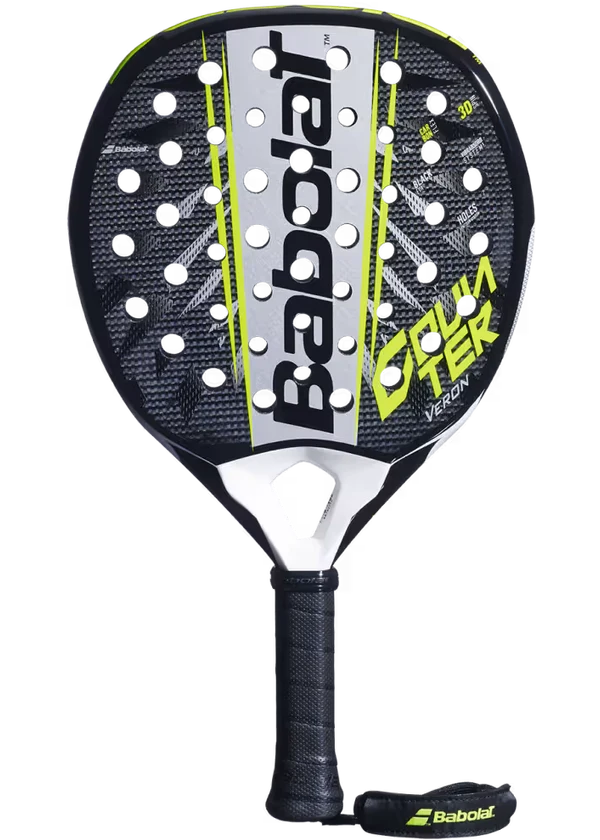


8 Parameters
Counter Veron 2026
On this page
Review
Babolat Counter Veron 2.6 2026 Review: Is This the Smartest Defensive Racket at Mid-Level?
The debate between comfort and control is never really settled in padel — you trade one to buy more of the other. What makes a round-shaped defender genuinely interesting is when it refuses that trade-off, offering both without a hidden cost buried in power or stability. That is exactly the tension the Babolat Counter Veron 2.6 2026 is built to resolve, and it largely succeeds — with one clear caveat for players who expect explosiveness at the net.
Under the hood: Black EVA elastic foam at medium-soft density, a Carbon Flex surface blending carbon and fibreglass weave, 3D Spin+ textured reliefs for ball grab, and a 38mm carbon frame. The proprietary stack also includes the Vibrabsorb System — elastomers embedded across the carbon structure to damp vibration — plus the Holes Pattern System, which places smaller holes centrally for precision and larger ones at the edges for added forgiveness. Declared weight is 365g at a 260mm balance point, placing this firmly in the round, low-balance defender category within the Babolat lineup.
Comfort leads at 8.5 — the highest single parameter on this racket. Attacker: 7.47 · Hybrid: 8.02 · Defender: 8.21. The 0.19-point gap between Hybrid and Defender is the key number: this racket tolerates versatility but clearly rewards a back-court mindset.
Performance Breakdown
How the Counter Veron 2.6 2026 Plays
SWEETSPOT 8.3
The Arm’s Best Friend in the 365g Class
The Vibrabsorb System is doing real work here — elastomers distributed through the carbon frame absorb the kind of repetitive micro-shock that accumulates over long matches. Comfort lands at 8.5, the highest score on this racket, and it earns it honestly: the medium-soft Black EVA cushions without going dead. Sweetspot Size at 8.3 is the other headline — the Holes Pattern System’s edge-heavy perforation pattern means off-center returns stay on court rather than sailing wide. For players spending long rallies in defense, this combination pays dividends in reduced fatigue and consistent baseline control.
PLAYABILITY 8.2
Precision That Doesn’t Demand Perfection
Control at 8.4 reflects a racket that prioritizes placement over pace — the smaller central holes focus feedback, giving the player a clear read on where the ball landed on the face. Playability at 8.2 confirms this isn’t a specialist tool requiring a technical game to unlock: intermediate players get a usable, consistent response without needing to generate perfect swings. The Carbon Flex surface blends fibreglass pliability with carbon directness, producing a touch that feels responsive on flat drives and measured on defensive lobs. What’s counterintuitive here is how well the round shape — associated with control-limiting softness in cheaper rackets — maintains feedback clarity even under pressure.
MANEUVERABILITY 7.8
Active Enough to Threaten, Not Built to Dominate
The 3D Spin+ surface reliefs provide genuine bite — Spin scores 7.6, which is solid for a defender and translates into effective bandeja and slice returns from deep. Maneuverability at 7.8 is respectable for a 365g frame, helped by the 260mm low balance keeping swing weight manageable. Neither score is a weakness, but neither suggests this racket is designed for fast-exchange net play. They’re transition scores — enough to construct the point from the back, not enough to close it decisively at the net.
STABILITY 7.5
The Ceiling That Defines the Buyer
Power at 7.1 is the lowest score on this racket, and it tells the whole story about who this frame is not for. The medium-soft EVA absorbs rather than rebounds — a design feature that pays for everything else on this list, but one that caps ball exit velocity noticeably versus stiffer attackers in the same weight class. Stability at 7.5 is adequate but not exceptional; against aggressive smashes, the round head distributes impact reasonably, yet the softer internals mean the response on heavy incoming shots lacks the locked-in authority of a denser core. These aren’t flaws in a defender context — they’re the logical cost of 8.5 comfort and 8.4 control. The buyer who already knows that is already the right buyer.
Technology
Carbon Flex + Vibrabsorb: Engineering Comfort Without Killing Feel
Carbon Flex is not a compromise material — it is a deliberate one. By weaving carbon and fibreglass together in the surface layer, Babolat introduces controlled flex at impact: the fibreglass component absorbs some shock and slows the rebound slightly, while the carbon preserves directional feedback. The result is the Control score of 8.4 without sacrificing the Comfort ceiling of 8.5 — both numbers sit higher than you’d expect from a single surface material choice, and that is exactly the point of the weave. Among round-shaped rackets, the ability to maintain feedback clarity at this comfort level is not standard.
The Vibrabsorb System positions elastomers at the graphite core junction and through the handle — not just at the throat, which is the standard placement. This distributed damping is what drives the 8.5 Comfort without relying entirely on the foam density. The Black EVA then handles the primary impact absorption, operating at medium-soft density to keep the touch alive while limiting harsh feedback. Together, these two systems are why the Power score (7.1) reflects a design choice rather than a construction failure: the energy is intentionally routed into damping and feel rather than ball exit.
The Holes Pattern System’s two-zone perforation — tighter centrally, more open at the edges — directly supports the Sweetspot Size score of 8.3. Off-center impacts hit the larger peripheral holes first, which flex more easily and partially compensate for the off-axis contact. The practical output: defensive lobs and counter-drives from the edges of the face stay on target at a rate that benefits intermediate players most, where consistency under pressure is the limiting factor. This is not a technology for power players — it is precision infrastructure for those who build points with placement rather than pace.
The 3D Spin+ surface reliefs add the final layer: textured micro-geometry on the face grabs the felt on slice returns and bandejas, producing the 7.6 Spin score from a round racket that might otherwise sacrifice spin generation for sweetspot width. It is the one parameter where the technology overcomes the shape’s natural limitation — and for a back-court player who leans on spin to push opponents wide, that matters.
Player Fit
Who Should Buy the Counter Veron 2.6 2026?
The Strategic Intermediate Who Builds From the Back
If you’re the type who wins points through placement and patience rather than overhead finishing, the Babolat Counter Veron 2.6 2026 is calibrated for exactly your game. A Comfort score of 8.5 means three-set sessions without arm accumulation, a Sweetspot Size of 8.3 keeps your defensive returns honest under pressure, and Control at 8.4 gives you the precision to redirect pace rather than generate it. You play the right side, you block overheads, you wait for the short ball — and this racket makes every part of that game more consistent. The Defender score of 8.21 isn’t just a profile label; it’s confirmation that the data agrees with your instinct. The same data puts it in our data-backed intermediate ranking for 2026 — worth a look before you decide.
Net Finishers and Power-First Attackers
If your game closes points at the net with smashes and volleys, Power at 7.1 is the number that ends the conversation. The soft EVA absorbs the energy you need for decisive overhead play, and Stability at 7.5 won’t give you the locked-in authority against heavy incoming that a denser core provides. The Attacker Score of 7.47 — the largest profile gap on this racket — is not a marginal difference. It reflects a genuine mismatch. Left-side players who want to attack should look at the attacker racket category for a better structural match.
FAQ
Frequently Asked Questions
What is the PadelVerdict score for the Babolat Counter Veron 2.6 2026?
The overall PadelVerdict score is 8.4, with a Consensus Modifier of +0.1 applied. Profile breakdown: Attacker 7.47 / Hybrid 8.02 / Defender 8.21. Specs are consistent across multiple sources with no conflicting figures, and specialist sources across multiple markets align on shape, core, and surface with zero contradictions identified — that cross-market consistency is what earns the positive adjustment. No independent physical measurements exist to push the modifier further. The 0.74-point gap between Attacker and Defender profiles is large enough to define the purchase decision clearly.
Is the Babolat Counter Veron 2.6 2026 good for intermediate players?
Yes, directly and without qualification. Playability at 8.2 is the key parameter — it means the racket produces consistent, usable output without demanding a technically polished swing. The 8.3 Sweetspot Size adds forgiveness for off-center contacts, which is where intermediate-level consistency typically breaks down. If you’re still developing your offensive game, the 7.1 Power score will eventually become a ceiling — but that’s a problem for when you’re ready to move up, not now.
Is the Babolat Counter Veron 2.6 2026 good for defenders and right-side players?
Yes. Defender score of 8.21 is the highest profile on this racket, and it’s backed by the right individual parameters: Control 8.4, Sweetspot 8.3, Comfort 8.5. For right-side players who block overheads and redirect pace, these three numbers are exactly what the position demands. The 7.8 Maneuverability keeps transitions manageable. If you’re building a case for a defensive frame, the defender racket category shows what else is in the conversation — but this one sits comfortably near the top of its class.
What is the actual weight of the Babolat Counter Veron 2.6 2026?
Declared weight is 365g with a ±10g manufacturer tolerance, placing individual units anywhere between 355g and 375g. No independent on-scale measurements have been published for this specific model. At the upper end of the tolerance range (375g), the difference would be perceptible during extended defensive play — particularly noticeable in shoulder fatigue over long matches. The 260mm balance point keeps the overall swing weight feeling lighter than the declared figure suggests.
How does the Babolat Counter Veron 2.6 2026 compare to the Counter Viper 2.6?
Think of it as a choice between two versions of the defensive game. The Counter Viper uses stiffer internals and a denser core — more ball exit, more stability under heavy shots, but a harsher feel that accumulates over time. The Counter Veron 2.6 trades that exit velocity and stability ceiling for significantly more comfort and forgiveness. Same weight, same balance class, different player: the Viper suits the physically confident defender who wants decisive counter-punch; the Veron suits the technical, consistent player who values longevity and placement over pace.
Why does the Babolat Counter Veron 2.6 2026 have a Consensus Modifier of +0.1?
The modifier reflects how well the available evidence holds together. Specs are declared consistently across multiple markets with no conflicting figures — but consistency alone is not enough to earn a positive adjustment. What moves the modifier above zero is the cross-market alignment of specialist sources on the core technical parameters: shape, core material, surface technology, and balance class all confirmed without contradictions across channels. What keeps it at +0.1 rather than higher is the absence of independent physical measurements — no on-scale weight or stiffness readings exist to verify the declared figures beyond manufacturer and retailer data. A confirmed independent measurement would support a positive adjustment to the modifier.
Similar Rackets
Independent testing, funded by readers
No brand deals, no sponsored picks. If you found this useful, you can support the next round of tests with a small tip.

