NOX Pro Cup Hard by Agustín Tapia 2027
A firm club all-rounder that makes direction the main event.
The short verdict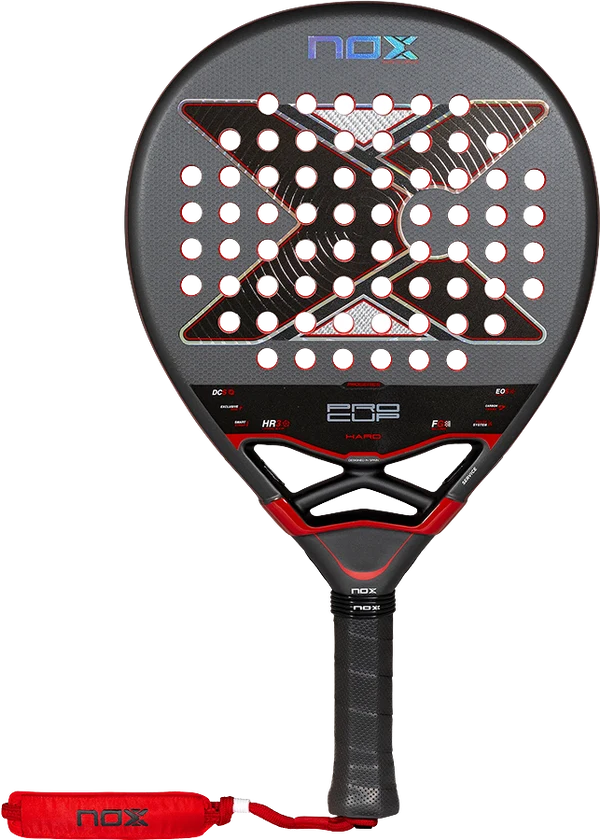


8 Parameters
NOX Pro Cup Hard by Agustín Tapia 2027
On this page
PadelVerdict Review · NOX Pro Cup Hard by Agustín Tapia 2027
NOX Pro Cup Hard 2027 Review: a firm answer to club-court chaos
The Pro Cup Hard uses one of the familiar shapes in padel and gives it a very specific 2027 voice. The teardrop mould carries aluminised fibreglass faces on a carbon frame, while HR3 Hard EVA makes the contact compact and direct. NOX declares 360–375 g; our scoring reference is the 368 g rounded midpoint. Tapia’s name is new on this branch, but the assignment is classic: keep the ball where you intended it.
Control 8.3 and Spin 8.2 lead the card, with Stability 8.0 supporting hard contact. Comfort 7.8 tells you this is not the muted member of the pair, and Power 7.7 keeps the fibreglass from being mistaken for carbon punch. Verdict 8.3 comes from Defender 8.12. The three profiles sit within 0.14, so this is an all-court tool with a defensive lean, not a specialist locked at the back glass.
Spin 8.2 is fifth among the 70 teardrops in our current perimeter. Control 8.3 gives the Hard its identity. Comfort 7.8 and Power 7.7 define the limits: clear feedback, useful response, no carbon cannon.
On court
How the NOX Pro Cup Hard by Agustín Tapia 2027 plays
The face gives a straight answer
Control 8.3 is the reason to choose the Hard over the Soft. The HR3 Hard core does not hold the ball as long, so direction arrives with less ambiguity on a volley or a firm block. Stability 8.0 helps when a fast ball hits away from the centre; the carbon frame keeps the fibreglass faces from folding into a mushy response. This is not surgical round-racket control, because the teardrop still carries some attacking intent. It is control for a player who wants one frame to survive every part of a club match.
Texture works harder than the foam
Spin 8.2 ranks fifth among the 70 teardrops we have scored. Exclusive Spin divides the surface between raised texture and sand, so a sliced bandeja and a brushed víbora have real grip. Power 7.7 is more restrained: the hard core returns energy cleanly, but the fibreglass faces do not imitate the rigid hit of the Genius or Ventus carbon. On the smash, technique still matters. On a fast counterattack, the combination is useful because the ball leaves with direction and rotation rather than unexplained rebound.
Firm, without becoming punishing
Comfort 7.8 is a warning only if you need a deeply cushioned strike. The medium-hard contact is clear, and Pulse System takes away some handle vibration, but the Hard keeps more feedback than its Soft sibling. Playability 8.3 and Sweetspot 8.1 stop that firmness from becoming a narrow expert tool. A late defensive block still has a useful margin. Rushed defence is where the shorter dwell can ask for cleaner hands, especially when the ball arrives heavy and low.
Shot by shot
Shot by shot
- Baseline: Control 8.3 keeps the volley on its line when you resist adding an extra wrist movement.
- Volleys: Spin 8.2 makes the sliced bandeja dip and the víbora kick without forcing a harder swing.
- Bandeja: Stability 8.0 gives a firm block enough body against a fast ball at the net.
- Víbora: Comfort 7.8 leaves clear feedback on repeated defensive contact; sensitive arms should note it.
- Smash: Power 7.7 needs a committed overhead gesture and rewards a clean strike more than a short jab.
Technology
Fibreglass, hard foam and a carbon frame: why the mix works
Silver Fiberglass faces usually suggest easy ball exit and a softer response. HR3 Hard EVA and the carbon frame move this racket in the opposite direction, creating the medium-hard feel declared by NOX. That is why Power 7.7 and Control 8.3 can coexist: the face supplies useful exit, while the core and frame organise it. The 38 mm teardrop keeps the familiar Pro Cup geometry. Static balance in millimetres and independent swingweight are NOT FOUND, so our card does not invent a head-light or head-heavy number.
Exclusive Spin is not a single rough coating: NOX combines 3D texture and sand in separate surface zones. EOS Flap shapes the heart to reduce air resistance, while Pulse System handles part of the vibration. DCS reinforces the frame and SmartStrap makes the cord replaceable. There is no Weight Balance or VCS here, unlike the Lite and full-weight carbon branches. The Pro Cup Hard stays mechanically simple, and the firm core remains the feature you notice first.
Player fit
Who should buy it, and who shouldn’t
The improving all-courter with clean hands
Defender 8.12 just leads Hybrid 8.08 and Attacker 7.98. That nearly flat profile fits a player who changes roles during the rally but wants a firm, readable response everywhere. Intermediate is our primary fit. Control 8.3 helps you build the point, Spin 8.2 adds a second way to finish it, and Playability 8.3 leaves room when preparation is not perfect. Advanced club players can use it as a direct, uncomplicated frame.
The arm that wants cushioning or the smash that wants carbon
Comfort 7.8 cannot match the Pro Cup Soft, whose core is explicitly softer. Power 7.7 also cannot mimic the sharper carbon response higher in the NOX range. If you need easy defensive depth with minimal effort, choose the Soft. If your game depends on heavy flat finishing, a carbon-faced model is the more coherent route. The Hard is about readable all-court contact.
The rivals
The rivals
Three defensive rivals show where the Pro Cup Hard spends its firmness and surface grip.
Bullpadel Neuron 27
Verdict 8.3 · Defender 8.01
Our Comfort 7.8 against its 6.8: a full point more tolerance over repeated contact, despite the Hard core.
StarVie Astrum+ Black 2027
Verdict 7.9 · Defender 7.89
Our Spin 8.2 against its 7.7: half a point more rotation in our card, at Verdict 8.3 against 7.9.
Siux Electra Elite 2026
Verdict 8.2 · Defender 8.00
Our Sweetspot 8.1 against its 7.3: eight tenths more usable margin on off-centre contact.
The verdict
Verdict 8.3: a clear club-court instrument
Defender base 8.12, excellence 0.1 and consensus 0.1 produce Verdict 8.3. The Pro Cup Hard does not win through a spectacular number; it wins by giving the intermediate and advanced club game a firm response, useful spin and enough forgiveness. Its limits are equally clear. The Soft is kinder, carbon frames hit harder, and this classic mould continues to occupy the sensible ground between those demands.
FAQ
Frequently asked questions
Pro Cup Hard or Pro Cup Soft?
They share the teardrop, fibreglass faces, carbon frame and 360–375 g declared range. The Hard uses HR3 Hard EVA and reads Control 8.3 with Comfort 7.8; the Soft uses HR3 Soft EVA and reads Control 8.0 with Comfort 8.7. Pick direction here or cushioning there.
Is the Pro Cup Hard good for intermediate players?
Yes. Intermediate is our primary fit because Playability 8.3 and Sweetspot 8.1 preserve useful margin. The firm response still asks for reasonably clean hands in rushed defence. Players with sensitive arms should compare the Soft before deciding.
What is the actual weight of the Pro Cup Hard?
NOX declares 360–375 g and our scoring reference is the rounded midpoint of 368 g. No independent scale reading is available for this exact model. Weigh the individual racket if the production spread matters to your choice.
Does the fibreglass face make the racket soft?
Not by itself. The HR3 Hard EVA core and carbon frame create the declared medium-hard feel. The faces help with useful ball exit, but the overall contact is firmer and more direct than the Pro Cup Soft.
Is the Pro Cup Hard only a defensive racket?
No. Defender 8.12 leads, but Hybrid 8.08 and Attacker 7.98 are close. Spin 8.2 and Power 7.7 support a complete club game. It leans defensive because direction and repeatability are stronger than raw finishing force.
Family sibling: NOX Pro Cup Soft by Agustín Tapia 2027 · Official specs: nox.com
Similar Rackets
Independent testing, funded by readers
No brand deals, no sponsored picks. If you found this useful, you can support the next round of tests with a small tip.

