
Electra Elite 2026
Same verdict as the Electra Pro, different route: softer, more playable, still all-court control in the Stupaczuk family DNA.
The short verdict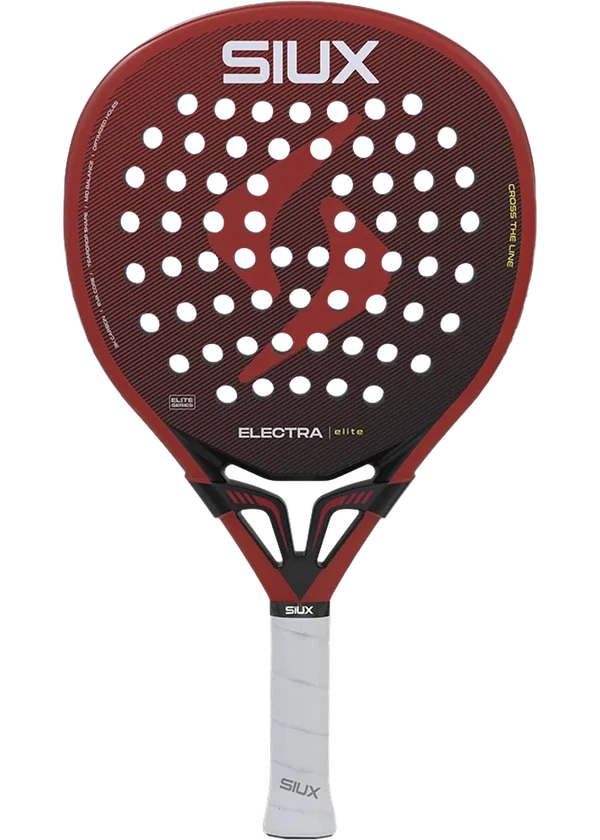


8 Parameters
Electra Elite 2026
On this page
PadelVerdict Review · Siux Electra Elite 2026
Siux Electra Elite 2026 Review: Same Verdict as the Pro, Different Way to Get There
The Electra Elite is the most interesting kind of second model: not a cheaper Pro, not a softer imitation, but a different route to the same score. Franco Stupaczuk’s Electra family is built around all-court control; the Elite keeps that DNA with a drop shape, medium balance and a noticeably more approachable response. The result lands at 8.2 — exactly the same verdict as the Electra Pro, with the strengths redistributed.
The build is 3K carbon faces, EVA Mid Touch core, matte sand finish, carbon frame and Switch Strap. The declared range is 355–375g; our reference is 365g with a 266mm medium balance. Estimated stiffness is 60, a clear step softer than the Pro’s harder 12K setup. It is still a performance racket, but one that lets the rally come to you. See the family in our Siux archive.
Sibling test
Electra Elite 2026 vs Electra Pro 2026
The Pro is Franco Stupaczuk’s sharper competition weapon. The Elite gives up very little precision and buys back comfort, speed and margin.
Performance
Shot by Shot: Control With a Softer Entry Point
Defender 8.00 · Attacker 7.98 · Hybrid 7.94. The top-two spread is 0.02 — tighter than 85.2% of our database. The Elite does not have a preferred side of the court; it has a preferred rhythm.
Control without losing the finish
Control 8.5 ranks sixth among the 49 drop rackets from the 2026 season in our database. Power 8.1 ranks seventh in the same group. That pairing is the Elite’s entire argument: you can defend with placement, then finish without changing racket personality.
The comfort gain is real
Comfort rises from 7.0 on the Pro to 7.6 here. The EVA Mid Touch core absorbs more of the impact and gives easier depth on late defensive contact. Playability 7.9 follows: this is still a performance frame, but it asks less from your wrist and shoulder over a full match.
Quick enough, not oversized
Maneuverability 8.0 makes the Elite quicker in transition than the Pro (7.6). Sweetspot 7.3 is the boundary: clean and predictable in the middle, less generous near the frame than the most forgiving drops. The racket helps good preparation; it does not replace it.
Grip and frame hold their own
The matte sand finish gives reliable bite on víboras and bandejas, and Stability 7.9 keeps the face composed on blocks. The Pro still feels denser against heavy pace; the Elite answers with a slightly faster recovery and less shock.
On court
Where the Electra Elite Wins Without Forcing the Point
From the baseline
This is where the Elite separates itself from the Pro. The softer core gives easier ball exit from the glass, the medium balance arrives on time, and Control 8.5 turns defensive resets into usable depth instead of survival shots.
At the net
Precise, quick and calm. The face does not launch the ball uncontrollably, so you can hold direction on fast volleys and blocks. Against very heavy incoming balls, the Pro’s denser 12K setup keeps a small stability edge.
Bandeja
A standout. The medium balance, sandy face and Control 8.5 make it easy to repeat deep, angled bandejas without over-swinging. This is the shot that best explains the Elite’s all-court profile.
Víbora
More about trajectory than violence. Spin 7.9 gives enough grip to bring the ball down toward the side glass, and Power 8.1 supplies pace when you commit. It rewards timing more than shoulder load.
Smash
Good, not the headline. Power 8.1 is enough to finish from good positions, especially with a fast arm. If your game depends on repeated flat winners from deep court, a diamond attacker — including the Fenix Elite — gives you more leverage.
Player fit
Who Should Buy the Siux Electra Elite 2026?
The intermediate-to-advanced all-court player
You want control first, but you do not want to give up the finish. The Elite lets you defend deep, change direction quickly and still attack with 8.1 Power when the opening appears.
Pure attackers and players who want maximum free power
The Elite is balanced, not explosive. If your first priority is overhead leverage, head-heavy inertia and a harder ball, the Fenix Elite or another diamond attacker is the more direct answer.
FAQ
FAQ
What is the PadelVerdict score for the Siux Electra Elite 2026?
8.2 — Defender 8.00, Attacker 7.98, Hybrid 7.94, plus a +0.1 consensus modifier. The score is built on control and balance rather than one dominant parameter.
How does the Electra Elite compare to the Electra Pro?
They tie at 8.2. The Elite improves Comfort (7.6 vs 7.0), Maneuverability (8.0 vs 7.6) and Playability (7.9 vs 7.4). The Pro keeps the denser, more competition-led feel and a small Stability edge (8.0 vs 7.9).
What is the actual weight of the Electra Elite?
We use 365g as the declared reference within the 355–375g range. No independently measured unit has been verified yet; the FAQ below makes that distinction explicit.
Is the Electra Elite good for intermediate players?
Yes. The primary level is intermediate, with advanced performance headroom. It is not a soft beginner racket, but it is meaningfully easier to move and more comfortable than the Pro.
Is the Electra Elite good for control players?
Yes — Control 8.5 is its defining score. The difference from a pure control racket is that Power 8.1 remains available when the rally opens up.
Why is the consensus modifier +0.1?
Court reports converge on the same profile: softer response, easier handling and control close to the Pro. Because weight and balance remain declared rather than independently measured, the uplift stays at +0.1.
Similar Rackets
Independent testing, funded by readers
No brand deals, no sponsored picks. If you found this useful, you can support the next round of tests with a small tip.

