
Unum S1
Can a Hybrid Actually Deliver on Both Ends?
The short verdict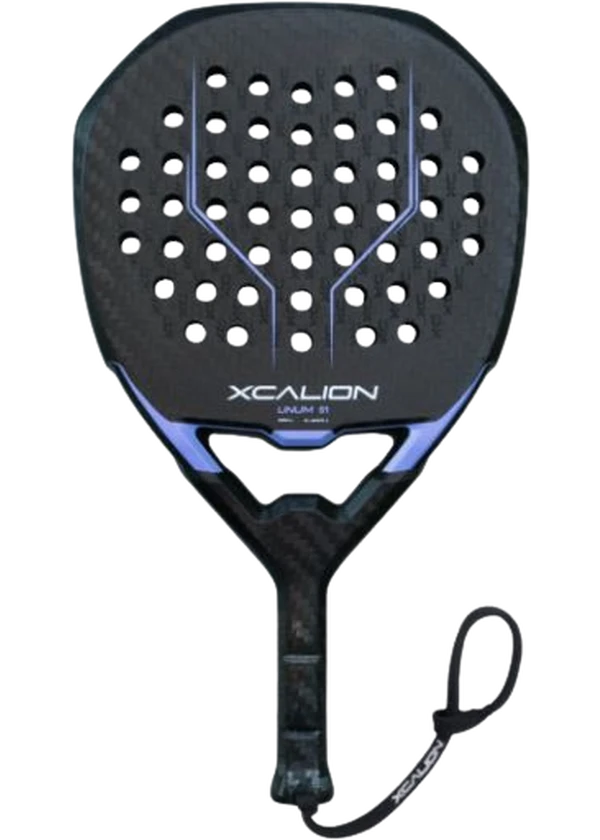
8 Parameters
Unum S1
On this page
Review
Xcalion Unum S1 2026 Review: Can a Hybrid Actually Deliver on Both Ends?
The hardest sell in padel is the racket that promises everything. Most hybrids end up as compromises — enough control to frustrate attackers, enough power to frustrate defenders, satisfying neither. The Xcalion Unum S1 2026 enters that conversation with a specific argument: that the balance of a drop shape, the feel of a medium-density core, and the texture of a rough 3D carbon surface can genuinely serve a player in transition — someone moving from round-racket control toward offensive capability without abandoning what made them good in the first place.
The Xcalion Unum S1 2026 is a drop-shaped hybrid positioned as the control model in Xcalion’s Unum lineup, sitting alongside the more aggressive H1. Its 12K T700 aerospace-grade carbon surface carries a rough 3D XC texture designed for spin generation, wrapped around a medium-density rubber foam core in a 38mm monocoque frame. The Alma/Unum patented construction adjusts carbon lamination thickness and fibre interlacing to produce a softer, more reactive feel than the stiffer H1 — declared at 333g and 280mm balance, with one independent measurement confirming a play-ready weight of approximately 340g and a 280mm balance point, closely matching the declared specs. Explore the full Xcalion lineup to see how the Unum S1 fits into the broader range.
Maneuverability leads at 8.6 — the highest single parameter in this racket. Profile breakdown: Attacker 7.46 / Hybrid 7.98 / Defender 7.93. The near-tie between Hybrid and Defender scores is the story: this racket doesn’t choose sides, and neither should its owner.
Performance Breakdown
How the Xcalion Unum S1 2026 Plays
PLAYABILITY 8.1
The Speed That Earns the Hybrid Tag
When a racket’s headline number is Maneuverability at 8.6, it signals a design philosophy centered on arm speed and fast exchanges rather than raw punch. The Unum S1’s monocoque construction and balanced weight distribution translate directly into quick reactions at the net — this is a racket that rewards athleticism in tight spaces. Playability at 8.1 confirms that speed doesn’t come at the cost of versatility: the learning curve is genuinely low, making it accessible to intermediates while still offering enough ceiling for advanced players working transitions. In the drop-shaped racket category, this combination of agility and usability is rarer than it looks.
SWEETSPOT SIZE 7.8
Precision That Doesn’t Demand Perfection
Control at 8.1 is the parameter that validates the Unum S1’s positioning as the control anchor of the lineup. The medium-density rubber core dampens the response just enough to give the player time to feel the ball before it leaves the face — a quality that shows most clearly from the baseline, where placement matters more than acceleration. The sweetspot at 7.8 is comfortably forgiving without being slack: off-center contact still returns a usable shot rather than punishing the player. The monocoque 38mm frame stiffens the perimeter just enough to maintain structural consistency across the hitting zone, which is the quiet engineering story behind that sweetspot score.
POWER 7.2
The Ceiling That Keeps Attackers Looking Elsewhere
Spin at 7.4 is respectable given the 3D XC rough texture — the surface does generate grip and rotation — but the medium-density core and softer carbon lamination absorb some of the energy that a harder frame would convert into ball deformation and spin imprint. Power at 7.2 is the most honest number in this profile: the Unum S1 can produce offensive shots from the net, but it is not a power generator. Players coming from harder diamond-shaped frames expecting sustained back-court aggression will find the power ceiling modest. These two scores together explain why the Attacker profile sits at 7.46 — meaningfully below the Hybrid and Defender scores — and why the racket is positioned as a control model rather than a versatile offensive weapon.
STABILITY 7.0
Arm-Friendly Enough, Until the Ball Gets Heavy
Comfort at 7.3 reflects the medium-density core doing its job without excelling at it — vibration is absorbed adequately, and the medium stiffness description aligns with a racket that won’t stress the arm in normal exchanges. The counterintuitive score here is Stability at 7.0: for a drop shape with an aerospace carbon frame, you might expect more resistance against heavy balls and off-axis contact. The 280mm balance point keeps the racket head-light enough for speed but pulls stability down in return — a trade-off the design consciously accepts. Players dealing with long rallies against hard hitters will notice the limitation before players engaged in faster, shorter exchanges will.
Technology
Alma/Unum Technology: Does Aerospace Engineering Translate to Court Performance?
The Alma/Unum patented system is built around one specific engineering decision: variable carbon lamination thickness and adjusted fibre interlacing across the frame. Rather than using uniform carbon layup throughout, the monocoque construction modulates stiffness zone by zone — stiffer at the perimeter for structural consistency, progressively softer toward the core of the hitting surface. The practical output is a racket that feels medium-dry and reactive without the sharp rigidity of harder carbon frames, which connects directly to the Control score of 8.1 and the arm-friendly Comfort rating of 7.3.
The 12K T700 aerospace-grade carbon surface adds a second layer of intentionality. T700 fibre at 12K weave density produces a tighter, more consistent surface than standard carbon, and the 3D XC rough texture machined into it creates additional friction at ball contact. This combination contributes to the Spin score of 7.4 — functional but not exceptional, because the medium-density core underneath absorbs energy before spin imprint fully develops. The system performs most visibly in Maneuverability at 8.6: keeping the play-ready balance at 280mm with a declared 333g frame is a manufacturing achievement that justifies the aerospace framing, even if the on-court result is simply a fast, light racket that handles well.
Who benefits? The player who wants a technically constructed hybrid without the harshness of full offensive engineering. The Alma/Unum system is designed for a transition player — someone building offensive game on a control foundation — and the scores reflect that exactly. It is not a system that unlocks elite power, and it was not designed to be.
Player Fit
Who Should Buy the Xcalion Unum S1 2026?
The Intermediate Transitioning From Round Control to Offensive Play
If you’ve been playing with a round control racket and feel you’re leaving offensive potential on the table, the Unum S1 was built for exactly that crossover moment. Control at 8.1 means you won’t sacrifice your baseline game, Maneuverability at 8.6 rewards the quick hands you’ve already developed, and Playability at 8.1 keeps the transition low-risk. The Hybrid score of 7.98 and Defender score of 7.93 running almost level tells you this racket is genuinely comfortable across multiple court positions — you don’t have to commit to a single identity to use it well. If that describes where your game is headed, this racket meets you there.
The Committed Attacker Who Needs Real Power Output
Power at 7.2 is the number that settles this quickly. If your game depends on sustained back-court aggression, hard smashes, or the kind of ball exit speed that puts opponents under pressure, the Unum S1 will feel like a ceiling too low. Stability at 7.0 adds a second constraint: against heavy-hitting opponents, the head-light balance that makes this racket so maneuverable becomes a liability in absorbing impact. The Attacker score of 7.46 — a full 0.52 below the Hybrid score — is not a gap you can play around. Look at harder, more head-heavy drop rackets in the attacker category if pure offensive output is the brief.
FAQ
Frequently Asked Questions
What is the PadelVerdict score for the Xcalion Unum S1 2026?
The PadelVerdict score is 8.2, with a Consensus Modifier of +0.1 applied. Specs are consistent across multiple sources (Data Quality: neutral), specialist sources across multiple markets align on shape, core, surface, and balance with no contradictions found (Field Validation: positive), but no independent physical lab measurements exist to go further (Market Correction: neutral). Profile breakdown: Attacker 7.46 / Hybrid 7.98 / Defender 7.93. The tight gap between Hybrid and Defender scores means this racket genuinely suits two player types — that’s rare enough to be a deciding factor.
Is the Xcalion Unum S1 2026 good for intermediate players?
Yes, genuinely. Playability at 8.1 and Maneuverability at 8.6 together mean the learning curve is low and fast exchanges don’t punish the player. Control at 8.1 provides the precision platform that intermediates rely on while they develop offensive capability. If you’re a beginner still building fundamentals, you might want a rounder frame first — but for anyone past that early stage, the Unum S1 is well-calibrated for where an intermediate game actually is.
Is the Xcalion Unum S1 2026 good for hybrid players?
Yes. The Hybrid profile score of 7.98 and Defender score of 7.93 running almost level confirm that this racket adapts to multiple court positions without forcing a compromise. Control at 8.1 covers the precision needed in baseline exchanges; Maneuverability at 8.6 handles net transitions. If your game moves between positions and you don’t want a specialist frame, this is a strong fit. Browse the full hybrid racket category for further comparisons.
What is the actual weight of the Xcalion Unum S1 2026?
The declared weight is 333g. One independent on-camera measurement recorded 325g unstrung without grip or overgrip, rising to approximately 340g in play-ready configuration with grip and overgrip. The play-ready figure sits 7g above declared — a difference that falls within normal tolerance and is unlikely to be perceptible on court. The 280mm balance point was confirmed at the same measurement, matching declared specs closely.
How does the Xcalion Unum S1 2026 compare to the Xcalion Unum H1?
These two frame the same Alma/Unum construction philosophy from opposite ends of the stiffness spectrum. The H1 uses harder carbon lamination for players who want more power transfer and firmer feel — the attacker’s choice within the lineup. The Unum S1 adjusts the lamination for a softer, more reactive response prioritizing control and arm comfort. Choose based on whether your game is built on power or precision — not on whether one label sounds more advanced than the other.
Why does the Xcalion Unum S1 2026 have a Consensus Modifier of +0.1?
The modifier reflects what the data earned, not what was claimed. Consistent spec alignment across multiple markets establishes a neutral baseline — that alone doesn’t move the number. What pushes it to +0.1 is specialist-level convergence on the technical control-hybrid profile — shape, core density, surface construction, and balance all described coherently and without contradiction across independent sources. The +0.1 is the honest editorial position given the depth and consistency of what the data provides.
Similar Rackets
Independent testing, funded by readers
No brand deals, no sponsored picks. If you found this useful, you can support the next round of tests with a small tip.

