
Atila 3.0 12K 2026
Does the Carbon Stack Deliver Real Attack?
The short verdict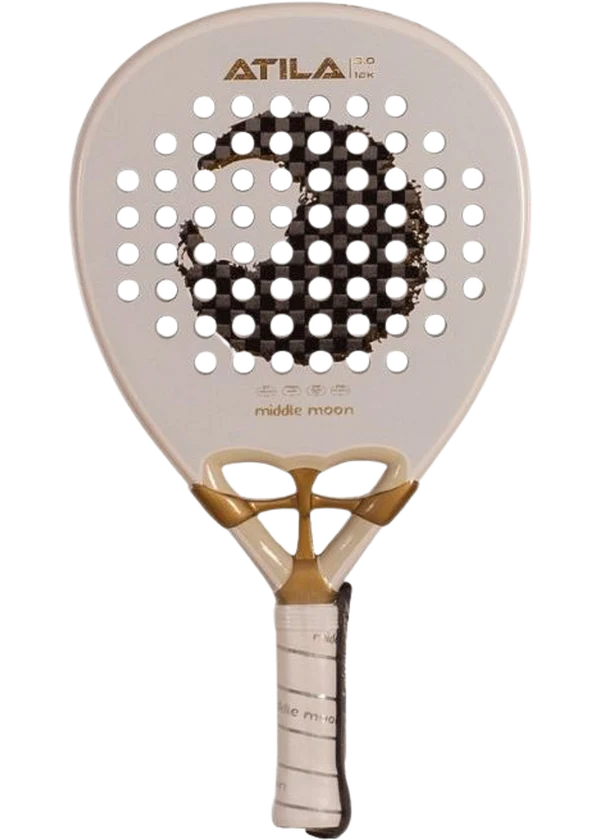
8 Parameters
Atila 3.0 12K 2026
On this page
Review
Middle Moon Atila 3.0 12K 2026 Review: Does the Carbon Stack Deliver Real Attack?
The old argument in drop-shape padel is whether you can build genuine power without sacrificing the control ceiling that makes the shape worthwhile. Push the balance too high, stiffen the core too much, and you end up with a racket that punishes any stroke that isn’t perfectly timed. Stay too conservative and the shape promises more than it delivers. The Middle Moon Atila 3.0 12K attempts to thread that needle with a layered carbon system and an EVA foam core — a combination that, on paper, keeps reactive punch accessible without stripping the frame of feel.
Under the skin, the Atila 3.0 runs a soft Power EVA core — reactive but forgiving — paired with a dual-layer carbon surface: 12K carbon as the primary face, with a 3K carbon reinforcement layer concentrated over the sweetspot zone. The frame carries Kevlar reinforcement for structural rigidity, while Graphene Max impregnation into the surface is claimed to distribute impact load more evenly across the face. Stiffness is rated at 42 RA — moderate-to-firm for the drop-shape category. Declared weight sits at 360–375g, balance at 260mm, placing it in intermediate-balance territory for a drop that still leans offensive. This is positioned as Middle Moon’s most aggressive drop-shape model in the current lineup.
Stability leads at 7.8 — the highest score on the card. The gap between the attacker and defender profiles is real but not dramatic — this racket has more range than its aggressive framing suggests.
Performance Breakdown
How the Middle Moon Atila 3.0 12K 2026 Plays
STABILITY 7.8
Stability Does the Selling, Power Does the Work
The Kevlar frame reinforcement earns its keep in a specific way: off-centre hits hold their line better than you’d expect from a racket priced well below €200 at current market rates. Stability at 7.8 is the highest score this racket posts, and it’s what allows the 7.6 Power reading to feel reliable rather than situational. The dual-layer carbon surface — 12K on the face, 3K concentrated over the sweetspot — adds stiffness locally where it matters most, so attacking shots from the right position carry genuine pace. Power won’t overwhelm a seasoned opponent, but it won’t let you down at intermediate level either.
MANEUVERABILITY 7.4
The Rough Surface Earns Its Place
The textured sand-like finish across the carbon face is what lifts Spin to 7.5 — meaningful for a drop shape that sits at intermediate balance rather than full head-heavy. Maneuverability at 7.4 is the number that surprises: at 368g declared and a 260mm balance, the Atila 3.0 moves faster than its specs suggest, aided by the Graphene Max impregnation distributing mass more evenly through the face. Attackers playing the right side will find both scores work together — topspin bandeja and aggressive smashes feel generated rather than forced. Among drop-shaped rackets in this range, that combination is less common than you’d think.
COMFORT 7.3
SWEETSPOT 7.4
Control Is the Trade-Off, Not a Failure
Control at 7.2 is the lowest score on the card — and that’s the story of what this racket is. The 42 RA stiffness and the upward-shifted sweetspot position create a face that rewards committed attacking strokes but punishes hesitation. Comfort at 7.3 is reasonable for a carbon frame at this stiffness level — the soft EVA core absorbs enough vibration to keep sessions manageable without being plush. Sweetspot at 7.4 reflects the 3K carbon reinforcement doing real work: the forgiving zone is genuinely larger than other drop shapes at this price. The control score connects directly to the defender profile sitting at the bottom of the three — this is an attacker’s tool with enough forgiveness to serve a confident hybrid player, but not built for defensive baseline work.
A Complete Racket Within a Defined Ceiling
Playability at 7.4 reflects a racket that delivers on its premise rather than overreaching. The score cluster — every parameter between 7.2 and 7.8 — tells you this isn’t a specialist weapon with obvious holes; it’s a coherent intermediate attacker built with layered technology and no single catastrophic weakness. Intermediate players who move forward and make contact early will find the Atila 3.0 responsive and honest. The ceiling is real: elite-level touch and defensive precision aren’t in the brief. But within the brief, the racket performs without compromise.
Technology
Dual Carbon + Graphene Max: Layered System or Marketing Stack?
The Atila 3.0’s surface construction is its most distinguishing technical feature: a primary 12K carbon weave across the full face, with a secondary 3K carbon layer applied specifically over the sweetspot zone. The distinction matters. 12K carbon — a tighter, denser weave — produces a stiffer, more powerful striking surface. 3K carbon, with its coarser weave, is slightly more flexible and more easily textured. Stacking 3K over the sweetspot creates a localized zone that is simultaneously more responsive and more forgiving — which is what drives the Sweetspot Size score to 7.4 despite the overall 42 RA stiffness. The dual-layer design is not simply cosmetic.
Graphene Max impregnation adds a third material dimension. Graphene dispersed through the carbon matrix increases tensile strength without adding meaningful weight — the effect on-court is a face that distributes impact load across a larger area before transferring energy to the ball. This is what supports the Maneuverability score of 7.4 at the declared 368g: the Graphene Max treatment prevents localized dead zones that would otherwise require more swing speed to generate the same pace. The frame’s Kevlar reinforcement works differently — it adds structural rigidity to the hoop specifically, keeping the face geometry stable on off-centre contact and delivering the 7.8 Stability score that anchors the whole performance profile.
The soft Power EVA core is the system’s moderating element. At 42 RA, the frame is firm enough to feel attacking; the EVA foam keeps the dwell time long enough to prevent the harsh feedback that kills sessions at this stiffness level — reflected in the 7.3 Comfort score. Together, the system is designed for an intermediate attacker who wants carbon-level pace without the arm fatigue of a fully stiff setup. It delivers that specific brief credibly.
Player Fit
Who Should Buy the Middle Moon Atila 3.0 12K 2026?
The Intermediate Attacker Who Plays the Right Side
If you’re the type who moves forward at every opportunity, times the ball early, and wants topspin and pace without carrying a specialist weapon that punishes off-days — this racket was built around you. The 7.8 Stability means aggressive smashes from the right side hold their line even when you’re not perfectly positioned. The 7.5 Spin and textured face mean your bandeja generates enough rotation to keep opponents from attacking the return. And the 7.4 Sweetspot Size, backed by the 3K reinforcement layer, gives you enough margin to stay aggressive without obsessing over contact quality. At the promotional price point, the carbon stack here punches above its weight class.
Defenders and Touch-First Players
If you play the left side, rely on defensive consistency and redirecting pace, or prioritize feel on drops and lobs over power generation — the 7.2 Control score is the honest answer to your question. The defender profile is the lowest on the card, and the 42 RA stiffness doesn’t reward the soft touch that defensive baseline play demands. The racket won’t punish you catastrophically on defence, but it won’t help you either. Beginners who haven’t yet built the stroke consistency to benefit from the layered carbon system will find this setup overqualified in the wrong direction — demanding technique before returning the investment.
FAQ
Frequently Asked Questions
What is the PadelVerdict score for the Middle Moon Atila 3.0 12K 2026?
PadelVerdict scores the Atila 3.0 12K 2026 at 7.6, with a Consensus Modifier of 0. Specs are consistent across multiple sources (Data Quality: neutral), declared figures show no implausible outliers (Field Validation: neutral), but no independent measurements exist to confirm them (Market Correction: neutral). Consistent data without independent validation earns neutral, not positive. Profile breakdown: Attacker 7.62 / Hybrid 7.49 / Defender 7.33. The gap between the attacker and defender profiles is meaningful — this racket has a clear orientation without being a one-trick specialist.
Is the Middle Moon Atila 3.0 12K 2026 good for intermediate players?
Yes, but with a condition: it’s good for intermediate players who already favour attacking play. The 42 RA stiffness and 7.2 Control score mean the racket expects you to generate your own precision — it won’t compensate for stroke inconsistency. An intermediate player who plays defensively or is still developing contact reliability should look at a softer-cored, rounder-shaped option first.
Is the Middle Moon Atila 3.0 12K 2026 good for attacking players?
Yes. The attacker profile is the highest on the card, supported by Stability 7.8, Spin 7.5, and Power 7.6. The dual carbon surface and textured finish are explicitly built around offensive stroke production. If you identify as an attacker, this racket will feel like it understands you. Browse the best attacker rackets to see how it compares to the wider field.
What is the actual weight of the Middle Moon Atila 3.0 12K 2026?
The declared range is 360–375g, with a midpoint around 368g. No independent physical measurements exist to confirm or challenge those figures. A 15g declared range is on the wider side — in practice, two units from the same batch could feel noticeably different in hand. If weight consistency matters to your game, weigh before you commit.
How does the Middle Moon Atila 3.0 12K 2026 compare to the Eclipse 9 Gold Attack 12K 2026?
Both sit at the top of Middle Moon’s 2026 lineup and share the 12K carbon face, but they target slightly different attacker types. The Atila 3.0’s drop shape and 42 RA stiffness favour the right-side player chasing pace and spin off high balls. The Eclipse 9 Gold Attack leans more toward an all-court attacking orientation based on its positioning. If you play primarily right side and want maximum drop-shape aggression, the Atila 3.0 is the more specific tool.
Why does the Middle Moon Atila 3.0 12K 2026 have a Consensus Modifier of 0?
The modifier reflects what the data can and cannot support. Specs appear consistently across multiple markets — shape, core material, surface construction, and weight range show no contradictions. That consistency is the baseline expectation, not a reason to award a positive adjustment. Consistent data without independent validation earns neutral. That is the honest position for a racket at this stage of its market life.
Similar Rackets
Independent testing, funded by readers
No brand deals, no sponsored picks. If you found this useful, you can support the next round of tests with a small tip.

