
Velocity Star 2025
Does It Actually Deliver on the Hybrid Promise?
The short verdict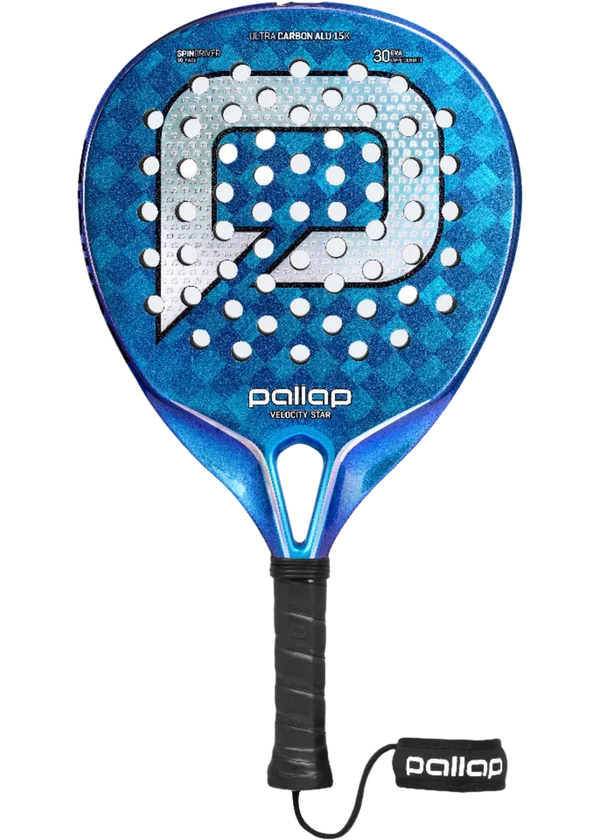
8 Parameters
Velocity Star 2025
On this page
Review
Pallap Velocity Star 2025 Review: Does It Actually Deliver on the Hybrid Promise?
The hybrid category is crowded with rackets that talk a good game about versatility while secretly favouring one style of play. The real test is whether the numbers bear out the claim — whether power, control, and maneuverability sit close enough together to make the racket genuinely useful across game situations, or whether one of them quietly betrays the pitch. The Pallap Velocity Star 2025 enters that conversation as Pallap’s declared most versatile racket, positioned above the Velocity Team and effectively replacing the Control Star with a more dynamic profile. The question is whether it earns the title or borrows it.
Spec-wise, the Velocity Star 2025 is built around a drop shape — balanced and approachable — with a medium-density EVA 30 foam core and a stiffness rating of 58, sitting on the firmer side of medium. The frame uses Pallap’s Ultra Carbon Alu 15K Basalt construction (manufactured in Italy), and the hitting surface carries a 3D SpinDriver texture designed to amplify friction and spin production. Proprietary systems include the Bridge Stabilizer, which targets torsional flex, and the Super Rotation Hole arrangement, which optimises apertures for spin and control. The declared balance point sits at 260mm, making this a genuinely mid-balance design. You can browse the full Pallap lineup for context on where this sits within the brand hierarchy.
Maneuverability leads at 7.9 — the Velocity Star’s sharpest edge. Attacker: 7.46 / Hybrid: 7.72 / Defender: 7.72. The tied Hybrid and Defender scores tell the real story: this racket rewards players who construct points, not players who end them.
Performance Breakdown
How the Pallap Velocity Star 2025 Plays
PLAYABILITY 7.8
The Drop Shape Does What Drop Shapes Should
At 260mm balance, the Velocity Star keeps weight central rather than high, and you feel that immediately in transition play — volleys, reflex blocks, and quick repositioning at the net all benefit from a racket that doesn’t fight you when time is short. Maneuverability at 7.9 is the single highest score in this profile, and it’s not a coincidence that Playability follows at 7.8. The drop-shaped platform among drop-shaped rackets consistently rewards players who value racket speed over raw power, and the Velocity Star executes that trade cleanly. For an intermediate player trying to read and respond rather than overpower, these two scores represent the racket’s strongest selling point.
SPIN 7.6
The Surface Earns Its Marketing
Control at 7.8 ties Playability as the second-highest score and reflects an EVA 30 core that is responsive without being unpredictable — firm enough to provide feedback, soft enough to absorb pace on directional shots. The 3D SpinDriver texture and Super Rotation Hole layout genuinely contribute to a Spin score of 7.6 rather than simply being listed in the brochure: the surface friction is perceptible on slice and topspin approaches. The Bridge Stabilizer’s torsion-reduction function reinforces Control specifically on off-centre contact, which is where intermediate players actually lose points.
SWEETSPOT SIZE 7.6
Arm-Friendly Without Being Soft
A stiffness of 58 is meaningfully firmer than most EVA-cored rackets in this segment, and that creates a small tension worth naming: the Bridge Stabilizer manages vibration at the handle level, but a stiffer frame still transmits more shock than a softer alternative. Comfort lands at 7.5 — adequate and appropriate for the spec, but not the racket’s strongest suit. The Sweetspot Size of 7.6 is slightly more surprising given the stiffness; the combination of mid-balance and drop shape spreads the effective hitting zone more evenly than a high-balance diamond would, making the racket more forgiving than the frame material alone might suggest.
STABILITY 7.5
Power Is the Ceiling, Not the Floor
Power at 7.4 is the lowest individual score and the direct reason the Attacker profile sits 0.26 points below the Hybrid and Defender scores. The Velocity Star generates functional power — it is not sluggish — but it relies on technique and swing speed to unlock it rather than offering the slingshot effect of a high-balance diamond. Stability at 7.5 is solid for the weight class, supported by the Dual Carbon Frame’s structural rigidity, but players who regularly face heavy flat groundstrokes will notice the mid-balance provides less mass behind the ball than a head-heavy design would. The Power ceiling is a design choice, not a flaw — it’s the deliberate trade-off that makes the control and maneuverability numbers possible.
Technology
Bridge Stabilizer + Super Rotation Hole: Two Systems, One Coherent Brief
The Bridge Stabilizer is not a vibration dampener in the traditional sense. Rather than absorbing energy at the handle after the fact, it addresses torsional flex at the frame level — the rotational movement that occurs when the ball contacts the racket off-centre. The result is a more consistent return of energy across the hitting surface, which shows up directly in the Control score of 7.8 and partially explains why the Sweetspot Size (7.6) reads above what the stiffness rating alone would predict. For intermediate players whose contact point varies shot to shot, reduced torsion means fewer mis-hits that bleed into errors.
The Super Rotation Hole system optimises the positioning and sizing of the apertures specifically to increase movement at contact — the mechanical basis of spin production. Combined with the 3D SpinDriver surface texture, which increases friction between ball and faces, this is the clearest line in the spec sheet between technology and outcome: Spin at 7.6 is real, measurable, and not just a function of how hard the player swings. Slice approaches and kick serves benefit most, making the system particularly useful for defenders and hybrids who use spin as a placement tool rather than a power multiplier.
The Ultra Carbon Alu 15K Basalt frame construction — manufactured in Italy — introduces a basalt fibre layer alongside carbon and aluminium. Basalt is denser than standard carbon, contributing to the Stability score of 7.5 without disproportionately increasing weight. The Dual Carbon internal structure (3K carbon tube inner layer, carbon-aluminium outer) distributes load efficiently, keeping the frame rigid under impact while the EVA 30 core handles feel. Together, these material choices produce a racket that feels more premium than its price point suggests — which matters for intermediate players who are upgrading from fibreglass-cored alternatives.
Player Fit
Who Should Buy the Pallap Velocity Star 2025?
The Intermediate All-Court Builder
If you’re the type who wins points through positioning and consistency rather than power, who plays doubles and needs to be reliable in all four court positions rather than dominant in one, the Velocity Star 2025 is built for your game. The tied Hybrid and Defender scores (both 7.72) confirm this isn’t a racket trying to be an attacker — it’s a racket that rewards players who make smart decisions under pressure. The Maneuverability score of 7.9 means you won’t be slow to the ball at the net, and Control at 7.8 means your placement holds up when the point gets fast. You’re not here for the smash. You’re here for the fifth shot after the smash — and this racket gives you that. For the full picture, check our full intermediate racket guide, where every option is ranked on data.
The Player Who Finishes Points With Power
If your game is built around aggressive finishing — bandejas, viboras, and flat smashes from mid-court — the Attacker score of 7.46 tells you what you need to know. The 0.26-point gap between Attacker and Hybrid isn’t dramatic, but the Power score of 7.4 is the lowest in the profile for a reason: the mid-balance and drop shape prioritise touch over punch. A high-balance diamond with more mass behind the sweet spot will serve that game better. The Velocity Star doesn’t fail attackers — it just doesn’t flatter them. If power is your primary currency, you’ll feel the ceiling before you find the floor.
FAQ
Frequently Asked Questions
What is the PadelVerdict score for the Pallap Velocity Star 2025?
The overall PadelVerdict score is 7.7, with a Consensus Modifier of 0. Specs are broadly consistent across multiple sources (Data Quality: neutral), declared technical figures show no implausible outliers (Field Validation: neutral), but no independent physical measurements exist to confirm them (Market Correction: neutral). Profile scores: Attacker 7.46 / Hybrid 7.72 / Defender 7.72. The tied top scores are the editorial signal — this racket doesn’t favour one role.
Is the Pallap Velocity Star 2025 good for intermediate players?
Yes, this is squarely an intermediate racket. The Playability score of 7.8 reflects low entry friction — it rewards you quickly without demanding technical perfection. The Sweetspot Size of 7.6 provides enough forgiveness for developing consistency, while the Control score of 7.8 supports directional improvement. If you’re a complete beginner, a softer-cored alternative would be kinder on the arm. If you’re advanced, you’ll likely want more power headroom.
Is the Pallap Velocity Star 2025 good for hybrid players?
Yes, without reservation. The Hybrid score of 7.72 is the joint highest in the profile, supported by Control at 7.8, Maneuverability at 7.9, and Spin at 7.6 — exactly the parameters that define all-court play. If you move between the net and baseline, switch between attack and defence, and value touch as much as pace, this racket fits. Explore the full hybrid racket category to compare alternatives.
What is the actual weight of the Pallap Velocity Star 2025?
Declared weight is 358g, but market data shows a variance that exceeds 10g across regions — with ranges of 350–355g, 355–360g, and 360–365g reported from different markets. No independent on-camera measurement exists to resolve this. The spread is large enough to be perceptible on court: a 15g difference at this balance point changes swing feel meaningfully. Treat the declared figure as a midpoint estimate, not a confirmed spec.
Why does the Pallap Velocity Star 2025 have a Consensus Modifier of 0?
The modifier reflects what the data can and cannot confirm. Core construction, surface technology, and proprietary systems appear with reasonable consistency across available sources — that earns a neutral baseline, not a positive. What prevents any upward movement is the complete absence of independent validation: no tester measurements, no community feedback, no physical weigh-ins on camera, and a weight variance across markets that exceeds 10g. Consistent data without independent confirmation earns neutral, and that is the accurate position here.
Similar Rackets
Independent testing, funded by readers
No brand deals, no sponsored picks. If you found this useful, you can support the next round of tests with a small tip.

