
Maxx Hype
Does Raw Power Come at Too High a Cost?
The short verdict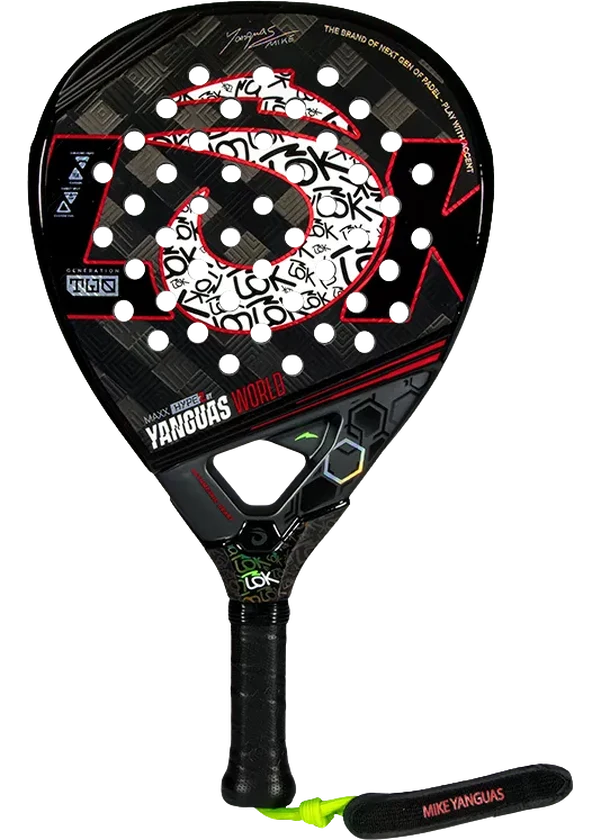


8 Parameters
Maxx Hype
On this page
Review
Lok Maxx Hype 2026 Review: Does Raw Power Come at Too High a Cost?
At the aggressive end of the padel spectrum, the debate is never really about power — it’s about what you give up to get it. Comfort narrows, the sweetspot shrinks, and the margin for technical error collapses. Some rackets hide that trade-off behind forgiving cores or wider frames. The Lok Maxx Hype 2026 does not. It puts the exchange on the table upfront: you get serious offensive firepower, and you pay for it with comfort and maneuverability.
This is a diamond-shaped attacker from Lok’s lineup, built around a custom EVA medium-hard foam core and 18K carbon fiber faces with a rough-textured 3D Spin Lines surface designed to extend dwell time and amplify spin RPM. Declared weight is 350g with a high balance point at 263mm — head-heavy by design. Stiffness is measured at 58 RA, placing it in the category where off-center hits are softened.
Comfort scores 6.2 — the lowest parameter and the defining constraint. Attacker: 8.3 · Hybrid: 7.76 · Defender: 7.26. That 1.04-point gap between top and bottom profiles tells you everything: this racket was engineered with one player type in mind, and it doesn’t pretend otherwise.
Performance Breakdown
How the Lok Maxx Hype 2026 Plays
STABILITY 8.2
Smash Depth That Pins Opponents Back
The Lok Maxx Hype’s head-heavy geometry concentrates mass above the hitting zone, and the payoff on overhead shots is decisive — smashes carry depth that consistently pushes opponents into the back glass. Power lands at 8.7, which reflects not just raw pace but the swing weight that keeps bandeja shots loaded even on mid-tempo swings. Stability at 8.2 is equally important here: block volleys don’t waver under pressure, and the frame doesn’t twist on aggressive cross-court exchanges. Where stability surprises is at net — the stiff 68 RA frame and carbon construction absorb lateral force rather than redirecting it, keeping directional intent intact on contact.
SWEETSPOT SIZE 7.2
The 3D Spin Lines Surface Earns Its Score
Spin at 8.4 is the figure that deserves most scrutiny — for a power-first diamond, this is genuinely high, and the 3D Spin Lines surface texture is the reason. Extended dwell time on the rough 18K carbon face allows the face to grip and release with enough RPM to open the por tres angle on a well-executed smash. Sweetspot at 7.2 is wider than the head-heavy shape implies — the upper-face bias of the hitting zone is positioned where an attacker actually makes contact, which softens the penalty for imperfect placement. Clean strikes unlock the spin potential; rushed or mis-timed shots reveal the diamond’s demands quickly.
PLAYABILITY 7.0
Control Is Real — But Only If You’ve Earned It
Control at 8.1 looks high for a diamond this stiff, and the honest explanation is that it’s conditional — the feedback is clear and the response is precise, but precision is what’s required in return. Net exchanges stay controlled when footwork and preparation are solid; the racket communicates exactly where contact happened, which makes it a useful coaching tool for technically sharp players. Playability at 7.0 reflects the ceiling on rushed swings: the Maxx Hype penalizes poor positioning more than most diamonds at this price point. Back-glass defense is workable for advanced players in temperate conditions, but the stiff core firms noticeably in cold weather, compressing the playability window further.
MANEUVERABILITY 7.0
The Price of Power: Felt on Every Off-Center Hit
Comfort at 6.2 is the defining constraint of this racket — and a score below 6.0 carries automatic weight in our scoring system, which kept this figure under close review. It doesn’t drop quite that low, but at 6.2 it sits in territory where players with any elbow or wrist sensitivity history should exercise genuine caution. The medium-hard EVA core transmits vibration on off-center defensive hits, and the bajada shock, while adequate for planned shots, accumulates stress across a long session. Maneuverability at 7.0 follows the same logic: the head-heavy balance resists quick direction changes, and switching from attack to defense demands preparation rather than reaction. For a front-court specialist with clean mechanics, this is acceptable — for anyone who mixes zones regularly, it’s a real friction point.
Technology
3D Spin Lines: Surface Engineering or Marketing Geometry?
The 3D Spin Lines system is a raised-texture architecture embedded into the 18K carbon fiber surface. Rather than relying solely on holes friction, the textured face extends the contact window between ball and surface — increasing the dwell time that generates spin RPM. The result shows up directly in the Spin score of 8.4, which is notably high for a racket this stiff and this power-oriented. On topspin smashes and viboras with full rotation, the surface grip opens attacking angles that a smooth carbon face at the same balance point simply wouldn’t reach.
The asymmetric frame construction and carbon reinforcements work in tandem with the head-heavy balance to concentrate mass where it matters most on overhead contact — which feeds directly into the 8.7 Power score and the 8.2 Stability reading. Block volleys hold their line because the frame doesn’t flex laterally under impact, and that structural rigidity is what makes the control feel precise rather than dead. The Dynamic Holes System — a progressive arrangement of differently sized holes across the frame — refines airflow resistance during swing, contributing a marginal but real reduction in drag that keeps the 7.0 Maneuverability score from falling lower on front-court exchanges. Among diamond-shaped rackets in this stiffness range, that’s a meaningful engineering compromise.
Who benefits from all of this? The advanced attacker who commits fully to technique, has solid footwork, and plays predominantly from the net. The technology stack is calibrated for one role, and the scores reflect it. Players looking for versatility across the court will find the engineering choices working against them rather than with them.
Player Fit
Who Should Buy the Lok Maxx Hype 2026?
The Technically Committed Front-Court Attacker
If you’re the type who plays the net aggressively, prepares early on every shot, and finishes points with overhead depth rather than defensive patience — this racket was built for your game. Power at 8.7 and Spin at 8.4 reward exactly the mechanics you already have: full rotation on viboras, decisive smashes that pin opponents back, and enough surface grip to open angles you’re already trying to create. Stability at 8.2 means your block volleys hold their line under pressure. If you’ve been playing at upper-intermediate or advanced level long enough that your footwork is automatic, the 6.2 Comfort score is a manageable trade-off, not a dealbreaker. You’ll feel this racket — and you’ll accept that because of what it gives you on the other end.
Developing Players, Defenders, and Anyone with Arm Sensitivity
The Defender score of 7.26 is the lowest profile reading, and it tells the story plainly: this racket does not accommodate defensive roles or mixed-zone play. If your game involves regular baseline exchanges, back-glass reads, or rapid attack-to-defense transitions, the head-heavy balance will work against you on every one of those shots. The 6.2 Comfort score is not a rounding error — players with any history of elbow or wrist issues should treat it as a hard stop. And if you’re still developing technique, Playability at 7.0 means the ceiling on rushed or mis-timed swings arrives earlier than you want. The Lok Maxx Hype 2026 has no forgiveness budget.
FAQ
Frequently Asked Questions
What is the PadelVerdict score for the Lok Maxx Hype 2026?
The overall PadelVerdict score is 8.4, with a Consensus Modifier of +0.1 applied. Specs are consistent across multiple sources (Data Quality: neutral), specialist sources across multiple markets align on shape, core, surface, and balance with no contradictions found (Field Validation: positive), but no independent physical measurements exist to go further (Market Correction: neutral). Profile breakdown: Attacker 8.3 · Hybrid 7.76 · Defender 7.26. That 1.04-point spread confirms this is a specialist tool — if you’re not an attacker, the profile gap is your answer.
Is the Lok Maxx Hype 2026 good for advanced players?
Yes — but specifically for advanced attackers with clean technique and solid footwork. The Playability score of 7.0 is the gating factor: it rewards players who prepare early and commit fully, and it penalizes rushed swings harder than comparable diamonds. If you’re advanced but play a mixed or defensive style, the 7.26 Defender profile score tells you this isn’t your racket. Look at a drop or round shape with a softer core instead.
Is the Lok Maxx Hype 2026 good for attacking players?
Yes — this is one of the cleaner attacker profiles we’ve scored. Power at 8.7, Spin at 8.4, and Stability at 8.2 line up exactly with what a net-dominant, overhead-focused player needs. The Attacker score of 8.3 isn’t padded by versatility — it reflects genuine offensive hardware. If attacking is your primary identity on court, browse the full best attacker rackets list to see how the Maxx Hype sits in context.
What is the actual weight of the Lok Maxx Hype 2026?
Declared weight is 350g. One user report logged 366g — a 16g variance that we’ve treated with caution given no measurement method was confirmed. We use a weighted average of 358g in our scoring. A 16g discrepancy is perceptible on court, particularly in head-heavy frames where extra grams at the top amplify swing inertia. If weight consistency matters to your selection process, handle one in store before committing.
How does the Lok Maxx Hype 2026 compare to the Lok Maxx Flow 2?
This is a choice between two fundamentally different player types. The Maxx Hype is built for the attacker who wants maximum overhead firepower and accepts a demanding comfort profile. The Maxx Flow 2 uses an EVA Memory core, a hybrid shape, and a medium balance — it’s calibrated for the intermediate-to-advanced player who wants technical feel and cross-court versatility over raw offensive punch. If your game is primarily net dominance, the Maxx Hype. If you mix zones and want a more forgiving experience, the Flow 2.
Why does the Lok Maxx Hype 2026 have a Consensus Modifier of +0.1?
The +0.1 comes from a specific signal: alignment across multiple markets, not just consistency within one. Shape, core material, surface description, and balance classification are all confirmed across specialist sources with no contradictions — that level of cross-market convergence is what earns the positive adjustment. Consistent data within a single source earns neutral. The ceiling stays at +0.1 because no independent physical measurements exist to validate the declared specs directly. A confirmed on-camera weigh-in would be the next step toward a higher modifier.
Similar Rackets
Independent testing, funded by readers
No brand deals, no sponsored picks. If you found this useful, you can support the next round of tests with a small tip.

