
Explorer Pro Attack 2.0 2026
Does the Teardrop Deliver Both Ways?
The short verdict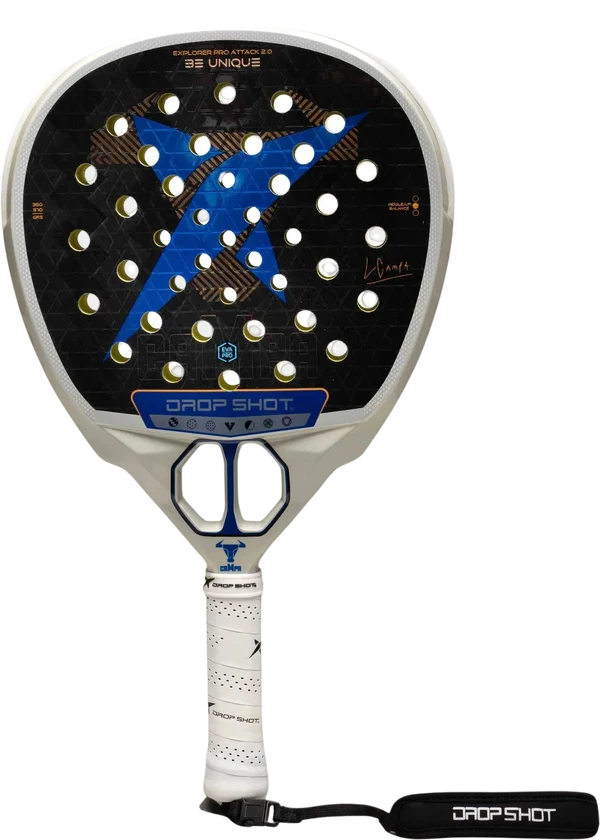

8 Parameters
Explorer Pro Attack 2.0 2026
On this page
Review
Drop Shot Explorer Pro Attack 2.0 2026 Review: Does the Teardrop Deliver Both Ways?
The sharpest tension in padel equipment sits between rackets that commit to one role and those that promise everything without delivering much. A drop-shaped racket priced above €300 and marketed as both offensive and versatile is exactly that kind of claim — one that demands scrutiny. The Drop Shot Explorer Pro Attack 2.0 2026 enters that territory directly, positioning itself as the flagship hybrid in a lineup that also offers dedicated power and softer comfort alternatives.
Built around an EVA Pro High Density foam core and a 24K Carbon Twill Textreme surface with 3D Face System texture, the frame incorporates Drop Shot’s Power Beam Heart and Twin Tubular System for structural reinforcement. The Vibra Tech system targets vibration damping, and the Ergo Pro Protector adds an ultra-resistant carbon edge protector. Declared weight runs 360–375g depending on the source, with one variant citing 350–370g — a spread wide enough to note. Balance sits at 260mm, stiffness at 62 RA, and profile at 38mm. Explore the full Drop Shot lineup for context on where this sits.
Power leads at 7.8 — the highest individual score — while Spin sits at 7.0, the floor. Attacker: 7.67 | Hybrid: 7.56 | Defender: 7.37. The 0.30-point gap between attacker and defender profiles tells the real story: this racket has a direction, and it points forward.
Performance Breakdown
How the Explorer Pro Attack 2.0 2026 Plays
STABILITY 7.6
The Frame Earns Its Premium Price Tag
The Twin Tubular System and Power Beam Heart aren’t marketing decoration — they translate directly into the racket’s strongest area. The 24K carbon frame at 62 RA sits on the firm side without tipping into punishing territory, and the EVA Pro High Density core adds mechanical memory that amplifies offensive shots. Power scores 7.8, the highest mark across all parameters, while Stability at 7.6 confirms the frame holds its line under hard contact. For a drop shape, the stability figure is notably solid — drop-shaped rackets often concede stability for accessibility, but the reinforced construction here resists that trade-off.
SWEETSPOT 7.3
Precision That Follows Power, Not Fights It
Control at 7.6 matches Stability exactly — that alignment is not coincidental. A stable frame reduces vibration scatter on off-center hits, and the Vibra Tech system reinforces that by managing residual feedback at the grip. The EVA Pro core’s density contributes a consistent dwell time, giving players a fraction more awareness of where the ball is going. Sweetspot Size at 7.3 sits at mid-range — adequate for the intermediate-advanced player this racket targets, but it tells you precision under fatigue will demand more from your technique than the racket itself provides.
PLAYABILITY 7.3
Vibra Tech Is Real, But This Is Still a Hard Racket
At 62 RA, the Explorer Pro Attack 2.0 is firm. The Vibra Tech system and the Smart Holes System’s progressive distribution do measurable work in reducing peak vibration at the grip — Comfort scores 7.3, a respectable number for this stiffness level, not a standout one. Playability matches it at 7.3, reflecting a racket that rewards players who arrive with good fundamentals rather than compensating for those who don’t. The Soft variant exists precisely for those who want the same frame architecture with less arm demand — the 2.0 here is for players who can handle the RA, not for those exploring their tolerance.
SPIN 7.0
Where the Hybrid Promise Has a Ceiling
Maneuverability at 7.2 and Spin at 7.0 are the two parameters that define the racket’s limits. The 260mm balance point sits mid-low, which typically aids handling — but the declared weight of up to 375g and the 38mm profile create a frame that requires deliberate preparation. The 3D Face System texture is designed for spin generation, and it contributes, but Spin at 7.0 is the floor of this racket’s scorecard. Neither score triggers a floor penalty, but together they confirm that this is not the tool for high-rotation baseline specialists or players who build points primarily through wrist speed and topspin angles.
Technology
3D Face System + Vibra Tech: Functional Stack or Feature Inflation?
The 3D Face System is Drop Shot’s answer to the surface texture arms race in padel — a three-dimensional roughness pattern on the 24K Carbon Twill Textreme face designed to increase dwell time and generate additional ball rotation. On a racket with 62 RA stiffness, the surface texture matters more than it would on a softer core, because the frame doesn’t naturally provide extended contact time. The 7.0 Spin score reflects that the system works at a functional level but doesn’t elevate the racket into the upper tier of spin-generating tools — a honest outcome for a frame primarily engineered around power and stability.
The Vibra Tech system operates at the grip end, targeting the vibration frequency that reaches the hand and forearm after hard contact. Combined with the EVA Pro High Density core’s impact absorption, the racket achieves a 7.3 Comfort score at 62 RA — a result that most frames at this stiffness level don’t reach. It’s not a soft racket dressed up as comfortable; it’s a hard racket that has done real structural work to reduce arm fatigue over extended sessions. The Smart Holes System adds a further layer: the curved, progressive hole distribution influences how mechanical forces distribute at impact, reinforcing both spin generation and vibration reduction simultaneously.
The Power Beam Heart and Twin Tubular System are frame-level technologies rather than surface or core features — their contribution shows in the 7.6 Stability score rather than in any single shot characteristic. For intermediate-advanced players who shift between attacking at the net and resetting from the back, this structural reinforcement is what keeps the racket honest across different phases of play. The technology stack is real and measurable in the scores. It doesn’t transform the racket into something it isn’t — but it does justify the architecture.
Player Fit
Who Should Buy the Drop Shot Explorer Pro Attack 2.0 2026?
The Intermediate-Advanced All-Court Attacker
If you’re the type who plays to win points at the net but needs the racket to hold up when you’re pushed back — this is exactly the profile the 2.0 was built for. Power at 7.8 and Stability at 7.6 give your offensive game a genuine foundation, while Control at 7.6 means you’re not sacrificing placement for pace. The Attacker score of 7.67 leads, but the Hybrid score of 7.56 is close enough that you don’t have to pick a lane. You’ve already developed your technique past the beginner phase, you understand racket stiffness, and you’re looking for a frame that pushes you forward rather than one that catches your mistakes. The Explorer Pro Attack 2.0 does exactly that.
Beginners, Spin Players, and Arm-Sensitive Defenders
The Defender score of 7.37 is the lowest of the three profiles — and the gap to the Attacker score tells you this racket has a direction. If your game is built around retrieving, lofting, and grinding from the back, the 7.0 Spin and 7.2 Maneuverability won’t serve you the way a dedicated defensive tool would. At 62 RA with a declared weight approaching 375g, this is also not the frame for players with existing elbow or shoulder sensitivity — the Vibra Tech system helps, but it doesn’t rewrite physics. Beginners will find the sweetspot at 7.3 unforgiving before they’ve built the consistency to stay centered. If arm protection and a lower learning curve are the priority, the Explorer Pro Attack Soft 2026 is the more honest starting point.
FAQ
Frequently Asked Questions
What is the PadelVerdict score for the Drop Shot Explorer Pro Attack 2.0 2026?
The overall Verdict Score is 7.8, with a Consensus Modifier of +0.1 applied. Specs appear consistently across multiple markets (Data Quality: neutral), specialist sources across multiple markets align on shape, core, surface, and weight with no contradictions found (Field Validation: positive), but no independent physical measurements exist to go further (Market Correction: neutral). That Field Validation component earns the +0.1. Profile breakdown: Attacker 7.67 | Hybrid 7.56 | Defender 7.37. The 0.30-point gap between top and bottom profiles means this is a racket with a clear offensive lean — it suits multiple player types, but not equally.
Is the Drop Shot Explorer Pro Attack 2.0 2026 good for intermediate players?
Yes — conditional on where you sit in the intermediate range. The Playability score of 7.3 and Sweetspot Size of 7.3 signal a racket that responds well to players with developing technique, but the 62 RA stiffness means early-intermediate players may find it punishing on off-center contact. If you’re comfortably past the beginner phase and hitting with reasonable consistency, the Explorer Pro Attack 2.0 gives you room to grow into its power. If you’re still building fundamentals, the Explorer Pro Attack Soft 2026 is the safer choice.
Is the Drop Shot Explorer Pro Attack 2.0 2026 good for attacker players?
Yes. The Attacker profile score of 7.67 leads the three profiles, anchored by Power at 7.8 and Stability at 7.6 — both of which matter most when you’re pressing from the net. Control at 7.6 keeps your placement honest under pressure. It’s the right tool for players who attack as their primary strategy. Browse the best attacker rackets to see how it stacks up in context.
What is the actual weight of the Drop Shot Explorer Pro Attack 2.0 2026?
The declared range across most sources is 360–375g, with one market citing 350–370g. That 25g variance is wider than typical — it’s likely a combination of production tolerance and inconsistent sourcing rather than genuinely different versions. No independent on-court measurements exist to narrow it further. A 15g difference at this weight class is perceptible on court, particularly in maneuverability and swing speed. If the exact unit weight matters to your game, weigh yours before your first session.
How does the Drop Shot Explorer Pro Attack 2.0 2026 compare to the Explorer Pro Attack Soft 2026?
Same frame architecture, different core. The Attack 2.0 uses EVA Pro High Density at 62 RA — built for players who want maximum response and can handle the stiffness. The Explorer Pro Attack Soft 2026 reduces arm demand at the cost of some power ceiling. The choice comes down to physical tolerance and playing style: if you have any arm sensitivity or play long sessions multiple times per week, the Soft is the responsible choice. If your body is fine with firm rackets and power is the priority, the 2.0 is the better investment.
Why does the Drop Shot Explorer Pro Attack 2.0 2026 have a Consensus Modifier of +0.1?
Because the data for this racket does something that most entries in this category don’t: it holds together across independent editorial sources, not just commercial ones. Shape, core material, surface technology, and weight range align without contradiction across multiple markets, which reflects active editorial attention rather than simple distribution. That cross-market convergence is the signal the modifier rewards. Consistent and validated are two different things — and for this racket, only the former is fully in place. That distinction is precisely what separates a +0.1 from a higher adjustment.
Similar Rackets
Independent testing, funded by readers
No brand deals, no sponsored picks. If you found this useful, you can support the next round of tests with a small tip.

