
Joma Blast Pro SFT 2026
Does the Balanced Bet Pay Off?
The short verdict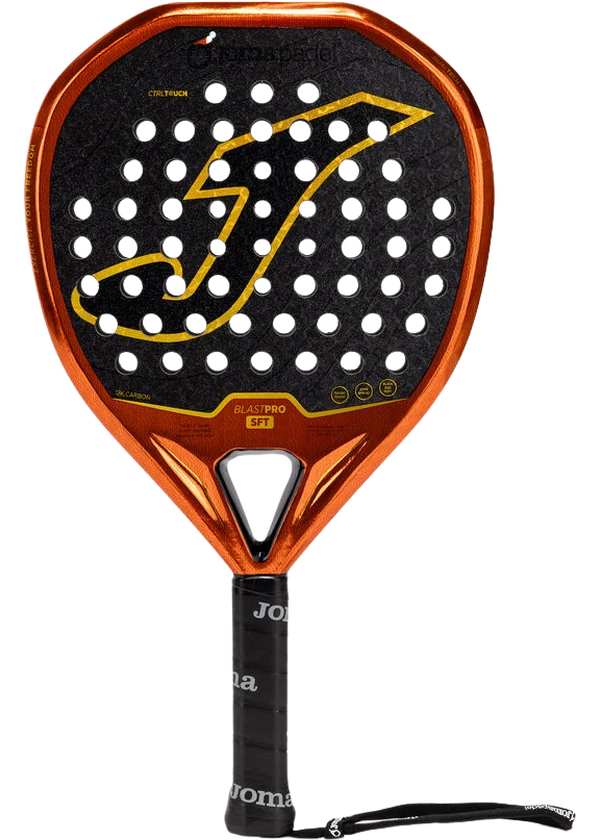
8 Parameters
Joma Blast Pro SFT 2026
On this page
Review
Joma Blast Pro SFT 2026 Review: Does the Balanced Bet Pay Off?
The most contested decision in padel racket selection isn’t power vs. control — it’s how much you sacrifice at either end to get a genuinely usable middle. Most rackets that claim balance deliver a diluted version of both. The Joma Blast Pro SFT 2026 is a drop-shaped hybrid that takes a clear position: build maneuverability and control into the frame architecture, let power serve as a supporting role, and give the intermediate-to-advanced player a racket that earns its keep across every phase of a match rather than dominating one.
The specs reinforce that argument structurally. The core is Black EVA SFT — high-density foam tuned for medium-soft response — paired with a surface that runs 66.7% fibreglass and 33.3% 12K carbon fiber, finished with Joma’s 3D SPIN texture for grip on the ball. The frame is built on the DUALTECH FRAME system, a 100% carbon tubular construction at 38mm profile. Three proprietary systems layer on top: AEROBUMP TECH (aerodynamic groove geometry for swing speed), CTRL TOUCH (an intelligent drilling pattern that redistributes weight and flex), and JOMA 3D SPIN (three-dimensional surface relief for topspin and slice). Stiffness sits at 50 — firmly in medium territory. Part of Joma’s 2026 lineup, the Blast Pro SFT is the softer counterpart to the Blast Pro HRD, positioned below the offensive Hyper and above the control-focused Valkiria.
Maneuverability leads at 8.1 — the highest single score in the set. Hybrid 7.87 / Defender 7.80 / Attacker 7.56. The gap between Hybrid and Attacker tells the story: this racket rewards patience and precision over raw aggression, and the 0.31-point spread confirms it’s not a pure specialist.
Performance Breakdown
How the Joma Blast Pro SFT 2026 Plays
PLAYABILITY 7.9
The Racket Does the Work at Net
Maneuverability at 8.1 is the single highest score in this set and the clearest performance signal the Joma Blast Pro SFT 2026 sends. The AEROBUMP TECH groove geometry reduces drag through the swing arc, and the medium-high balance point keeps transitions fast without making the head feel uncontrolled. Playability at 7.9 reflects how that agility compounds across a full match — the racket doesn’t punish rushed footwork or late ball contact the way a stiff diamond would. For a drop-shaped racket built around this profile, those two scores are exactly where they need to be.
SWEETSPOT 7.8
COMFORT 7.6
Off-Center Shots Don’t Cost You the Point
Control and sweetspot both land at 7.8 — a pairing that matters more than either number in isolation. The CTRL TOUCH drilling pattern redistributes weight and flex so that the hitting zone remains responsive even when contact moves toward the frame edge. The fibreglass-dominant face (66.7%) softens the feel relative to a full-carbon surface, which is what keeps comfort at 7.6 rather than below it — the Black EVA SFT core absorbs shock well enough for players with arm sensitivity concerns. The DUALTECH FRAME adds structural damping that keeps vibration from compounding through the handle on mistimed shots.
SPIN 7.4
Enough to Finish — Not Enough to Overwhelm
Power at 7.6 is a deliberate design outcome, not a shortcoming. The medium-soft core absorbs some of the energy that a harder compound would redirect, which is the trade-off you accept for the comfort and control gains above. The more interesting number is spin at 7.4 — the lowest in the set. The JOMA 3D SPIN texture adds grip and helps generate topspin and slice, but the fibreglass-heavy face composition limits how aggressively the surface can bite the ball compared to a full-carbon alternative. Players who build heavily on spin-heavy drives should note that gap before committing. Among drop-shaped rackets at this level, the spin ceiling here is moderate.
Stable Enough — But Not a Wall
Stability at 7.4 is the weakest parameter alongside spin, and it connects directly to the lower Attacker score of 7.56. The DUALTECH FRAME provides respectable rigidity under hard contact, but the medium-soft core will flex more than players who dominate from the smash position would prefer. This isn’t a racket that neutralizes pace from big hitters — it redirects it. That’s fine for the hybrid and defender profiles it’s designed to serve, but players taking heavy smashes from the back left or right corners will notice the reduced platform stability on block returns.
Technology
DUALTECH FRAME + Three Systems: Architecture That Earns Its Complexity
The Joma Blast Pro SFT 2026 runs three proprietary systems on top of its DUALTECH FRAME base, and each one addresses a specific parameter rather than a generic claim. AEROBUMP TECH places aerodynamic indentations in the frame profile to reduce air resistance through the swing arc — the measurable outcome is an 8.1 maneuverability score that leads the entire parameter set. For a drop-shaped racket at 355g, that swing ease doesn’t happen by accident; it’s engineered into the frame geometry before the player even touches the grip.
CTRL TOUCH operates through the drilling pattern — the holes aren’t positioned arbitrarily but are placed to redistribute weight and flex in a way that expands the effective hitting zone. The result shows in the 7.8 sweetspot score: off-center contact remains predictable rather than punishing, which directly supports the 7.8 control figure. This is the system that makes the racket forgiving without making it mushy, and it’s what separates the SFT from competitors that achieve similar sweetspot size through softer cores alone.
JOMA 3D SPIN adds three-dimensional surface relief to the 12K carbon face, creating micro-texture that grips the ball for topspin and slice generation. The spin score of 7.4 reflects the system’s real-world ceiling: it helps, but the fibreglass-dominant face composition (66.7%) limits how much bite the surface can generate at pace. The three systems together serve intermediate-to-advanced players who want a technically coherent racket — one where maneuverability, forgiveness, and touch are the primary outputs, and power is built from those foundations rather than imposed from a stiff frame.
Player Fit
Who Should Buy the Joma Blast Pro SFT 2026?
The Patient Builder Who Finishes on Their Terms
If you’re the type who constructs points from the back, waits for the right ball to attack, and needs a racket that stays obedient through every phase rather than demanding you play around it — this is your frame. The hybrid score of 7.87 leads the profile breakdown, supported by an 8.1 maneuverability figure that keeps transitions effortless and a 7.8 sweetspot score that absorbs the imperfect contacts that come with patient rallying. Intermediate-to-advanced players who have struggled with arm discomfort on stiffer frames will find the Black EVA SFT core genuinely forgiving without sacrificing the control precision that competitive play demands. If that description sounds like your last three matches, this racket confirms the instinct. It’s among the intermediate picks from our 8-parameter tests — worth comparing before you buy.
Power-First Attackers Who Live at the Net
The attacker score of 7.56 — a full 0.31 below the hybrid score — tells the story plainly. If your game depends on ending points with heavy smashes and spin-loaded drives from the left side, the stability floor at 7.4 and the spin ceiling at 7.4 will leave you working harder than the racket works for you. The medium-soft core flexes where an attacker needs rigidity, and the fibreglass-dominant face doesn’t generate enough surface bite to support the spin game that net dominance requires. The Blast Pro HRD — the firmer variant in the same lineup — is the more honest choice for that profile.
FAQ
Frequently Asked Questions
What is the PadelVerdict score for the Joma Blast Pro SFT 2026?
PadelVerdict scores the Joma Blast Pro SFT 2026 at 7.9 overall, with a Consensus Modifier of 0. Specs are consistent across multiple sources (Data Quality: neutral), declared figures show no implausible outliers (Field Validation: neutral), but no independent physical measurements exist to validate them (Market Correction: neutral). Profile breakdown: Hybrid 7.87 / Defender 7.80 / Attacker 7.56. The 0.31-point gap between Hybrid and Attacker confirms this is a versatile all-court racket with a clear ceiling for aggressive play.
Is the Joma Blast Pro SFT 2026 good for intermediate players?
Yes, genuinely. The 7.8 sweetspot and 8.1 maneuverability are the numbers that matter most for intermediate players — they reduce the punishment for imperfect contact and keep rally transitions manageable. The playability score of 7.9 confirms the racket doesn’t demand technical perfection to function well. It sits at the upper boundary of intermediate-appropriate rackets; advanced intermediates will find more to work with here than beginners will.
Is the Joma Blast Pro SFT 2026 good for hybrid players?
Yes. It leads the profile breakdown at 7.87 and the three systems — AEROBUMP TECH, CTRL TOUCH, and JOMA 3D SPIN — collectively optimize for the versatility that hybrid play demands. Control at 7.8, maneuverability at 8.1, and sweetspot at 7.8 all serve an all-court game. If hybrid rackets are what you’re evaluating, the hybrid racket category has the full comparison set.
What is the actual weight of the Joma Blast Pro SFT 2026?
Joma declares 355g as the nominal weight, but manufacturer specs range between 350–360g and 360–370g depending on the source — an unusually wide variance. No independent measurements exist to resolve the discrepancy. On court, a difference of up to 15g at this balance point is perceptible, particularly during extended rallies. If weight precision matters to your setup, handle-weighting or gripping adjustments after purchase may be worth considering.
How does the Joma Blast Pro SFT 2026 compare to the Blast Pro HRD?
The choice between them is a choice between two player types. The SFT rewards patience — softer core, more forgiveness, better arm comfort, and a game built around control and maneuverability. The HRD is for players who want more rigidity under hard contact and a firmer response on attacking shots. If you construct points and finish selectively, the SFT. If you want to end points with pace and need the frame to hold under pressure, the HRD is the more honest match.
Why does the Joma Blast Pro SFT 2026 have a Consensus Modifier of 0?
The specs are consistent — the same shape, core, surface composition, and technology stack appear uniformly across multiple markets with no contradictions. That consistency earns a neutral baseline, not a positive modifier. What moves the modifier upward is specialist-level convergence beyond retailer descriptions, or independent physical measurements confirming declared figures. Neither exists for this racket. Consistent data without independent validation earns neutral, not positive. A confirmed on-camera weight measurement or structured field validation would support a positive adjustment.
Similar Rackets
Independent testing, funded by readers
No brand deals, no sponsored picks. If you found this useful, you can support the next round of tests with a small tip.

