
BlackTitan 2026
When Precision Is the Power
The short verdict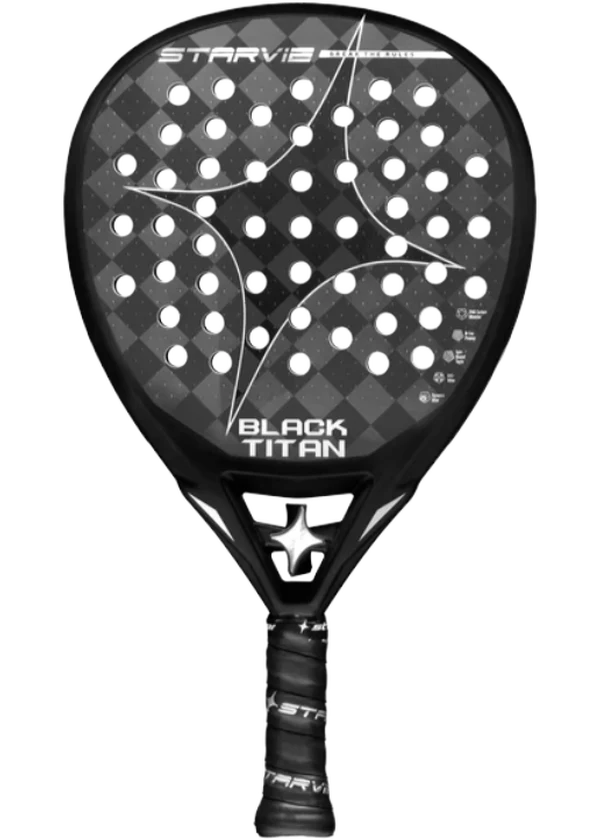


8 Parameters
BlackTitan 2026
On this page
Review
Starvie BlackTitan 2026 Review: When Precision Is the Power
At the top end of the attacking racket category, the central tension isn’t between power and control — most premium frames claim both. The real tension is between rawness and refinement: how much of that explosive output can you actually place, under pressure, on a moving ball? The Starvie BlackTitan 2026 bets that a hard, dry, low-ball-output frame tuned to surgical precision is the correct answer for a very specific kind of player.
Built around an H-EVA Power high-density hard EVA foam core and clad in a 24K Carbon Master surface with 3D rough texture and Spin Boost Tech, the BlackTitan sits on a drop shape with a 38mm profile and a stiffness rating of 78 — the hardest in the Starvie 2026 lineup. The Five Sides Tech frame provides structural rigidity while the proprietary Dynamic Star System — a swappable central weight — allows balance adjustment of up to 0.3cm, shifting the measured balance point between 261mm and 265mm depending on configuration. Anti-Vibe Technology sits in the construction as vibration damping, and Reactive Holes distribute contact in a curved pattern aimed at sweetspot consistency and ball exit control.
Control at 9.2 is the headline — the highest parameter in the set, and on a frame with Power at 8.8, that combination is genuinely rare. Attacker: 8.73 / Hybrid: 8.21 / Defender: 7.89. A 0.84-point gap between Attacker and Defender tells you exactly who this racket was built for — and who it was not.
Performance Breakdown
How the Starvie BlackTitan 2026 Plays
CONTROL 9.2
The Rarest Combination in Attacking Padel
Most hard attacking frames force a trade: power climbs as placement precision slips. The BlackTitan sidesteps this through the interplay of its stiff 24K Carbon Master surface and the measured balance adjustment of the Dynamic Star System. Power lands at 8.8 — explosive and direct — but the story is Control at 9.2, which is the highest individual score on this racket and genuinely uncommon at this level of stiffness. The dry, low-ball-output feel expert sources consistently describe is a product of that combination: when the ball doesn’t compress as deeply into the core, placement becomes more predictable, not less. This is an attacking frame where the shot you intended is the shot that happens.
STABILITY 8.4
Spin That Earns Its Score
The 3D rough surface texture delivered by Spin Boost Tech is not decorative — on a frame with this level of rigidity, ball contact is brief and decisive, which means spin generation is maximised in that compressed window. The 8.3 Spin score reflects that efficiency: a bandeja or vibora hit cleanly generates trajectory that jumps aggressively off the court. Stability at 8.4 comes from the Five Sides Tech profile and the Reactive Holes curved pattern working together with a 38mm frame to resist torsion on off-centre contact. For aggressive net play — where the ball arrives fast and the margin for error is small — that structural confidence is directly measurable in shot quality.
SWEETSPOT 7.2
The Price of a High Balance Point
A measured balance of 263mm — even in its lightest Dynamic Star configuration — places the BlackTitan firmly in high-balance territory for a drop-shaped drop-shaped racket. Maneuverability at 7.4 reflects that honestly: this is not a frame you flick into quick exchanges or recover with during a defensive scramble. The sweetspot at 7.2 compounds this — smaller than sibling models like the Triton Power, it rewards clean contact and penalises anything hit in haste or off-balance. These two scores together are the direct explanation for the Defender profile sitting at 7.89: the racket is not built to be forgiving under duress, and it doesn’t pretend otherwise.
PLAYABILITY 7.1
Hard-Feeling Does Not Mean Harmful — With Caveats
Comfort at 6.4 is the BlackTitan’s most candid number, and a score below 6.5 carries real weight in our scoring framework. The Anti-Vibe Technology does absorb a meaningful share of impact vibration — the hard, dry feel is present but not punishing on clean contact, and no arm or elbow issues emerge from structured feedback. However, this is a stiffness-78 frame: players with existing joint sensitivity, or those who play multiple long sessions weekly, will notice cumulative fatigue that a softer core would buffer. Playability at 7.1 narrows the addressable audience further — this is not a racket that teaches you to play attacking padel, it’s one that executes it for you, provided you already know how. The technical ceiling is high; the learning curve is real.
Technology
Dynamic Star System: Does Adjustable Balance Actually Change How This Racket Plays?
The Dynamic Star System is a swappable central weight insert that shifts the BlackTitan’s balance point by up to 0.3cm — measured at 261mm with the system installed and 265mm without. That 4mm window is modest in absolute terms, but it operates on a frame already dialled to a precise attacking profile, which makes the adjustment more meaningful than it sounds. At 265mm balance, the racket behaves as a purer attacking tool with enhanced overhead leverage. At 261mm it becomes marginally more neutral in hand, recovering some Maneuverability from the 7.4 baseline. Neither configuration makes this a different racket — but for an advanced player fine-tuning positioning preferences between left-side dominance and more balanced play, the adjustment is real and repeatable.
The 24K Carbon Master surface is responsible for the Power (8.8) and Control (9.2) scores more than any other single element. Ultra-rigid 24K carbon provides the structural platform for a direct, explosive ball exit — the frame deforms minimally on contact, meaning energy transfer is efficient and the ball goes where it’s directed rather than where the frame decides. Spin Boost Tech’s 3D rough texture is layered onto this surface to maximise grip within that brief contact window, which is how Spin reaches 8.3 despite the low dwell time inherent to a hard core at stiffness 78.
Five Sides Tech — the five-edged frame profile — directly underlies the Stability score of 8.4 by resisting torsional flex on off-centre contact, which matters when finishing points from overhead at pace. Reactive Holes, the curved hole distribution pattern, contributes to sweetspot consistency within the 7.2 score: it’s not a large sweetspot, but it’s a predictable one, and for advanced players who generate their own pace, predictability is the more valuable property. Anti-Vibe operates at the intersection of the Comfort score (6.4) — it keeps the BlackTitan in the “hard but manageable” category rather than the “physically punishing” one, though it cannot fully compensate for a stiffness rating at the top of the market.
Player Fit
Who Should Buy the Starvie BlackTitan 2026?
The Advanced Attacker Who Owns the Net
If you’re the type who finishes points rather than grinding them — who measures a session by how many smashes landed on target rather than how many balls you retrieved — the BlackTitan was engineered for your game. You generate your own pace and don’t need the frame to do it for you, which means the Playability score of 7.1 is irrelevant to your decision. What matters is that Power (8.8), Control (9.2), and Stability (8.4) combine into a platform that doesn’t second-guess your intentions. The Dynamic Star System lets you configure balance to your preferred court position, and the high-balance drop shape gives you natural leverage when it counts most. If your technique is clean, this racket makes every attacking shot feel inevitable.
Defenders, Improvers, and Anyone Who Hates a Hard Feel
The Defender profile score of 7.89 is the lowest on the sheet, and it tells the whole story: a Sweetspot at 7.2 combined with Maneuverability at 7.4 means this frame does not rescue mistimed or defensive shots — it exposes them. If you’re still building your attacking game, the Playability floor of 7.1 will work against your development rather than with it. And if joint comfort is a concern, a Comfort score of 6.4 on a stiffness-78 frame is a clear signal. Players in that position would be better served by something with a larger sweetspot and softer core — like the Starvie Triton Power 2026, which trades some precision for significantly more forgiveness.
FAQ
Frequently Asked Questions
What is the PadelVerdict score for the Starvie BlackTitan 2026?
The PadelVerdict score is 8.9. The Consensus Modifier is +0.1: specs are consistent across multiple sources (Data Quality: neutral), specialist sources across multiple markets align on shape, core, surface, balance range, and stiffness with no contradictions found (Field Validation: positive), but no independent physical measurements exist to go further (Market Correction: neutral). That Field Validation component earns the +0.1. Profile breakdown: Attacker 8.73 / Hybrid 8.21 / Defender 7.89. The 0.84-point gap between Attacker and Defender makes the racket’s intended audience unmistakable — this is a specialist, not a generalist.
Is the Starvie BlackTitan 2026 good for advanced players?
Yes — but only for advanced players with a developed attacking game. The Playability score of 7.1 is the gate: this frame does not guide you toward better technique, it assumes you already have it. If your shot execution is consistent and you play primarily at the net, the Control (9.2) and Power (8.8) combination will feel like an upgrade. If you’re still building those foundations, a more forgiving frame with a higher Playability score will serve your development better.
Is the Starvie BlackTitan 2026 good for attackers?
Yes, decisively. The Attacker profile score of 8.73 is supported by three parameters working in concert: Power at 8.8, Control at 9.2, and Stability at 8.4. That’s a platform built to finish points, not survive them. Spin at 8.3 adds trajectory aggression when the ball lands. If you’re looking for validation that this is the right tool, those numbers provide it. You can browse all best attacker rackets on PadelVerdict to see how it compares in category.
What is the actual weight of the Starvie BlackTitan 2026?
Measured weight ranges between 361g and 373g across sources, depending on whether the Dynamic Star system (approximately 12g) is installed or removed. The declared average is 367g. That 12g variance is perceptible on court — high-balance frames amplify small weight differences at the top of the head — so if you’re optimising for a specific feel, testing with and without the insert is worth doing before settling.
How does the Starvie BlackTitan 2026 compare to the Starvie Raptor 2026?
Both are hard, dry hybrid-attacking frames with customisable weight and low ball output — the design DNA is shared. The distinction comes down to contact: the Raptor has a more forgiving sweetspot, making it the better choice for advanced players who want attacking intent with a slightly lower technical demand. The BlackTitan’s smaller sweetspot pushes precision further — it’s for the player who is already consistently clean and wants maximum output from that consistency, not a buffer against the moments they aren’t.
Why does the Starvie BlackTitan 2026 have a Consensus Modifier of +0.1?
The +0.1 reflects convergence that goes beyond baseline consistency. Specs appearing uniformly across sources is the starting point — that’s neutral, not positive. What earns the positive adjustment here is specialist-level alignment across multiple markets: shape, core material, surface technology, balance range, and stiffness all described without contradiction by independent expert sources. That cross-market agreement on technical detail is the signal. The ceiling stays at +0.1 because no independent physical measurements exist to confirm the declared figures — that confirmation would be required to go further.
Similar Rackets
Independent testing, funded by readers
No brand deals, no sponsored picks. If you found this useful, you can support the next round of tests with a small tip.

