
Triton Power+ 2026
Is Raw Power Worth the Trade-Off?
The short verdict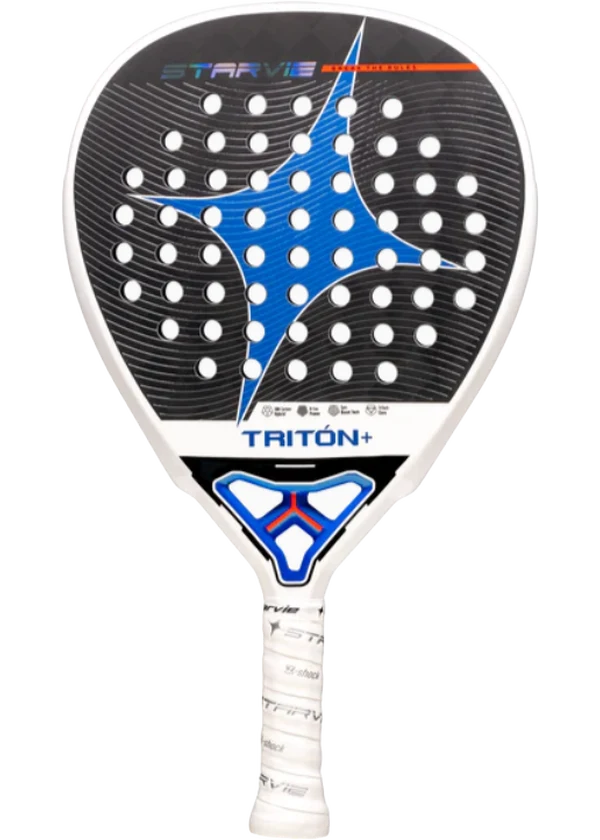

8 Parameters
Triton Power+ 2026
On this page
Review
Starvie Triton Plus Power 2026 Review: Is Raw Power Worth the Trade-Off?
Diamond rackets make a contract with the buyer: you accept reduced margin for error in exchange for weapons-grade ball exit. The question is never whether that contract is fair — it’s whether the specific racket asking you to sign it delivers enough on the power side to justify what it costs you in comfort and maneuverability. The Starvie Triton Plus Power 2026 stakes its claim firmly in this territory, targeting advanced attackers who don’t want a ceiling on their offensive ceiling.
The Triton Plus Power is built on a high-density H-EVA Power foam core, which StarVie positions above standard EVA in firmness and responsiveness. The surface is an 18K carbon hybrid layup with rough texturing branded as Spin Boost Tech, designed to generate grip on the ball without sacrificing exit velocity. The frame itself is pure carbon constructed with Five Sides Tech — five-edged geometry for structural rigidity and aerodynamic profile — while the proprietary TriTech Core system uses a triple-layer architecture aimed at distributing stability, maneuverability, and accuracy across the frame. Z-Shock vibration dampening is integrated into the frame to address what is historically the biggest complaint against high-stiffness diamonds. A longer handgrip completes the profile. Browse the full StarVie lineup for context on where this sits in their 2026 range.
Comfort lands at 6.4 — the lowest score in the set, and the number that defines everything. Attacker: 8.21 · Hybrid: 7.72 · Defender: 7.39. The 0.82-point gap between Attacker and Hybrid isn’t ambiguous: this racket has a role, and deviating from it costs you.
Performance Breakdown
How the Starvie Triton Plus Power 2026 Plays
STABILITY 8.3
The Ceiling Is Deliberately High
High-density H-EVA Power foam in a hard diamond frame produces a ball exit that is immediate and decisive — there is minimal dwell time, and energy transfer is almost entirely mechanical rather than feel-based. At 8.7, Power is the headline score, and it is supported by a Stability reading of 8.3 that prevents the frame from torquing on off-center contact during hard smashes. The Five Sides Tech geometry contributes directly to that stability figure by reinforcing the frame at its most vulnerable stress points. For an advanced attacker who hits through the ball rather than timing it softly, this combination is exactly what the racket was built to deliver.
CONTROL 7.8
Spin Punches Above Its Weight Class
A Spin score of 7.9 is genuinely notable on a racket this stiff — rough surface texturing via Spin Boost Tech adds directional bite that most hard diamonds sacrifice entirely in favor of flat power. Control at 7.8 is respectable in context: this is not a placement racket, but the TriTech Core’s triple-layer construction introduces enough feedback differentiation across the hitting zone that experienced players can shape shots with confidence at pace. The surprise is that these two scores stay this close together — on comparable diamond rackets, Spin often either dominates or collapses relative to Control. Here the gap is only 0.1.
SWEETSPOT SIZE 7.2
PLAYABILITY 7.1
Where the Contract Bites
Maneuverability, Sweetspot Size, and Playability all land at 7.2 or 7.1, and that cluster is the mechanical consequence of the power package above it. A 268mm balance point with a high-density core shifts mass away from the handle and toward the head — that’s physics working for you on smashes, and against you on quick net exchanges or reactive blocks. Playability at 7.1 is the lowest in the non-comfort group, and it explains precisely why the Defender profile score (7.39) trails by nearly a full point. Players who spend significant time defending from the back corner will feel this as resistance rather than response.
Z-Shock Helps — But Doesn’t Solve the Problem
Comfort at 6.4 is the lowest score in the set, and it is the number that limits this racket’s audience most sharply. Z-Shock vibration dampening is a genuine engineering response to the stiffness problem — the system is present and measurable in how it attenuates shock on clean contact — but a stiffness rating of 75 on a high-balance diamond sets a hard floor that no dampening system fully overcomes on mishits. Players with any history of elbow or shoulder sensitivity should treat this number as a hard constraint, not a soft advisory. The Z-Shock does enough to prevent this from being a punishment tool in the right hands, but those hands need to be conditioned and technically consistent.
Technology
TriTech Core + Z-Shock: Architecture That Earns Its Name?
TriTech Core is StarVie’s triple-layer internal construction — not a marketing label for a single material, but a genuine structural decision that layers materials with different density and flex characteristics across the core thickness. The primary outcome is stability distribution: by differentiating the core’s response across its depth, the system reduces the torque differential between center and off-center hits, which is exactly what keeps the Stability score at 8.3 even when Power is running at 8.7. On a single-density foam diamond, that gap between Power and Stability tends to widen; TriTech Core closes it.
Z-Shock operates at the frame level rather than the core, using the carbon layup geometry to interrupt vibration propagation before it reaches the handle. The result is visible in the Comfort score — 6.4 is not a comfortable racket by any absolute measure, but for a stiffness-75 diamond with a high balance point, it is meaningfully above what unmitigated designs produce. Think of Z-Shock as moving the ceiling on who can physically play this racket, not as making it feel soft.
Spin Boost Tech — the rough-textured 18K carbon hybrid surface — contributes to the 7.9 Spin score by creating surface friction that generates bite on slice and topspin without adding weight or altering the frame’s aerodynamic profile. The longer handgrip is a finishing detail that supports leverage on aggressive overhead shots, reinforcing the attacker’s toolkit this racket is assembling from the inside out. Every system here has a target user: the advanced player who approaches the game as an offensive problem to be solved.
Player Fit
Who Should Buy the Starvie Triton Plus Power 2026?
The Advanced Attacker Who Lives at the Net
If you’re the type who treats every transition ball as an opportunity to close the point rather than extend the rally, the Triton Plus Power 2026 was built with you in mind. You play at an advanced level — not because you’ve been playing long, but because your technique is consistent enough that mishits are the exception. Power at 8.7 and Stability at 8.3 give your smashes and volleys genuine authority, while Spin at 7.9 means you can load the ball with direction rather than just pace. You already know your elbow is fine with firm rackets; the 6.4 Comfort score doesn’t scare you because you’ve played this type of frame before and your swing is clean enough to keep it there. This racket doesn’t flatter you — it amplifies you.
The Developing Player or Defensive Specialist
If your game is built around retrieving, absorbing pace, or reading the play from the back glass, a Defender score of 7.39 and a Comfort score of 6.4 are not incidental numbers — they are the story. The combination of head-heavy balance, high-density core, and stiffness-75 construction punishes technical inconsistency; an unclean swing becomes a jarring shot rather than a neutral one. Developing players trying to grow into power will find the feedback window too narrow and the arm fatigue too real to accelerate their learning. The racket demands that you already have the swing before you pick it up. If you’re building toward this profile but aren’t there yet, something with a more forgiving sweetspot and lower stiffness will make you better faster.
FAQ
Frequently Asked Questions
What is the PadelVerdict score for the Starvie Triton Plus Power 2026?
The overall PadelVerdict score is 8.2. The Consensus Modifier is 0: specs are consistent across multiple sources (Data Quality: neutral), declared figures carry no implausible outliers (Field Validation: neutral), but no independent physical measurements exist to confirm them (Market Correction: neutral). Consistent data without independent validation earns neutral, not positive. Profile breakdown: Attacker 8.21, Hybrid 7.72, Defender 7.39. The 0.82-point gap between Attacker and Hybrid leaves no ambiguity about what this racket is for.
Is the Starvie Triton Plus Power 2026 good for intermediate players?
Probably not yet. The Comfort score of 6.4 and Playability of 7.1 are the blockers — a stiffness-75 high-balance diamond does not forgive the technical inconsistencies that intermediate play involves. The power ceiling is wasted if the technique isn’t there to unlock it cleanly. Intermediate players developing their game would be better served by a round or teardrop shape with a lower balance point and softer core.
Is the Starvie Triton Plus Power 2026 good for attacking players?
Yes — unambiguously. Attacker score of 8.21, Power at 8.7, Stability at 8.3, and Spin at 7.9 form an offensive toolkit that is coherent and complete. The longer handgrip and high-balance geometry reinforce the smash and overhead game specifically. If aggressive net play defines your style, this is built for you. Browse all best attacker rackets to compare options at this level.
What is the actual weight of the Starvie Triton Plus Power 2026?
The declared weight is 365g. No independent measurements exist for this model, so the variance is unknown and the manufacturer figure is the only available reference. At 365g for a diamond with high balance at 268mm, the swing weight will feel substantial — particularly on quick defensive reactions where head mass works against you.
How does the Starvie Triton Plus Power 2026 compare to the Starvie Black Titan?
Think of it as two different offensive philosophies. The Black Titan is StarVie’s maximum ball-output instrument — raw striking power above all else. The Triton Plus Power trades a fraction of that ceiling to integrate Spin Boost Tech and TriTech Core’s stability layering, making it more directional and structurally consistent under repeated aggressive play. If you want pure ball exit, Black Titan. If you want power with spin and stability, the Triton Plus Power is the more complete attacker’s tool.
Why does the Starvie Triton Plus Power 2026 have a Consensus Modifier of 0?
The modifier reflects what the data can and cannot confirm. Specs appear consistently across multiple markets with no contradictions — shape, core, surface, technologies, and balance all align. But consistency is only the baseline; it doesn’t earn a positive adjustment on its own. What’s missing is any independent physical measurement — no on-camera weigh-ins, no lab-verified balance point, no third-party stiffness readings. That absence keeps the modifier at 0. Independent measurements would be what moves it to +0.1.
Similar Rackets
Independent testing, funded by readers
No brand deals, no sponsored picks. If you found this useful, you can support the next round of tests with a small tip.

