
Fenix Pro 2026
Maximum Power Output — But at What Cost?
The short verdict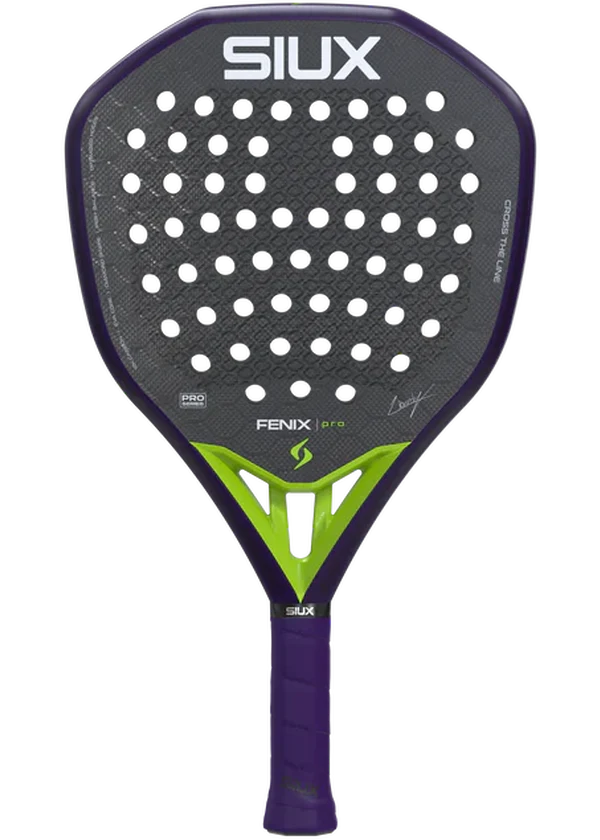

8 Parameters
Fenix Pro 2026
On this page
Review
Siux Fenix Pro 2026 Review: Maximum Power Output — But at What Cost?
There is a class of attacking racket that makes no attempt to serve multiple player types. It commits fully to one outcome — ending points — and asks the player to meet it on its own terms. The trade-off is always the same: what you gain in offensive ceiling, you concede in arm safety, forgiveness, and anything resembling a defensive use case. The question with rackets like the Siux Fenix Pro 2026 is never whether the power is real. It always is. The question is whether you are the player it was built for.
The Siux Fenix Pro 2026 is a diamond-shaped attacking racket built around a hard EVA foam core and a 12K carbon surface with a 3D satin texture designed for ball grip and spin production. The balance point sits at 274mm — decisively head-heavy — with a declared weight range of 355–375g and a single independent measurement at 358g. The frame integrates Siux’s HAMMER technology, a construction philosophy focused on concentrating mass toward the hitting zone to amplify swing momentum on overhead contact. Stiffness is uniformly described as firm to hard across all available data. This is part of the Siux lineup and carries the endorsement of Leo Augsburger, whose attacking style of play the racket directly reflects.
Power leads at 8.8 — the highest parameter and the defining number. Attacker: 8.40 · Hybrid: 7.71 · Defender: 7.17. The 1.23-point gap between Attacker and Defender is unambiguous: this racket has one identity, and every design decision enforces it.
Performance Breakdown
How the Siux Fenix Pro 2026 Plays
STABILITY 8.4
The Ceiling Is Not a Figure of Speech
A 274mm balance point on a diamond frame with a hard EVA core creates the conditions for Power at 8.8 — the highest single parameter in this profile and one of the stronger readings across the current attacker category. The HAMMER construction channels mass exactly where overhead swing momentum converts to ball velocity. What makes the combination coherent rather than simply explosive is Stability at 8.4: the stiff carbon frame resists torsion on off-center contact, meaning the pace does not bleed away when the connection is not perfect. For a player whose game is built on smashes and decisive net volleys, this pairing is the core argument.
CONTROL 7.6
Spin Is a Design Priority, Not a Byproduct
The 3D satin texture on the 12K carbon surface does genuine work — Spin at 7.8 reflects a face that grips the ball at contact, enabling trajectory deviation on víboras and bandeja exits that a smooth surface at the same stiffness would not produce. Control at 7.6 is honest for what this racket is: on clean, deliberate contacts the placement is precise enough to be tactical, but it does not soften feedback on rushed or defensive shots. The 7.6 is not a limitation — it is a clear signal about the technique level required to use this racket well.
SWEETSPOT 7.0
The Geometry Demands Precision, Not Effort
At 358g with a 274mm balance, the Siux Fenix Pro 2026 is not built for reactive defensive scrambles — Maneuverability at 7.2 is serviceable for an attacker who sets up shots deliberately, but it resists anyone needing rapid wrist transitions under pressure. Sweetspot Size at 7.0 is the honest cost of the diamond geometry: the hitting zone is positioned high on the face and rewards central contact emphatically. These two scores together explain why the Defender profile sits at 7.17 — the lowest of the three by a significant margin.
COMFORT 6.5
Manageable — Not Comfortable by Design
Comfort at 6.5 is adequate rather than reassuring — a hard EVA core and stiff carbon frame transmit impact feedback directly to the arm, and while the construction keeps this within acceptable range for conditioned players, it is not a racket that protects the arm over long sessions or forgives physical fatigue. Playability at 6.7 tells a parallel story: this racket performs well when you are imposing on the point, and noticeably less well when you are not. Players with any history of elbow or shoulder sensitivity should treat 6.5 as a genuine caution signal, not a clean bill of health.
Technology
HAMMER + 12K Carbon: Does Concentrating Mass Actually Deliver?
HAMMER is Siux’s construction philosophy for mass distribution — the deliberate concentration of frame weight toward the hitting zone to amplify the momentum of overhead swings. The result is visible in Power at 8.8: the head-heavy 274mm balance does not passively add inertia, it creates the swing arc conditions in which a hard EVA core can return energy to the ball with minimal absorption. This is what separates maximum-output diamond rackets from merely powerful ones — the mass is positioned to do work, not simply to exist.
The 12K carbon construction contributes directly to both Power and Stability at 8.4. The denser weave produces a stiffer layup than lower-count carbon constructions — this is the structural reason the frame does not flex or twist under high-velocity contact. The result is a racket that holds its geometry through full-swing smashes, keeping the energy transfer pathway intact rather than losing it to frame deflection.
The 3D satin surface texture is the mechanism behind Spin at 7.8. Physical friction at the point of contact allows the player to shape ball trajectories on víboras and finishing volleys — grip-based spin generation that holds up at full swing speed, which is the only speed this racket operates at effectively.
The system as a whole amplifies offensive output and accepts the arm-feedback consequences that follow from a hard core and stiff frame. Comfort at 6.5 is the honest outcome of that equation — manageable for conditioned players, a genuine consideration for anyone else. The technology is coherent for one player type: the advanced attacker who generates pace through technique and does not rely on the racket to compensate for position or fatigue.
Player Fit
Who Should Buy the Siux Fenix Pro 2026?
The Advanced Attacker Who Closes Points for a Living
If you’re the type who plays to dominate net positions, finish rallies with pace, and considers a smash a decision rather than a hope — this racket was engineered around your game. Power at 8.8 and Stability at 8.4 give you the offensive ceiling and structural composure to execute under pressure. Spin at 7.8 adds trajectory variation that pure power rackets without textured surfaces cannot match. You have been playing at advanced level for years, your arm is conditioned, and you have no history of elbow or shoulder issues. The Attacker score of 8.40 is the number, but the 1.23-point gap to Defender is the whole story — this racket knows exactly who it is for, and so do you. New to diamond shapes? Read our diamond vs round vs teardrop: our shape breakdown to understand what you’re signing up for.
Developing Players, Arm-Sensitive Players, and Defensive Specialists
Playability at 6.7 and Sweetspot Size at 7.0 will expose every technical gap for players still building consistency — this racket does not compensate for imperfect mechanics, it amplifies them. Comfort at 6.5 is a genuine signal for anyone with elbow or shoulder history: a hard core and stiff carbon frame at this stiffness level will make itself felt over extended sessions. And for defensive players, the Defender score of 7.17 — 1.23 points below Attacker — is not a rounding error. The Siux Electra Pro 2026 offers a more accessible alternative within the same brand for players who need a wider performance envelope.
FAQ
Frequently Asked Questions
What is the PadelVerdict score for the Siux Fenix Pro 2026?
The PadelVerdict score is 8.5, with a Consensus Modifier of +0.05 applied. Specs are consistent across multiple sources (Data Quality: neutral), specialist sources across multiple markets align on the attacking profile with no contradictions found (Field Validation: positive), but only a single independent physical measurement exists — insufficient to go further (Market Correction: neutral). Profile breakdown: Attacker 8.40 · Hybrid 7.71 · Defender 7.17. The 1.23-point Attacker-to-Defender gap is the decisive signal: one role, fully committed.
Is the Siux Fenix Pro 2026 good for advanced players?
Yes — for advanced attacking players with conditioned arms. Playability at 6.7 makes the technical demands clear: this racket rewards players who impose on the point, not those who absorb it. Advanced players with a retrieval or hybrid game will find the Defender score of 7.17 limiting. Comfort at 6.5 is a genuine consideration for anyone with arm sensitivity, regardless of level.
Is the Siux Fenix Pro 2026 good for attacking players?
Yes. Attacker score of 8.40, led by Power 8.8, Stability 8.4, and Spin 7.8 — the combination that makes net-dominant play decisive rather than just forceful. If you close points rather than construct them, this belongs in the conversation. Browse the best attacker rackets to see how it compares across the full category.
What is the actual weight of the Siux Fenix Pro 2026?
Declared range is 355–375g. A single independent on-camera measurement confirmed 358g — at the lighter end. That 20g declared spread is wider than typical: at the heavier end, swing weight increases perceptibly and Maneuverability at 7.2 will feel earned rather than comfortable. The 358g confirmed figure is the most reliable data point available.
How does the Siux Fenix Pro 2026 compare to the Siux Electra Pro 2026?
The Fenix Pro is the pure specialist: maximum power, maximum commitment, minimum forgiveness. The Electra Pro is the broader proposition — offensive capability without the physical cost and technique demands the Fenix Pro imposes. If you want a weapon and your game qualifies, the Fenix Pro. If you need a tool that works across more situations, the Electra Pro is the rational choice.
Why does the Siux Fenix Pro 2026 have a Consensus Modifier of +0.05?
The +0.05 reflects a narrower validation base than a full +0.1 requires. Specialist sources across multiple markets converge on the same aggressive attacking profile without contradiction — that alignment is what moves the modifier above neutral. The ceiling stays at +0.05 because only a single independent physical measurement exists, community feedback is entirely absent across all platforms researched, and comfort claims remain unverified by any third-party testing. Broader independent data would support a higher adjustment.
Similar Rackets
Independent testing, funded by readers
No brand deals, no sponsored picks. If you found this useful, you can support the next round of tests with a small tip.

