
Extreme One 2025
The Diamond That Scores Like a Defender
The short verdict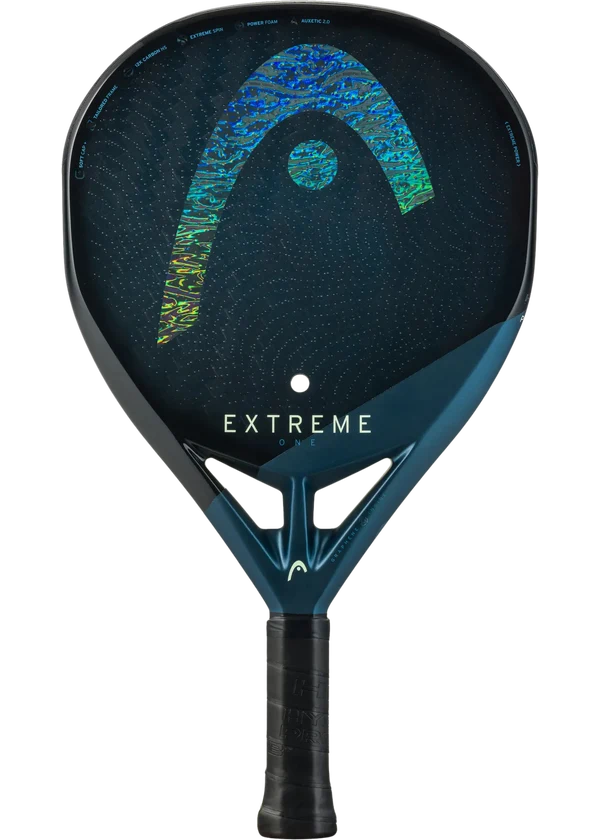


8 Parameters
Extreme One 2025
On this page
Review
Head Extreme One 2025 Review: The Diamond That Scores Like a Defender
The premise of most diamond rackets is simple: head-heavy balance, stiff surface, maximum power transfer. The Head Extreme One 2025 breaks that contract in an unusual way. The shape says attacker. The balance point says attacker. But Power scores 6.8 — and that number redirects everything else. The result is a diamond-shaped frame whose best profile is Defender, whose strengths are Control, Comfort, and Maneuverability, and whose identity is something the market doesn’t have many clean categories for: a precision-first diamond built for players who want the geometry without the raw output.
The Extreme One sits at the lighter end of Head’s Extreme lineup at 350g declared weight, distinguished from the heavier Extreme One X (370g) by its intermediate-to-advanced positioning and unisex target. The core is Power Foam — a reactive EVA at medium firmness — mated to a 12K carbon surface with Extreme Spin rough texture. Frame technology includes Auxetic 2.0, Graphene Inside shaft and head reinforcement, Soft Cap+ for vibration management, and the HEAD ONE singular hole system replacing a conventional pattern. Declared balance is 272mm, beam width 38mm, stiffness index 62.
Control leads at 8.2 — the joint-highest parameter alongside Maneuverability. Defender: 8.15 · Hybrid: 7.96 · Attacker: 7.58. Power at 6.8 is the number that explains the profile gap: this diamond doesn’t finish points with brute force. It earns them with placement.
Performance Breakdown
How the Head Extreme One 2025 Plays
MANEUVERABILITY 8.4
The Case for This Diamond Is Speed and Placement
The two highest-scoring parameters on this sheet are Control and Maneuverability — and together they define exactly what this racket does well. At 350g with a 272mm balance, the Extreme One prepares faster at the net than any other diamond in Head’s current lineup. Maneuverability at 8.4 is the number that makes quick volleys and defensive redirects feel natural rather than forced. Control at 8.2 reflects the HEAD ONE singular hole construction’s contribution to consistent ball feel on centered contact: the reduced frame interruption in the carbon weave produces a cleaner, more predictable response on placement shots. This is a racket that rewards reading the court, not loading up on it.
PLAYABILITY 8.2
The Softest Diamond Head Makes
Comfort at 8.3 is the most striking score in this profile for a diamond-shaped racket. Power Foam’s medium-firmness EVA absorbs a meaningful share of impact vibration before it reaches the handle, and the Soft Cap+ manages what remains. At stiffness 62 — lower than the Extreme Motion’s 68 — the frame itself contributes less shock to the arm, which is why a full session with this racket feels significantly more forgiving than the shape alone would suggest. Playability at 8.2 reinforces the same point: this is accessible for intermediate players in a way that heavier, stiffer diamonds are not. Auxetic 2.0’s tactile feedback gives players a communicative feel at contact rather than the deadened response common in foam-core designs.
SPIN 7.8
Usable, Not Generous
Sweetspot Size at 7.9 reflects a genuine improvement over conventional diamond geometry — the HEAD ONE system’s singular hole construction does expand the effective contact area — but 7.9 still means this is not a forgiving tool. Off-center contact on the frame periphery communicates immediately. Spin at 7.8 tells a similar story: the Extreme Spin rough texture creates real surface grip, but the top-weighted balance requires intentional swing technique to convert that into topspin. Players who generate spin actively through swing path will benefit; those who rely on surface texture alone will find the diamond geometry working against them. Both scores sit comfortably in the mid-range for this shape — better than expected, not exceptional.
STABILITY 7.8
The Number That Changes Everything
Power at 6.8 is the defining constraint of this racket and the reason its best profile is Defender rather than Attacker. The 272mm balance and diamond shape create the geometry for overhead power — but the medium-firmness Power Foam core and stiffness index 62 don’t deliver the fast rebound that converts that geometry into high ball exit speed. Players who approach this expecting Extreme Motion-level output on smashes will be surprised. What 6.8 Power means in practice: the racket does not amplify your overhead; it relies on you to generate pace. Stability at 7.8 is the lowest score in the set and connects directly — under torsional load from wide defensive balls, the 350g frame has real limits. Graphene Inside mitigates but does not eliminate this. Both scores are honest, and both point to the same player profile: someone who builds points rather than finishes them.
Technology
HEAD ONE System: What Removing the Traditional Holes Pattern Actually Changes
The HEAD ONE system’s singular hole construction changes the carbon weave continuity across the hitting surface — fewer frame interruptions mean more consistent flex distribution at contact. In scoring terms, this is the primary driver of the Control score of 8.2 and the Sweetspot Size of 7.9: both sit above what the diamond geometry and balance point would typically produce, and the ONE system is the engineering reason. The cleaner response on centered contact also contributes directly to Playability at 8.2 — players get predictable feedback rather than the variable response that multi-hole conventional patterns can produce at this stiffness.
Auxetic 2.0 operates through a re-entrant lattice geometry that expands on compression rather than contracting — the practical effect is improved energy distribution across the frame at impact rather than concentration at the contact point. This is what keeps Comfort at 8.3 for a diamond design: energy is spread rather than channeled, which means less vibration transmission to the handle. Combined with Power Foam’s medium-firmness EVA and the Soft Cap+ handle system, the Extreme One’s comfort profile is meaningfully better than its shape category average. The trade-off is that these same mechanisms — energy distribution, medium foam firmness, stiffness 62 — are also why Power sits at 6.8. A frame engineered for feel and access gives up some of the rapid rebound that drives raw output.
Graphene Inside reinforces the shaft and upper frame, addressing the torsional weakness inherent in 350g head-heavy designs. Stability at 7.8 reflects that this reinforcement is meaningful — without it, the score would be lower — but not sufficient to eliminate the physical limitation of the weight class. The player who gets the most from this technology stack is the intermediate-to-advanced player who wants diamond geometry for its shape and court presence but needs the comfort ceiling and control precision that heavier, stiffer alternatives can’t provide.
Player Fit
Who Should Buy the Head Extreme One 2025?
The Tactical Intermediate Who Wants Diamond Shape Without Diamond Demands
If your game is built around placement, quick net transitions, and consistent defensive returns — and you want to play with a diamond shape without paying the weight and stiffness tax of heavier models — the Extreme One 2025 was made for you. Control at 8.2, Maneuverability at 8.4, and Comfort at 8.3 give you the three things a tactical intermediate needs: placement precision, arm survivability over a full session, and the speed to be in position. The diamond geometry adds court presence and the Extreme Spin surface provides usable rotation on bandejas. What you won’t get is the kind of overhead finish that sends the ball through the glass. If you’re a builder rather than a finisher, the Defender profile at 8.15 is the right place to start.
The Overhead Attacker Who Expects the Diamond to Do the Work
If you play the right side of the court, close the net aggressively, and need the frame to amplify your smash rather than simply not impede it — Power at 6.8 is a disqualifying number. The Attacker profile at 7.58 is the lowest of the three for a reason: this diamond doesn’t generate pace, it manages it. Players who approach the Extreme One expecting Extreme Motion-level output will be frustrated. The Extreme Motion 2025 is the honest answer for that profile — same family, same shape, a fundamentally different power contract.
FAQ
Frequently Asked Questions
What is the PadelVerdict score for the Head Extreme One 2025?
The PadelVerdict score is 8.2, with a Consensus Modifier of 0. Specs are consistent across multiple sources, but no independent measurements confirm the declared balance point or actual unit weight, and no specialist cross-market validation beyond manufacturer data exists — consistent data without independent confirmation earns neutral, not positive. Profile breakdown: Defender 8.15 · Hybrid 7.96 · Attacker 7.58. The Defender profile leading an Extreme-family diamond is the core editorial signal here: this racket’s identity is precision and control, not raw output.
Is the Head Extreme One 2025 good for intermediate players?
Yes — more so than most diamonds at this balance point. Comfort at 8.3 and Playability at 8.2 are genuinely accessible scores for the shape, and the stiffness index of 62 is low enough that arm fatigue is a smaller concern than on stiffer alternatives. The honest qualifier is Sweetspot Size at 7.9: if your contact consistency is still developing, this will punish off-center hits more than a round or teardrop alternative would. For intermediates with structured technique who want diamond geometry, this is one of the more honest entry points.
Why does the Head Extreme One 2025 have a Defender profile despite being a diamond?
The Defender formula weights Control, Maneuverability, and Comfort heavily — and those are precisely the parameters where the Extreme One excels. Power at 6.8, by contrast, carries significant weight in the Attacker formula and pulls that profile score down considerably. The result is a racket whose shape suggests one identity and whose parameter distribution delivers another. It’s not a contradiction — it’s a specific design choice to prioritise feel and accessibility over output, and the profile scores reflect that honestly.
What is the actual weight of the Head Extreme One 2025?
Declared weight is 350g with a manufacturer tolerance of ±10g. No independent measured weights exist in the available data. At the heavy end of that tolerance (360g), swing speed and arm fatigue over a long match would both be meaningfully affected. Until independent measurements surface, treat 350g as a central estimate rather than a guarantee.
How does the Head Extreme One 2025 compare to the Head Extreme Motion 2025?
These are different rackets for different players, despite sharing the Extreme family name and diamond shape. The Extreme Motion scores Power at 8.8 and profiles as an Attacker — it’s built to amplify overhead aggression. The Extreme One scores Power at 6.8 and profiles as a Defender — it’s built around control, comfort, and maneuverability. Choosing between them is a question of what your game actually needs: if you finish points from the net, the Motion. If you build points through placement and precision, and want a diamond shape that doesn’t cost you your arm, the Extreme One.
Why does the Head Extreme One 2025 have a Consensus Modifier of 0?
The available data is internally consistent but not independently verified. Declared specs are stable across multiple sources with no contradictions — but stability alone does not earn a positive adjustment. No specialist cross-market sources have confirmed key parameters like balance point or actual unit weight beyond repeating manufacturer figures, and no independent physical measurements exist for this model. Consistent data without independent validation earns neutral, not positive. A confirmed on-camera weigh-in or independent balance measurement would be what shifts this modifier upward.
Similar Rackets
Independent testing, funded by readers
No brand deals, no sponsored picks. If you found this useful, you can support the next round of tests with a small tip.

