
Cross IT Light 2026
Control at Speed, or Speed Without Sacrifice?
The short verdict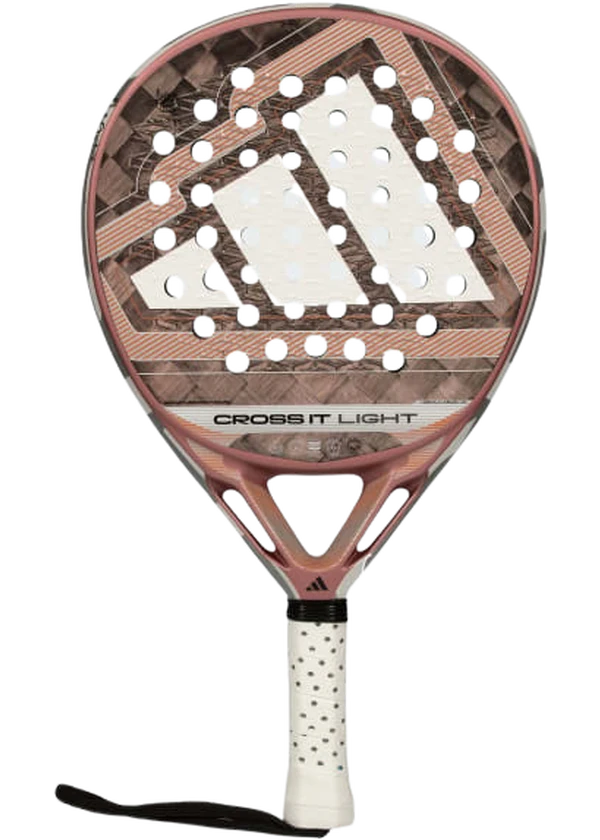


8 Parameters
Cross IT Light 2026
On this page
Review
Adidas Cross IT Light 3.5 2026 Review: Control at Speed, or Speed Without Sacrifice?
The standard tension in round-shaped racket design is between responsiveness and forgiveness — build it too reactive and it punishes mistimed shots; soften it too much and you lose the precision that makes the shape worth choosing. The Adidas Cross IT Light 3.5 2026 sits at the sharper end of that spectrum, positioning itself not as an entry-level defender but as a speed-first control tool for women who already know what they want from a racket.
Designed in collaboration with Marta Ortega and built specifically for advanced women players, this racket combines a low-density EVA Soft Energy core with a Carbon Aluminized 24K surface and Spin Blade Mold 3D texture. The frame runs 38mm thick with an even balance point, and the 11 Thirteen hole pattern — 11 smaller central holes plus 13 standard outer holes — shapes the way power and stability distribute across the face. This sits at the top of the Adidas lineup in the lightweight control category for 2026.
Maneuverability at 8.6 is the standout — unusually high for a carbon-faced racket at this level. The 0.78-point gap between Defender and Attacker profile scores is the whole story: this racket is built for the baseline, not the net post.
Performance Breakdown
How the Cross IT Light 3.5 2026 Plays
PLAYABILITY 8.4
Where the Weight Does the Work
For a racket with a carbon aluminized surface — a material that typically adds rigidity and perceived weight — the 8.6 Maneuverability score is genuinely surprising. The low-to-even balance combined with the declared 345–360g weight range keeps swing speed high, and that shows up in rally transitions and net recovery. Playability at 8.4 confirms what the design promises: this racket works across a range of situations, not just in its optimal conditions. Dynamic Air Flow side slots contribute a measurable reduction in drag that makes the racket feel faster than its specs alone would suggest.
COMFORT 8.5
The Soft Core Earns Its Place
Control at 8.3 and Comfort at 8.5 form the structural backbone of this racket’s identity. The EVA Soft Energy low-density foam absorbs enough vibration to keep extended baseline rallies comfortable on the arm, while still transmitting enough feedback to place shots with intention. These two scores moving together — rather than one at the expense of the other — is the signal that the core tuning is well-calibrated for the defensive profile this racket targets.
SPIN 7.4
Forgiving Enough, Precise Enough
A Sweetspot Size of 8.0 on a round-shaped racket is expected, but the Spin score of 7.4 deserves attention. The Spin Blade Mold 3D texture is designed to add grip on the ball, and it does generate varied spin — but carbon-aluminized surfaces inherently offer less natural grip than textured fiberglass, and that ceiling shows in the number. For a player whose game is built on precise placement rather than heavy topspin, 7.4 is workable. For someone who relies on spin as a primary weapon, it’s a ceiling worth noting before buying.
STABILITY 7.6
Power Is Not the Promise — and Stability Reminds You Why
Power at 7.2 is the lowest score in the set, and it directly explains the Attacker profile — this racket does not generate the exit velocity that an aggressive net game demands. Stability at 7.6 is solid but not exceptional; the 11 Thirteen hole pattern distributes the load well on centered strikes, but off-axis contact reveals the lighter frame. Neither score is a flaw for the player this racket is built for — both become relevant only if someone tries to use it as something it isn’t.
Technology
Carbon Aluminized 24K and Dynamic Air Flow: Engineering for Speed or Marketing for Speed?
The Carbon Aluminized 24K surface integrates aluminum reinforcement into the carbon fiber weave, producing a face that is rigid enough to provide the feedback and shot definition associated with higher-end round-shaped rackets, while keeping the overall frame weight in the 345–360g range. That rigidity is what drives the Control score to 8.3 — the surface doesn’t flex unpredictably on contact, so direction stays where you put it. The tradeoff is the Spin ceiling: aluminum-reinforced carbon simply doesn’t offer the surface friction of textured fiberglass, which holds the Spin score at 7.4 regardless of what the Spin Blade Mold 3D texture adds.
Dynamic Air Flow — the lateral slots cut into the frame profile — reduces aerodynamic drag during swing. This is the most direct contributor to the 8.6 Maneuverability score. It’s not a marginal effect: the combination of low balance, light weight category, and reduced air resistance compounds into a racket that changes direction faster than most carbon-faced options at this level. For a defender tracking wide balls or a hybrid player recovering from net, that swing speed difference is felt in the rally.
The 11 Thirteen hole pattern — 11 smaller central holes paired with 13 standard outer holes — modulates stiffness distribution across the face. Smaller central holes increase the effective rigidity of the hitting zone, which supports the Sweetspot Size score of 8.0 by concentrating response in a predictable area rather than spreading it unevenly. This is the technology behind the Stability score of 7.6: adequate on-center, less so at the edges. The player who benefits is one who prioritizes consistent placement over raw striking power — exactly who Marta Ortega’s collaboration was designed for.
Player Fit
Who Should Buy the Cross IT Light 3.5 2026?
The Advanced Woman Who Wins With Precision, Not Power
If you’re the type who builds points from the baseline, relies on placement over pace, and needs a racket that keeps up with fast exchanges without punishing your arm — this is the tool. The Defender profile, supported by Control at 8.3 and Comfort at 8.5, validates every part of that game. The 8.6 Maneuverability means you won’t be slow getting into position, and the 8.0 Sweetspot gives enough margin on slightly mistimed balls to stay in the rally. This racket is built specifically for advanced women players, and if that’s you and your game is technical and fast-paced, it will feel exactly right.
The Net-Dominant Attacker Looking for Exit Velocity
Power at 7.2 tells the story plainly: this racket does not generate the ball exit speed that an aggressive attacking game requires. The gap between Defender and Attacker profile scores is nearly 0.8 points — and Stability at 7.6 means off-axis attacking shots won’t feel composed. If you play primarily at the net and want a racket that loads up on smashes and volleys, the lightweight carbon frame works against you here. A diamond-shaped option in the attacker category will serve that game far better.
FAQ
Frequently Asked Questions
What is the PadelVerdict score for the Adidas Cross IT Light 3.5 2026?
The overall score is 8.4, with a Consensus Modifier of +0.05. The modifier reflects a situation where data consistency across multiple markets is solid, and specialist sources describe the control-comfort profile without contradiction — but the absence of independent physical measurements keeps the adjustment modest rather than fully positive. Profile breakdown: Defender 8.34 / Hybrid 8.13 / Attacker 7.56. The 0.78-point gap between Defender and Attacker means if you’re not primarily a baseline player, you’re working against the racket’s design.
Is the Adidas Cross IT Light 3.5 2026 good for intermediate players?
Probably not yet. The Playability score of 8.4 is encouraging, and the large sweetspot helps, but the carbon-aluminized surface gives honest, unforgiving feedback on mistimed shots. The control ceiling is high — but you need the technical foundation to reach it. An intermediate player would get more out of the fiberglass Cross IT Team Light variant, which is designed specifically for that level.
Is the Adidas Cross IT Light 3.5 2026 good for defenders?
Yes. The Defender profile score is the highest of the three, and the combination of Control 8.3, Comfort 8.5, and Maneuverability 8.6 covers everything a baseline defender needs — placement precision, arm comfort over long sessions, and fast recovery speed. If defending is your primary role, this racket is built around you. Browse all defender rackets to see how it compares in category.
What is the actual weight of the Adidas Cross IT Light 3.5 2026?
The declared weight range is 345–360g, which places it firmly in the lightweight category. No independent on-camera or laboratory measurements exist to confirm the exact figure. No weight variance data was supplied. The 352g midpoint listed in manufacturer specs is the most reliable single number available — and the low balance point means it plays lighter than that number suggests.
How does the Adidas Cross IT Light 3.5 2026 compare to the Cross IT Team Light 2026?
They share the same round shape and weight range, but they’re built for different players. The Cross IT Light 3.5 uses Carbon Aluminized 24K for a more precise, feedback-rich feel — it’s the advanced player’s tool. The Team Light uses fiberglass, which is softer, more forgiving, and better suited to intermediate players who want comfort over control sharpness. Choose the 3.5 if you’re technically confident; choose the Team Light if you’re still developing consistency.
Why does the Adidas Cross IT Light 3.5 2026 have a Consensus Modifier of +0.05?
The modifier sits at +0.05 because the available signal is partially positive but not fully validated. Specialist sources across multiple markets describe the control-comfort profile consistently, with no outliers or conflicting claims — that alignment earns a modest positive contribution to the modifier. What keeps the adjustment small is the absence of independent physical measurements to confirm declared specs. Consistent descriptions are a good sign; confirmed measurements would support a more positive adjustment.
Similar Rackets
Independent testing, funded by readers
No brand deals, no sponsored picks. If you found this useful, you can support the next round of tests with a small tip.

