
Metalbone Carbon CTRL 2026
Precision Over Power, But at What Cost?
The short verdict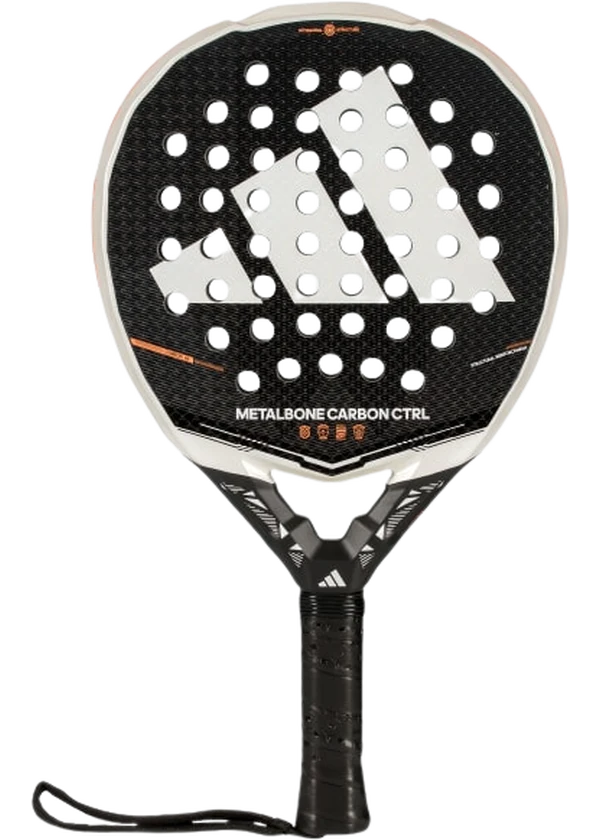


8 Parameters
Metalbone Carbon CTRL 2026
On this page
Review
Adidas Metalbone Carbon CTRL 2026 Review — Precision Over Power, But at What Cost?
The eternal argument in padel racket design runs like this: stiffen the frame for power, soften the core for comfort — and then pray both things happen at once. The Adidas Metalbone Carbon CTRL 2026 takes a clear side in that argument. It pairs a rigid 6K carbon shell with a low-density Soft Performance EVA core, using the stiffness for precision and the foam for absorption. The result is a racket that leans hard toward control without abandoning the Metalbone family’s structural backbone. The question isn’t whether it controls — it does. The question is whether you need that level of control, or whether you’d rather have more of everything else.
Specs: round shape, 365g declared weight (manufacturer range 360–375g, with one camera measurement landing at 360g), 260mm balance point, 38mm profile, 6K carbon surface with Spin Blade Decal texture, Octagonal Structure frame to reduce torsion, Low Poly geometry for added rigidity, and an Extra Power Grip handle for extended inertia. This is the CTRL variant within the Metalbone family — the round, even-balance counterpart to the head-heavy Carbon and HRD+ diamond models. It sits at the control end of a lineup built around all Adidas rackets, designed specifically for players who want the Metalbone frame technology without the aggressive attack bias.
Control leads at 8.8 — the highest single parameter in this racket’s profile. Attacker: 7.67 / Hybrid: 8.12 / Defender: 8.37. The 0.70-point gap between Attacker and Defender is the whole editorial: this racket has a clear role, and that role is defensive construction, not offensive finishing.
Performance Breakdown
How the Metalbone Carbon CTRL 2026 Plays
SWEETSPOT 8.2
The Racket’s Entire Identity, in Two Numbers
Control and sweetspot are where the Metalbone Carbon CTRL 2026 makes its argument, and the argument is convincing. The round shape naturally distributes the sweetspot evenly, and the Smart Holes Curve hole pattern widens the effective contact zone beyond what the frame geometry alone would produce. Combined with a low 260mm balance point that keeps the head from rotating through impact, direction precision is genuine and consistent. The 8.8 Control score reflects a racket that rewards placement-based play — you feel where the ball is going before it leaves the surface.
COMFORT 7.8
Heavy Frame, Soft Landing
At 365g declared weight and with the Octagonal Structure frame reducing torsion under off-center hits, Stability comes in at a solid 8.0 — the frame simply doesn’t flex unpredictably under pressure. Comfort at 7.8 is respectable for a 6K carbon construction, and it’s the Soft Performance EVA doing most of that work: it absorbs enough vibration to make the racket arm-friendly despite the stiff outer shell. Players dealing with elbow sensitivity should stay near the lower end of the manufacturer’s weight range; the heavier-loaded units push that comfort floor noticeably.
PLAYABILITY 8.2
Heavier Than It Feels at the Net
The 8.1 Maneuverability score might surprise anyone who’s weighed this frame and assumed the worst. The even balance point at 260mm redistributes the mass toward the grip rather than the head, and the round shape keeps swing arc predictable in fast exchanges. At net, the racket responds quicker than its weight class suggests — the Extra Power Grip’s extended handle further aids rotational leverage on volleys. Playability at 8.2 reflects genuine versatility across court positions, not just defensive retrieval. Among round-shaped rackets in the intermediate-to-advanced range, this accessibility profile is consistently strong.
SPIN 7.4
The Ceiling This Racket Refuses to Raise
Power at 7.2 is the defining constraint, and it’s the direct consequence of design choices made everywhere else. The round shape, even balance, and soft core all reduce trampoline effect by design — precision is purchased at the cost of raw output. The Spin Blade Decal texture does generate legitimate bite on lifted balls and slice, landing Spin at 7.4, but this isn’t a racket that manufactures spin automatically — it rewards players who already generate their own. Power is the lowest profile driver and the primary reason the Attacker Score sits at 7.67, nearly three-quarters of a point below the Defender score. If your game leans on finishing from overhead positions, this number is the one that should give you pause.
Technology
Octagonal Structure + Low Poly: Engineering Rigidity Without Punishing the Arm
The Octagonal Structure replaces a conventional circular or oval cross-section frame tube with an eight-sided profile. The mechanical consequence is measurable: torsional resistance increases under off-center contact, meaning the racket doesn’t twist when you catch the ball at the edge of the sweetspot. That translates directly to the 8.0 Stability score — and more practically, to the feeling that even imperfect shots still travel where you intended them.
Low Poly adds a polyhedral geometry to both the frame and the core structure, increasing stiffness without requiring additional material thickness. The 6K carbon surface then layers a further rigidity component on top — but stiffness without absorption would push this into uncomfortable territory. The Soft Performance EVA core is the counterbalance: low-density foam that takes enough energy out of the impact to keep the vibration profile manageable and the Comfort score at 7.8 despite the frame’s overall stiffness.
Smart Holes Curve, specific to the CTRL variant, optimizes the hole distribution across the surface to expand the effective sweetspot zone — contributing to that 8.2 Sweetspot Size score. The Extra Power Grip’s extended handle increases the lever arm from grip to head, which partially offsets the power deficit from the round shape by adding inertia through the swing. It’s not enough to close the gap with the diamond Metalbone siblings on pure power, but it prevents the CTRL from feeling passive. These technologies combine into a coherent system: every element reinforces the control-first, arm-friendly brief, with no component working against any other.
Player Fit
Who Should Buy the Metalbone Carbon CTRL 2026?
The Intermediate-to-Advanced Player Who Wins With Their Head
If you’re the type who reads the court rather than blasting through it — who wins points through placement, resets, and consistent pressure rather than outright pace — the Metalbone Carbon CTRL 2026 was built around your game. The 8.8 Control and 8.2 Sweetspot Size give you a reliable platform for tactical shot-making, and the 8.1 Maneuverability means you won’t be late on quick defensive exchanges. The Defender Score of 8.37 confirms this alignment isn’t marginal — it’s structural. You’ll feel most at home in the left-back position, or anywhere on court where precision and endurance matter more than explosive finishing. If you’ve been playing for 2–4 years and are tired of losing the thread of a rally under pressure, this is the racket that stops that from happening. Want the bigger picture? Here’s where it lands in our 2026 ranking of the best padel rackets, compared against every top model we’ve scored this year.
Attackers and Right-Side Players Who Live at the Net
If your game is built on winning points with overhead smashes, aggressive net play, and generating power from the right side, the 7.2 Power score is a hard ceiling that the CTRL’s design won’t let you break through. The Attacker Score of 7.67 — nearly 0.70 points below the Defender score — isn’t close. The even balance and soft core do exactly the opposite of what an attacking profile needs. The Spin at 7.4 also won’t manufacture easy topspins without genuine technique to support it. For that player, the Metalbone Carbon (diamond variant) makes a more honest offer — and if you want to see how a head-heavy Metalbone compares in direct profile terms, that model is worth your time before committing here.
FAQ
Frequently Asked Questions
What is the PadelVerdict score for the Adidas Metalbone Carbon CTRL 2026?
The overall PadelVerdict score is 8.5, with a Consensus Modifier of +0.1 applied. The adjustment reflects strong alignment across specialist sources on this racket’s control-first, defender-oriented profile — no contradictions or conflicting technical data were found, which is the signal that earns a positive adjustment. Spec consistency across sources prevents a negative, but doesn’t generate additional upside on its own; and the absence of broad independent physical measurement coverage keeps the modifier from going further. Profile breakdown: Attacker 7.67 / Hybrid 8.12 / Defender 8.37. The 0.70-point gap between Attacker and Defender tells you exactly what kind of player this racket respects.
Is the Adidas Metalbone Carbon CTRL 2026 good for intermediate players?
Yes — with one condition. Intermediate players who are already developing tactical awareness and want a racket that reinforces placement over power will find the 8.2 Playability and 8.8 Control genuinely supportive. If you’re still at the stage where generating pace is the priority, the Power score of 7.2 will feel limiting before your game can extract the full value from the Control ceiling.
Is the Adidas Metalbone Carbon CTRL 2026 good for defensive players?
Straightforwardly yes. The Defender Score of 8.37, driven by Control 8.8, Sweetspot 8.2, and Maneuverability 8.1, makes this one of the stronger defensive profiles in its class. If your game is built around resetting pace, redirecting pace, and outlasting opponents through consistency, this racket confirms your instinct. Browse all defender-profile rackets to compare it against alternatives in the same category.
What is the actual weight of the Adidas Metalbone Carbon CTRL 2026?
Declared weight is 365g (manufacturer range 360–375g). One camera measurement on a single unit came in at 360g — the bottom of the declared range. That 5g gap is perceptible under sustained play for players sensitive to fatigue, and given the range spans 15g, unit variance is worth accounting for if you’re particular about feel consistency.
How does the Adidas Metalbone Carbon CTRL 2026 compare to the Metalbone Carbon (diamond)?
These are two rackets for two different player identities, not two difficulty levels. The CTRL is a round, even-balance frame built for defenders and tacticians — precision is its ceiling. The Carbon diamond is head-heavy with a harder feel, designed for attackers who want to finish points. If you’re choosing between them, ask yourself which half of the court you live on, not which one looks better on paper.
Why does the Adidas Metalbone Carbon CTRL 2026 have a Consensus Modifier of +0.1?
The +0.1 reflects one clear signal: specialist and retailer descriptions across multiple markets converge consistently on a control-first, defender-oriented profile, with no technical contradictions found. That editorial alignment earns a positive adjustment. Spec consistency across sources is a baseline — it avoids a negative, but doesn’t generate upside on its own. And with only one camera measurement on record, independent physical verification of the full declared spec range remains limited; broader measurement coverage would support a further positive adjustment.
Similar Rackets
Independent testing, funded by readers
No brand deals, no sponsored picks. If you found this useful, you can support the next round of tests with a small tip.

