
Arrow Hit Carbon CTRL 2026
The Control Racket That Doesn’t Ask You to Sacrifice
The short verdict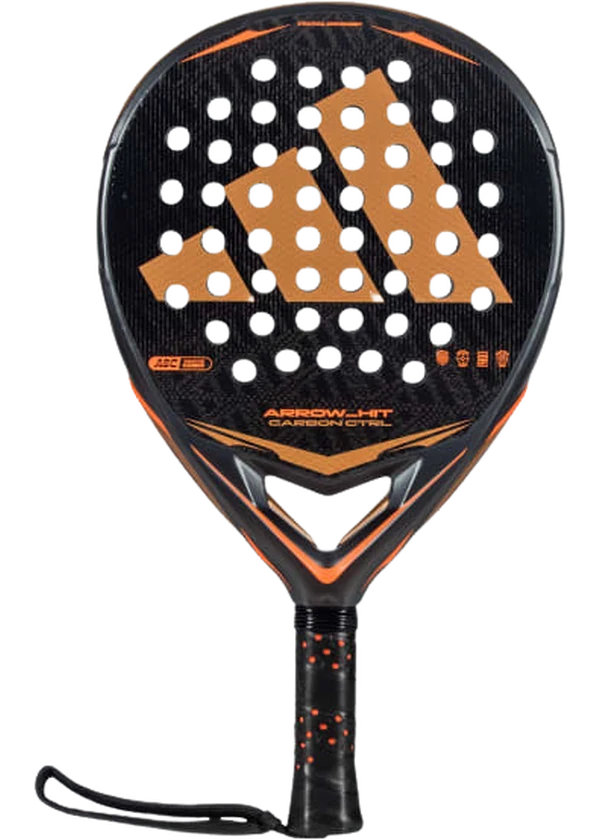


8 Parameters
Arrow Hit Carbon CTRL 2026
On this page
Review
Adidas Arrow Hit Carbon CTRL 2026 Review: The Control Racket That Doesn’t Ask You to Sacrifice
The tension in padel equipment almost always lands in the same place: control rackets protect you from errors but leave you chasing power, while power rackets punish you the moment your timing slips. The Adidas Arrow Hit Carbon CTRL 2026 is built around the argument that this trade-off is less inevitable than the market suggests — that a round shape with the right frame architecture can deliver clean, directed power without dismantling the precision game that makes intermediate and advanced players competitive.
The CTRL is the round-shaped, control-oriented entry in Adidas’s new 2026 Arrow Hit line — the counterpart to the diamond-shaped Carbon version built for attackers. It runs an EVA Soft Performance low-density foam core, Carbon ASC interlaced fiber layup on the face, and a 38mm carbon fiber frame. The proprietary stack includes the Muscle Power System (carbon-rib throat reinforcement for torsion resistance), Power Groove (perimeter rail for structural rigidity), Intelligent Balance System (adjustable 9g side weights for balance customization), Extra Power Grip extended handle, Spin Blade Decal texture, and Smart Holes Curve pattern. Declared weight sits at 360–375g with a medium balance point and a stiffness rating of 52. You can browse the full Adidas lineup to see where it sits in the broader range.
Sweetspot Size reaches 8.4 — highest individual parameter in this racket. Profile breakdown: Attacker 7.72 / Hybrid 8.21 / Defender 8.41. The 0.69-point gap between Attacker and Defender is the entire brief: this is a racket that rewards patience over aggression, and the data confirms it without ambiguity.
Performance Breakdown
How the Arrow Hit Carbon CTRL 2026 Plays
SWEETSPOT 8.4
The Round Shape Delivers on Its Core Promise
Round-shaped rackets live or die by their ability to place the ball with consistency under pressure, and this one lives. The centered sweetspot created by the round geometry, amplified by the Smart Holes Curve distribution and Power Extra Grip extended handle, produces an 8.4 on Sweetspot Size — the highest individual score in this racket’s profile. That width translates directly into the 8.6 Control figure: off-center strikes are forgiving enough to stay in the rally, while centered contact gives genuine directional precision. The combination is what makes the round-shaped category compelling for players who build points rather than end them early.
STABILITY 8.2
Carbon Stiffness Without the Punishment
Carbon-framed rackets at stiffness 52 often create a vibration penalty that accumulates over long sessions — the Arrow Hit Carbon CTRL avoids this through the low-density EVA Soft Performance core, which absorbs impact energy before it reaches the handle. Comfort lands at 8.3, genuinely high for a full carbon construction at this stiffness rating. Stability at 8.2 is held up by the Muscle Power System’s carbon-rib throat reinforcement, which resists torsional flex on wide-angle exchanges. The result is a racket you can play for two hours without arm fatigue becoming a scoring variable.
PLAYABILITY 8.4
Handles Like a Racket Half Its Weight Class
At 368g declared with a medium balance, this racket should feel deliberate rather than quick — but the Intelligent Balance System’s adjustable 9g side weights allow the player to tune the distribution, keeping the swing weight manageable. Maneuverability at 8.1 is the outcome: fast enough for defensive scrambles, controlled enough for volleys that need placement over pace. Playability at 8.4 reflects how immediately legible the racket feels — intermediate players don’t need weeks of adaptation to extract what it offers. The round shape keeps everything predictable.
SPIN 7.4
Where the Control Focus Costs You
Power at 7.2 is the lowest individual parameter and the direct driver of the Attacker score gap — this is a racket that will not generate the explosive response players rely on for aggressive bandejas and smashes. The Power Groove perimeter rail and Muscle Power System do contribute incremental punch, keeping the figure from falling further, but the round shape and soft core are fundamentally oriented away from raw pop. Spin at 7.4 is adequate rather than exceptional: the Spin Blade Decal texture and Smart Holes Curve support topspin rally play, but players whose game depends on heavy slice or kick serves will find the output modest. These two figures explain the 0.69 gap between the Defender and Attacker profile scores.
Technology
Multi-System Architecture: Does Stacking Technologies Actually Compound?
The Arrow Hit Carbon CTRL 2026 runs six distinct proprietary systems. The question isn’t whether each one does something — it’s whether they compound into a coherent on-court identity or merely add marketing noise to the spec sheet. The answer here leans toward genuine compounding, with two systems doing the structural heavy lifting.
The Muscle Power System places carbon ribs at the throat to resist torsional flex — the kind that occurs when you catch a ball toward the 9 o’clock or 3 o’clock edge of the face. This directly supports the Stability score of 8.2, which is meaningfully high for a round racket at this weight class. Without throat reinforcement, round shapes can feel slippery on off-axis contact; with it, the racket holds its line and returns the ball where you intended. The Power Groove perimeter rail adds structural rigidity around the frame’s outer edge, contributing to the incremental power output that prevents the 7.2 Power score from dipping further.
The Intelligent Balance System is the genuinely unusual element in this stack — adjustable 9g weights in the side rails let the player shift the balance point toward their preference for swing weight versus maneuverability. Players who want a more defensive, wrist-led response can shift weight lower; those who want more plow-through can move it higher. This flexibility keeps the Maneuverability score at 8.1 without locking the racket into a single playing style, and it’s the most tangible reason the Hybrid score of 8.21 sits closer to the Defender figure than the architecture alone would suggest.
The Carbon ASC interlaced layup on the face, combined with the Spin Blade Decal texture, supports the 8.6 Control figure by creating a consistent, slightly textured contact surface — one that grips the ball long enough for directional intent to translate but doesn’t produce the aggressive spin output of a diamond-optimized face. The Extra Power Grip extended handle broadens sweetspot access on two-handed backhands and stretching volleys, which is where the 8.4 Sweetspot Size score becomes most relevant for baseline defenders and transition players.
Player Fit
Who Should Buy the Arrow Hit Carbon CTRL 2026?
The Intermediate-to-Advanced Player Who Wins by Outlasting
If you’re the type who builds points through placement and consistency rather than pace — who wants the ball to go exactly where you aimed it on the third exchange, not just the first — this racket was designed around your game. The Defender score of 8.41, Control of 8.6, and Sweetspot Size of 8.4 aren’t coincidental: they reflect a racket tuned for players who read the rally ahead of time and execute. The Comfort score of 8.3 matters too if you play regularly — this is a racket that doesn’t add arm fatigue as a variable in long sessions. The Intelligent Balance System gives you enough personalization to adapt it to your specific style within the defender-hybrid range. If you’ve been playing two to three years and your game is fundamentally about precision and consistency, this racket confirms the instinct you already had about the kind of player you are. It’s one of the intermediate rackets we’d actually recommend — see the full ranked list.
Power-First Players Who Need the Smash to Finish Points
The Attacker score of 7.72 is the honest verdict: if your game is built around aggressive overhead play, bandejas that push opponents off the glass, or heavy-spin drives that create short balls, the 7.2 Power score will leave you feeling like you’re playing through a dampener. Round shapes at this balance point don’t generate the rebound velocity that attacking play demands — no amount of frame technology changes that geometric reality. The Spin score of 7.4 reinforces the same message for players who rely on kick or slice as weapons. For a racket with genuine attacking credentials in the same lineup, the Arrow Hit Carbon is the direction to look.
FAQ
Frequently Asked Questions
What is the PadelVerdict score for the Adidas Arrow Hit Carbon CTRL 2026?
The overall PadelVerdict score is 8.5, with a Consensus Modifier of +0.1 applied. The adjustment reflects strong alignment across specialist sources on this racket’s carbon construction, round shape, and EVA core — descriptions across multiple markets converge without contradiction, which is the signal that earns a positive adjustment. Spec consistency across sources prevents a negative but doesn’t generate additional upside on its own; and the absence of independent physical measurements keeps the modifier from going further. Profile breakdown: Attacker 7.72 / Hybrid 8.21 / Defender 8.41. The 0.69-point spread between top and bottom profile scores tells you this is a specialist racket — the decision between it and a more balanced option comes down entirely to how central the control game is to your identity as a player.
Is the Adidas Arrow Hit Carbon CTRL 2026 good for intermediate players?
Yes, directly. The Playability score of 8.4 is the number that matters here — it reflects how immediately accessible the racket is without a long adaptation curve. Intermediate players who have developed a control-oriented game will get full value from it right away. If you’re still building technique and need maximum forgiveness across all parameters rather than specialist control, a racket with a higher baseline Hybrid score and less pronounced profile gap would serve you better in the short term.
Is the Adidas Arrow Hit Carbon CTRL 2026 good for defenders?
Yes. The Defender score of 8.41 is the highest profile score and the intended identity of this racket. Control at 8.6, Sweetspot Size at 8.4, and Comfort at 8.3 all point in the same direction: a racket built for players who reset rallies, redirect pace, and win through consistency rather than aggression. If defending and rallying are central to how you play, this belongs in your shortlist. Explore the full defender racket category to compare it against alternatives.
What is the actual weight of the Adidas Arrow Hit Carbon CTRL 2026?
The manufacturer declares a range of 360–375g; the specific unit used in our scoring is 368g. No independent measured weight data exists for this model — no tester weigh-ins or on-camera measurements have been recorded. The 15g declared range is wide enough that two units from the same batch could feel noticeably different on court, particularly given the adjustable IBS weights that add another 18g of potential variability. Worth checking the specific unit weight at point of purchase if swing weight precision matters to your game.
How does the Arrow Hit Carbon CTRL 2026 compare to the Arrow Hit Carbon (diamond version)?
These two rackets serve opposite ends of the same lineup and essentially ask you to answer one question: do you win points by controlling them or by ending them? The CTRL’s round shape, soft EVA core, and centered sweetspot produce the 8.6 Control and 8.41 Defender scores that define defensive and hybrid play. The diamond Carbon version’s higher balance point and harder response prioritize the aggressive overhead and attacking exit that the CTRL’s 7.2 Power score won’t deliver. Same line, different briefs — pick the one that matches how you actually score points.
Why does the Adidas Arrow Hit Carbon CTRL 2026 have a Consensus Modifier of +0.1?
The +0.1 reflects one clear signal: specialist sources across multiple markets independently align on the round shape, EVA Soft Performance core, Carbon ASC surface, and the key technology stack — no contradictions, no implausible outliers, and consistent positioning of this racket as a control-oriented instrument for intermediate to advanced players. That convergence earns a positive adjustment. Spec consistency across sources is a baseline that avoids a negative but doesn’t generate upside on its own. Independent physical measurements of the declared weight range and balance point would support a further positive adjustment.
Similar Rackets
Independent testing, funded by readers
No brand deals, no sponsored picks. If you found this useful, you can support the next round of tests with a small tip.

