
Equation Soft Advanced 2026
Is Comfort the Right Trade-Off?
The short verdict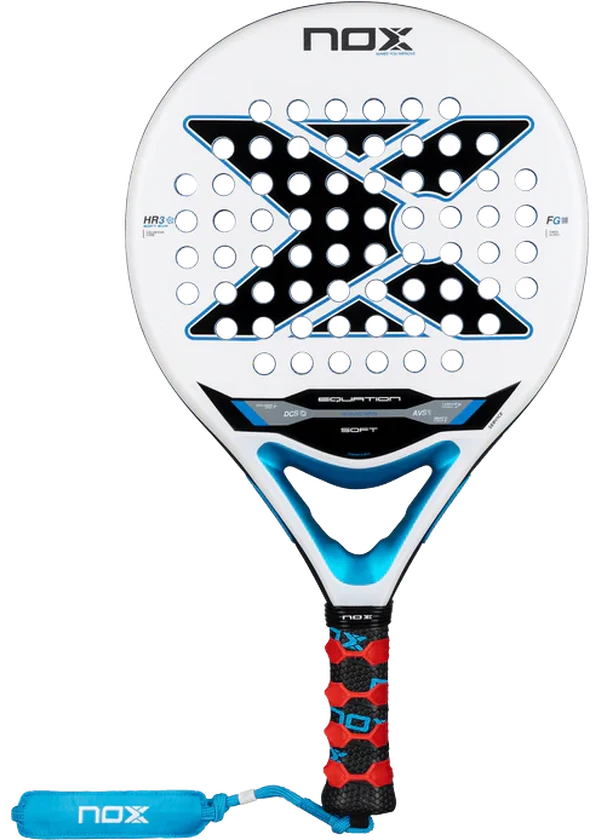

8 Parameters
Equation Soft Advanced 2026
On this page
Review
Nox Equation Soft Advanced 2026 Review — Is Comfort the Right Trade-Off?
There is a real tension in padel between rackets that protect your arm and rackets that give you enough firepower to end points. Most rackets at the intermediate level try to straddle both and end up delivering neither convincingly. The Nox Equation Soft Advanced 2026 makes a deliberate choice: it steps fully toward comfort, control, and longevity — and asks you to accept that pace generation is not part of the deal.
The Equation Soft Advanced 2026 is built around a round shape with an HR3 Soft EVA low-density foam core and a Fiberglass 3K surface carrying Nox’s Exclusive Spin texture — a combination of a 3D hexagonal centre panel and a sandblasted finish across the face. The 100% carbon frame integrates Nox’s AVS (Anti-Vibration System), rubber inserts designed to dampen shock at contact, alongside the Smartstrap replaceable safety cord. Balance sits at a medium-low 255mm, keeping the mass centered and the head light. Declared weight runs between 350 and 375g depending on the source, with no independent measurements to resolve the spread. This is a Nox lineup entry built explicitly for intermediate players who play frequently and need the racket to protect their body as much as it performs.
Control lands at 8.6 — the highest single score in this profile. Defender: 8.25 / Hybrid: 7.87 / Attacker: 7.17. That 1.08-point gap between Defender and Attacker isn’t noise — it’s the whole purchasing decision compressed into a single number.
Performance Breakdown
How the Nox Equation Soft Advanced 2026 Plays
PLAYABILITY 8.2
The Racket Does the Placement Work for You
Round shapes with low-density cores create a specific kind of control: the ball dwells slightly longer at contact, giving you just enough time to direct it. The Equation Soft Advanced takes that principle seriously. Control at 8.6 is the headline figure, but Playability at 8.2 confirms the story — this racket doesn’t demand technical precision to produce usable output. For an intermediate player building consistency from the back, that combination is more valuable than any power figure, because it converts mishits into recoverable exchanges rather than outright errors.
SWEETSPOT SIZE 7.8
Built for the Long Session, Not Just the Long Rally
Comfort at 8.4 reflects the combined effect of the HR3 Soft EVA core and the AVS rubber inserts — this is a racket that genuinely reduces vibration transmission rather than simply softening the feel by chance. The Sweetspot Size at 7.8 is broader than you might expect from a round racket at this price point, which means off-centre contact is absorbed rather than punished. For players with a history of elbow or wrist discomfort, or those who train multiple times per week, this combination materially reduces the physical cost of high-volume play.
SPIN 7.2
Fast Enough to Recover, Grippy Enough to Shape
A medium-low balance point at 255mm keeps the head nimble, and Maneuverability at 8.1 confirms the racket moves well in tight defensive exchanges. This matters more than it might seem: a slow racket in the hands of a back-court player is a liability in transition. Spin at 7.2 benefits from the Exclusive Spin texture — the hexagonal centre panel and sandblasted face generate real grip on the ball, enough to add direction and bounce variation on defensive lobs. It won’t produce the kind of aggressive topspin that pressures opponents, but it gives your shots shape.
STABILITY 7.1
This Is Where the Trade-Off Lives
Power at 6.4 is the number that defines who this racket is for — and who it isn’t. The soft EVA core absorbs energy at contact, which is exactly why comfort is high and why pace generation is structurally limited. This isn’t a flaw in execution; it’s the design logic working as intended. Stability at 7.1 is the secondary constraint: the medium-low balance and round frame limit the racket’s resistance to torque on hard lateral impacts. These two scores together connect directly to the Attacker profile sitting at 7.17 — the lowest of the three. If generating pace and holding the net is your game, this number tells the whole story. See all diamond rackets for options built differently.
Technology
AVS + Exclusive Spin: Engineering Comfort or Just Marketing It?
The Anti-Vibration System (AVS) uses rubber inserts at specific stress points in the carbon frame to interrupt the vibration path between the hitting surface and the handle. The effect is measurable in the Comfort score — 8.4 doesn’t emerge solely from the soft core; it requires the frame to do its part by not transmitting shock upward. For a player coming off a wrist or elbow injury, or one managing chronic arm fatigue from high-frequency play, this is the technology that earns its place.
The Exclusive Spin surface combines a 3D hexagonal texture panel in the hitting centre with a sandblasted finish across the rest of the face. The hexagonal geometry creates micro-edges that grip the ball longer through contact, while the sandblasted zones provide consistent friction across a wider area. This explains why Spin lands at 7.2 despite the soft core — which on its own would typically suppress spin generation by reducing dwell-time pressure. The surface texturing compensates meaningfully.
The Smartstrap replaceable cord is a quality-of-life detail rather than a performance technology — but it reflects the same logic of reducing friction over time. The 100% carbon frame at a 38mm profile provides enough structural rigidity to keep Stability at 7.1 without compromising the arm-friendly feel. The technologies work together: AVS handles the vibration, the soft core handles the feel, and the carbon frame prevents the whole structure from flexing into inconsistency. The beneficiary is any intermediate player whose priority is sustaining performance across a long session rather than maximising it in a single exchange.
Player Fit
Who Should Buy the Nox Equation Soft Advanced 2026?
The Consistent Intermediate Who Plays Often and Feels It the Next Day
If you’re the type who plays three or four times a week, loves the back-court game, and has started noticing that your elbow or wrist is taking longer to recover after sessions — this racket was designed around your reality. Control at 8.6 and Playability at 8.2 mean your consistent, well-placed game is fully supported; Comfort at 8.4 means you can sustain it across two hours without the racket working against you. The Defender score of 8.25 validates the fit: you’re not being asked to play outside your game, you’re being given a tool that makes your game easier to execute, session after session. It’s exactly the profile we break down in our full guide to the best padel rackets for intermediate players, where it’s ranked against every intermediate option we’ve scored.
The Net-Hunter Who Wins by Applying Pace and Pressure
If your game is built around attacking the net, winning with smashes, and putting away volleys with authority, Power at 6.4 and Stability at 7.1 will both work against you. The soft core absorbs the energy you’re trying to generate, and the medium-low balance limits your ability to hold firm on hard lateral contact. The Attacker score of 7.17 isn’t close — it’s 1.08 points below the Defender score, and that gap is not recoverable through technique. You need a diamond-shaped racket with a denser core and a higher balance point. The Nox AT10 Genius 2026 is built for exactly that game.
FAQ
Frequently Asked Questions
What is the PadelVerdict score for the Nox Equation Soft Advanced 2026?
The PadelVerdict score is 8.4. A Consensus Modifier of +0.1 was applied: specs are consistent across multiple markets with no contradictions (Data Quality), declared figures show no implausible outliers (Field Validation), but no independent measurements exist to confirm weight or balance — keeping the adjustment at a modest positive. Profile breakdown: Defender 8.25 / Hybrid 7.87 / Attacker 7.17. The 1.08-point spread between Defender and Attacker is the sharpest editorial signal in this review: this racket has a clear home, and it isn’t in attacking play.
Is the Nox Equation Soft Advanced 2026 good for intermediate players?
Yes — decisively. Playability at 8.2 is the number that confirms it: the racket generates usable output without demanding technical precision. For an intermediate building consistency, that matters more than raw scores in any other category. If you’re an intermediate who predominantly attacks, look at something with a denser core and higher balance.
Is the Nox Equation Soft Advanced 2026 good for defensive players?
Yes. The Defender profile score of 8.25 is the highest of the three — supported by Control at 8.6, Maneuverability at 8.1, and Comfort at 8.4. That’s exactly the combination a back-court player needs: precision, recovery speed, and a racket that doesn’t punish you physically for a long defensive session. Browse the defender racket category for a full comparison.
What is the actual weight of the Nox Equation Soft Advanced 2026?
This is genuinely unresolved. Declared ranges across multiple sources vary between 350-365g, 355-365g, and 360-375g — a 25-gram spread with no independent measurements to settle it. In practical terms, 25 grams is perceptible on court, particularly in fatigue conditions. Until independent measurements are available, treat the declared weight as a range rather than a fixed figure.
How does the Nox Equation Soft Advanced 2026 compare to the Nox Equation Hard Advanced 2026?
The choice between them is a choice between two player types, not two specs lists. The Soft version gives you arm protection, longer dwell time, and back-court reliability — the Hard version gives you more energy return and better suitability for players transitioning toward net play. If you’re not yet sure which role you primarily occupy, the Soft is the lower-risk entry into the Equation series.
What is the best padel racket for defensive players in 2026?
The Nox Equation Soft Advanced 2026 is a strong option in this category, but the answer depends on your level and physical priorities. Browse the full defender racket category to compare it against everything PadelVerdict has scored — filtered by profile, so you’re always comparing like for like.
Why does the Nox Equation Soft Advanced 2026 have a Consensus Modifier of +0.1?
Technical specifications — shape, core, surface material, frame construction, and proprietary systems — are consistent across multiple markets without meaningful contradiction. That cross-market consistency earns a small positive adjustment. It doesn’t reach higher because no independent real-world measurements exist to validate the declared weight and balance ranges. Consistent data without physical verification supports a modest positive — not a full one. Independent measurements would support a stronger adjustment.
Similar Rackets
Independent testing, funded by readers
No brand deals, no sponsored picks. If you found this useful, you can support the next round of tests with a small tip.

