
Gea 2026
The Control Racket That Refuses to Punish You
The short verdict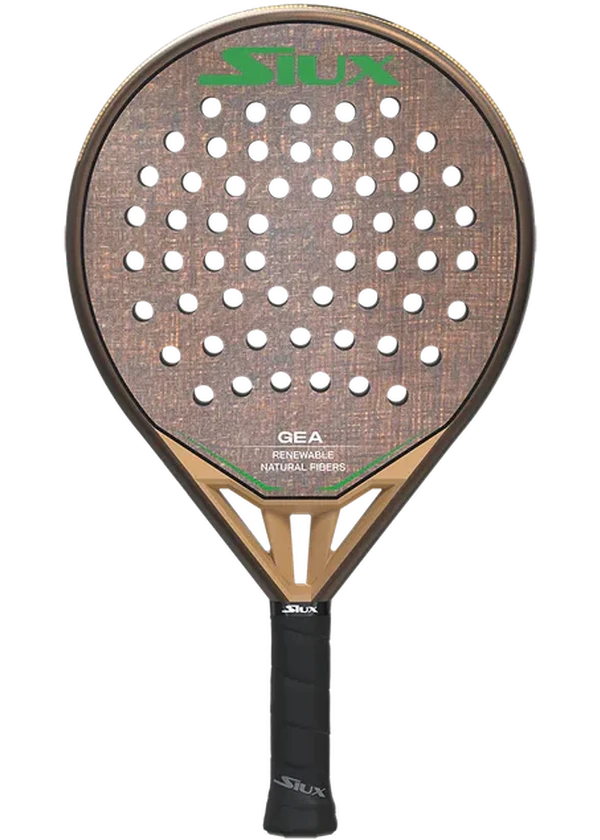

8 Parameters
Gea 2026
On this page
Review
Siux Gea 2026 Review: The Control Racket That Refuses to Punish You
The oldest tension in padel equipment: how much forgiveness can you build into a racket before it starts costing you something else? Most control-oriented rounds hedge their bets — soft enough to absorb, stiff enough to push. The Siux Gea 2026 takes a different position. It leans hard into comfort and sweetspot size, accepts a real power ceiling, and bets that the right player will never need what it gives up.
Underneath that bet sits a medium-soft Bio EVA foam core paired with a hybrid carbon and natural bamboo fiber frame — a construction choice that quietly separates the Gea from standard carbon builds. The striking surface is 3K Amplitex, a carbon-aramid weave with a matte, sandy texture that generates friction without the rigidity of full carbon sheets. Frame profile sits at 38mm, balance at 252mm, declared weight between 355–375g. This is a round-shaped defender from the Siux lineup, built around the idea that eco-conscious materials and performance aren’t a trade-off.
Sweetspot Size leads at 8.4 — the highest single parameter in this profile. Attacker: 7.01 · Hybrid: 7.96 · Defender: 8.20. That 1.19-point gap between Attacker and Defender is the whole story: this racket is built for one thing, and it doesn’t pretend otherwise.
Performance Breakdown
How the Siux Gea 2026 Plays
PLAYABILITY 8.4
Forgiveness Is the Feature, Not a Compromise
Round geometry combined with a low 252mm balance creates a striking face that feels generous even under pressure — off-center contacts lose pace but stay playable, which is precisely what a defender needs when stretched wide or caught off-guard. Sweetspot Size lands at 8.4, the highest individual score in this profile, and Playability matches it. The medium-soft Bio EVA absorbs just enough to widen the margin for error on mis-hits without turning the racket into a trampoline. What surprises here is how high Playability scores for an intermediate-positioned model — this is a racket that performs well almost immediately, with a short learning curve that doesn’t sacrifice depth of play.
COMFORT 8.1
Placement You Can Trust, Rally After Rally
Control sits at 8.2 — the kind of score that means lobs land where you put them, cross-court passes hold their line, and chiquitas arrive with intent rather than hope. The hybrid bamboo-carbon frame contributes something concrete here: it dampens the micro-vibrations that accumulate through long defensive rallies without softening the feedback entirely. Comfort at 8.1 is the direct result of that construction, making the Gea a serious option for players managing elbow sensitivity or multi-match tournament schedules. The Amplitex 3K surface, despite its matte sandy texture, channels pace into direction rather than generating it — which keeps arm strain low during prolonged backcourt exchanges.
STABILITY 7.2
Quick in the Hand, Honest at the Net
Maneuverability at 8.3 is among the strongest scores on the card — the low balance and round shape allow fast direction changes and quick net preparation, qualities that matter more than raw speed when you’re defending at the back. The trade-off arrives at Stability: 7.2 is the weakest number here, and it’s the main reason the Defender profile leads over Hybrid. Against hard-hit drives at pace, the frame absorbs rather than redirects — a response pattern that suits patient defenders but limits aggressive transition play for players who want to finish points from mid-court. If your game depends on counter-punching off pace, that gap between Maneuverability and Stability is the signal to pay attention to.
SPIN 6.8
The Ceiling You’re Agreeing To
Power at 6.4 is the score this racket was designed around — not accidentally low, but structurally limited by the soft core and bamboo-carbon hybrid that prioritize feel over trampoline effect. Flat smashes and aggressive overheads require good technique to generate pace; the racket will not add speed you didn’t bring. Spin at 6.8 reflects the same philosophy — the sandy Amplitex texture creates some purchase, but the soft core dissipates the snap that high-spin shots demand. These two scores drive the Attacker profile down to 7.01 and explain the 1.19-point gap to Defender. Buying the Gea 2026 means accepting this trade-off consciously: you are choosing a racket that extends rallies, not one that ends them.
Technology
Amplitex 3K and Bamboo Hybrid Frame: Eco Materials That Actually Pull Their Weight?
Amplitex is a woven carbon-aramid composite — the 3K designation refers to the thread count density, which produces a tighter, more consistent surface than standard woven carbon. In practical terms, that surface texture generates enough friction to support moderate spin and provides a tactile response that communicates ball contact clearly to the hand. This connection to Control at 8.2 is direct: the weave doesn’t deaden feedback, it filters the unwanted vibration while preserving the useful information. The sandy matte finish amplifies this effect, giving the striking face a grip on the ball that plain carbon lacks.
The more distinctive element is the frame construction — a hybrid of carbon fiber and natural bamboo strands. Bamboo adds flex damping properties that pure carbon cannot replicate without altering the core chemistry; it absorbs micro-shock at the frame level before it reaches the hand. This is the primary driver behind Comfort at 8.1 and the reason the Gea is positioned for players with elbow sensitivity. The Bio EVA foam core, calibrated to medium-soft density, amplifies this further: it compresses on contact and extends dwell time, which is what produces the wide sweetspot score of 8.4. The engineering chain here is coherent — frame damps, core extends, surface communicates. Each element does its job, and all of them point in the same direction. Among round-shaped rackets at this price point, the bamboo-hybrid frame is the one genuinely uncommon choice — and it earns its place in the spec sheet.
The player who benefits is specific: someone who plays long defensive rallies, values arm health across a full season, and doesn’t need the frame to generate power they haven’t built themselves. If that’s you, the technology is doing exactly what it claims. If you’re looking for the construction to add pace or spin, it won’t — and no amount of innovative materials changes that fundamental limitation.
Player Fit
Who Should Buy the Siux Gea 2026?
The Patient Defender Who Wins by Outlasting
If you’re the type who plays from the back, wins by placement rather than pace, and relies on lobs and cross-court precision to create errors — the Gea 2026 was built for your game. Sweetspot Size at 8.4 means your defensive retrieves stay in play even when you’re stretched; Control at 8.2 means the lob you’re constructing the point with lands where you intend it. Maneuverability at 8.3 keeps your net preparation fast enough to surprise, without demanding a technical overhaul. If your elbow has started to talk back after long sessions, the bamboo-hybrid frame and 8.1 Comfort score are reasons to take this racket seriously. You’re an intermediate player who understands that winning the rally is more valuable than winning the point quickly — and this racket agrees with you completely.
The Transition Player Who Wants to Finish Points
If you’re developing your game toward mid-court aggression — finishing from the net, generating pace on the bandeja, counter-punching off fast drives — the Gea’s Power score of 6.4 is a structural ceiling, not a temporary limitation. The soft core and bamboo frame were designed to absorb, and no technique adjustment changes that. Stability at 7.2 is the lowest score in this profile and the clearest signal: this racket doesn’t redirect pace, it dampens it. The Attacker profile of 7.01 tells you everything about the gap between what this racket does and what a transition game needs. Players at that crossroads would be better served by a stiffer, higher-balance option.
FAQ
Frequently Asked Questions
What is the PadelVerdict score for the Siux Gea 2026?
The PadelVerdict score is 8.3, with a Consensus Modifier of +0.1 applied. Specs are consistent across multiple sources (Data Quality: neutral), specialist sources across multiple markets align on shape, core, surface, and balance with no contradictions found (Field Validation: positive), but no independent physical measurements exist to go further (Market Correction: neutral). That Field Validation component is what earns the +0.1. Profile breakdown: Attacker 7.01 · Hybrid 7.96 · Defender 8.20. The 1.19-point gap between Attacker and Defender is the clearest signal this racket has a defined identity — buy it for what it is, not what you might want it to become.
Is the Siux Gea 2026 good for intermediate players?
Yes — with one condition. Playability at 8.4 and the wide sweetspot make it genuinely accessible at intermediate level, and the short learning curve means you’ll find your game with it quickly. The condition: your game needs to be control-oriented. If you’re an intermediate who is actively pushing toward power and aggression, the Power ceiling of 6.4 will feel like a wall within weeks. In that case, a stiffer drop-shaped option at the same price point would serve you better.
Is the Siux Gea 2026 good for defenders?
Yes. Unambiguously. Defender profile scores 8.20 — the highest of the three — and the individual parameters tell the same story: Sweetspot 8.4, Control 8.2, Comfort 8.1, Maneuverability 8.3. Every score that matters for defensive play lands in the upper tier. If your identity on court is patient, precise, and positional, this racket fits that game like it was designed around it — because it was. Browse the full defender racket category to see how it compares across the market.
What is the actual weight of the Siux Gea 2026?
The declared range is 355–375g, with a nominal spec of 365g. No independent measured weight data exists for this model — all figures come from manufacturer and commercial sources. The 20g declared range is wider than average, which means individual units could feel meaningfully different in the hand. If weight consistency matters to your game, weigh your specific unit before committing to it on court.
Why does the Siux Gea 2026 have a Consensus Modifier of +0.1?
The +0.1 comes from one specific signal: consistent specialist-level agreement across multiple markets on the core parameters — shape, material, balance, density, and surface texture — with no contradictions between sources. That level of cross-market alignment on technical detail moves the modifier from neutral to positive. The ceiling stays at +0.1 because no independent physical measurements exist to confirm what the specs claim. That’s not a knock on the racket — it simply means the data hasn’t been independently verified, and going further than +0.1 requires that step.
Similar Rackets
Independent testing, funded by readers
No brand deals, no sponsored picks. If you found this useful, you can support the next round of tests with a small tip.

