
Future Control 12K 2026
Precision as a Philosophy
The short verdict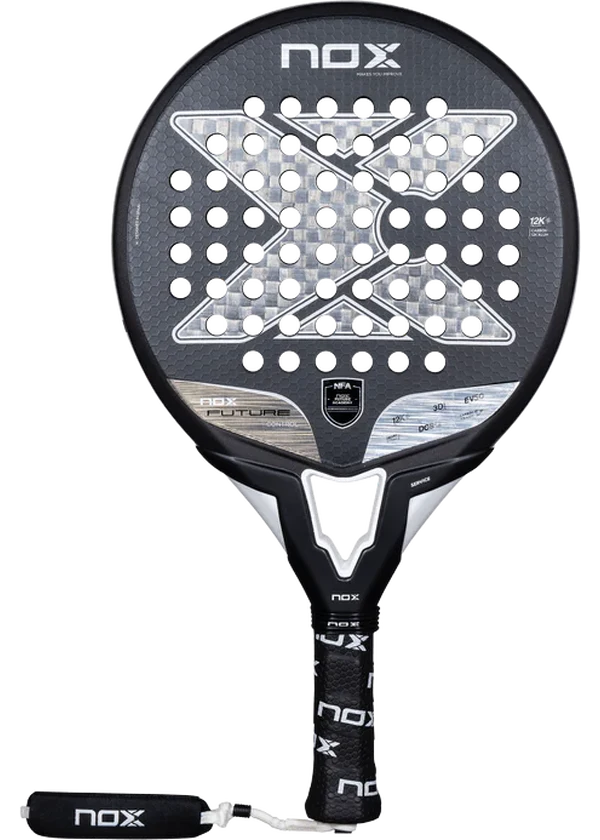


8 Parameters
Future Control 12K 2026
On this page
Review
Nox Future Control 12K 2026 Review — Precision as a Philosophy
There is a persistent debate in padel equipment: does a racket serve the player, or does it force the player to serve the racket? Attack-oriented rackets tend to answer that question one way. The Nox Future Control 12K 2026 answers it the other. This is a round-shape defender’s tool — a racket built entirely around the premise that winning rallies through placement and patience is a more reliable strategy than winning them through force. Whether that trade-off suits you is the whole question.
The Future Control 12K sits within the Nox lineup as the control anchor of the NFA (Nox Future Academy) series. Its core is EV50 high-density EVA rubber — reactive enough to deliver feedback, firm enough to resist deformation under pace. The surface is 12K Carbon Alum with a 3D Spin texture rough finish, paired with a DCS (Dynamic Composite Structure) frame that pushes material four centimetres inward from the frame edge to reduce rigidity differential and prevent cracking. Declared weight sits at 368g with a low-to-medium balance point of 252mm — a setup that prioritises wrist speed and court coverage over raw head weight.
Control leads at 8.6 — the highest parameter on the card. Defender: 8.17 · Hybrid: 7.93 · Attacker: 7.11. The 1.06-point gap between Defender and Attacker scores is the clearest signal this racket sends: it is built for one style of play, and it does not pretend otherwise.
Performance Breakdown
How the Nox Future Control 12K 2026 Plays
PLAYABILITY 8.1
The Number That Explains Everything
Control at 8.6 is not just the headline — it is the engineering brief made visible. The combination of EV50 rubber and 12K Carbon Alum surface creates a dwell time that registers each contact as information, not just force. Playability at 8.1 reflects how accessible that control is: this is not a racket that demands perfect mechanics to behave. The DCS frame contributes here too, reducing the stiffness differential between frame and face so the ball exits more predictably across the hitting zone. For a player whose game runs on placement decisions, those two numbers compound each other.
SWEETSPOT SIZE 8.0
Round Shape, Real Consequences
Round-shaped rackets earn their maneuverability reputation honestly, and the Future Control 12K is no exception — 8.1 here is driven by a 252mm balance point that keeps the head light enough to react in tight exchanges. What surprises is the sweetspot at 8.0: geometry distributes mass more evenly across the face, making the forgiving zone genuinely large rather than centrally clustered. For round-shape rackets, that combination of quickness and forgiveness is the defining advantage — particularly at the net when reaction time collapses.
COMFORT 7.6
Texture Does What Technique Can’t Always Do
Spin at 7.8 is meaningfully higher than the profile average for control rackets — the 3D Spin texture rough finish earns that score rather than simply benefiting from geometry. The surface grips the ball long enough to allow topspin and slice to develop without requiring extreme swing mechanics. Comfort at 7.6 reflects a considered tension: the 12K Carbon Alum is a stiffer surface than fibreglass alternatives, but EV50 rubber absorbs a meaningful portion of impact shock, and the Custom Grip system reduces vibration transmission to the handle. It sits in the firm-but-manageable range — appropriate for extended sessions but worth monitoring for players with existing arm sensitivities.
STABILITY 7.4
The Honest Trade-Off
Power at 6.2 is the score that defines this racket as much as the 8.6 Control. It is not a penalty — it is a design decision executed fully. Low balance and a round frame are structurally incompatible with high power generation, and the Future Control 12K does not attempt to hide that. Stability at 7.4 is adequate for baseline exchanges but will compress under pace from hard-hitting opponents — the low balance that enables maneuverability also reduces torsional resistance on off-centre contacts. Players who rely on blocking and redirecting will accept both figures. Players who need to generate pace from their own side of the court will find Power at 6.2 a genuine constraint on their game.
Technology
DCS and 12K Carbon Alum: Engineering Choices or Marketing Labels?
The DCS (Dynamic Composite Structure) is the most structurally consequential technology in this racket. It redistributes carbon material from the frame inward by four centimetres — meaning the transition zone between rigid frame and more flexible face is graduated rather than abrupt. The practical result is a reduction in the stiffness differential that causes micro-fractures over time and creates inconsistent exit velocity across the face. That engineering decision is the primary reason Sweetspot Size lands at 8.0: the ball does not suddenly behave differently when it moves away from the geometric centre.
The 12K Carbon Alum surface specification refers to the weave density of the carbon fibre. A tighter 12K weave produces a thinner, lighter surface layer than coarser weave configurations, which keeps overall frame weight manageable without sacrificing rigidity. That weight reduction feeds directly into the Maneuverability score of 8.1 — a heavier surface would have shifted the balance point upward and slowed the swing arc. The trade-off is that 12K carbon is less flexible than coarser weaves, which partially explains Comfort sitting at 7.6 rather than higher.
The 3D Spin texture is a surface treatment rather than a structural technology — a rough, raised pattern that increases contact friction with the ball. Its contribution shows in the Spin score of 7.8, which is high for a control-category round racket. The Custom Grip system handles vibration damping at the handle end, complementing the EV50 core’s mid-impact absorption. These are not transformative technologies individually, but together they produce a coherent performance profile: the scores cohere because the engineering decisions cohere. This racket is built for a specific player type, and every technical choice reinforces that intent.
Player Fit
Who Should Buy the Nox Future Control 12K 2026?
The Intermediate Tactician Who Wins From the Baseline
If you are the type who reads the point two shots ahead, builds pressure through placement rather than pace, and would rather reset a rally than risk an error on a low-percentage attack, this is your racket. Control at 8.6 and Playability at 8.1 confirm that the precision is accessible — you do not need elite mechanics to execute. Maneuverability at 8.1 means it keeps up with you in defensive exchanges, and Sweetspot Size at 8.0 means off-centre contacts do not punish you the way a stiffer, smaller sweetspot diamond racket would. You finish points by making the opponent make the mistake. This racket rewards exactly that.
The Player Who Needs to Generate Pace
If your game depends on finishing points from the left side with bandeja pace, closing the net with authority, or overpowering opponents from mid-court — Power at 6.2 will work against you every session. The Attacker score of 7.11 trails the Defender score by more than a full point; that gap is not an oversight, it is the racket’s identity. Stability at 7.4 also means that when the ball arrives with genuine pace, the frame gives more than a dedicated attacker’s tool would. Players in that profile should look at the Nox Future Hybrid 12K, which balances control with meaningful power through a teardrop shape without abandoning precision entirely.
FAQ
Frequently Asked Questions
What is the PadelVerdict score for the Nox Future Control 12K 2026?
The overall PadelVerdict score is 8.2, with a Consensus Modifier of 0. Profile breakdown: Defender 8.17, Hybrid 7.93, Attacker 7.11. The 1.06-point gap between Defender and Attacker is the decision signal — this racket has a clear identity. On the modifier: specs align consistently across multiple sources (Data Quality: neutral), declared figures show no implausible outliers (Field Validation: neutral), but no independent measurements exist to confirm what the manufacturer declares (Market Correction: neutral). Consistent data without independent validation earns neutral, not positive. Independent measurements would support a positive adjustment.
Is the Nox Future Control 12K 2026 good for intermediate players?
Yes — conditionally. Playability at 8.1 and Sweetspot Size at 8.0 make it forgiving enough for intermediate mechanics. The caveat is style: intermediate players who want to develop an attacking game will hit a ceiling at Power 6.2 relatively quickly. For intermediate defenders or all-court players who win through consistency and placement, this is a strong fit right now and for the next year or two of development.
Is the Nox Future Control 12K 2026 good for defensive players?
Yes. Defender profile at 8.17 is the highest of the three scores, and it earns that position legitimately. Control at 8.6 and Maneuverability at 8.1 are exactly the parameters that matter for defenders — precision on resets, quickness in tight spaces. Spin at 7.8 adds tactical variety on defensive lobs and angled shots. If your game is built around the right side of the court and keeping balls in play, this feels like it was designed for you. See how it compares across all defender rackets in our full category.
What is the actual weight of the Nox Future Control 12K 2026?
The declared weight is 368g. No independent measured weight data was available for this model — retailer listings reference a 360-375g range, which reflects typical production variance rather than confirmed measurement. There is no PadelVerdict weight variance figure for this racket. The 252mm balance point is the more performance-relevant specification: that low balance point keeps the effective swing weight lower than the raw gram count suggests.
How does the Nox Future Control 12K 2026 compare to the Nox Future Hybrid 12K?
This is a choice between two different approaches to the same carbon platform. The Future Control 12K is a round-shape defender’s racket — it gives up power to maximise control and maneuverability. The Future Hybrid 12K uses a teardrop shape that shifts balance upward, recovering some power generation at the cost of a slightly smaller sweetspot and reduced forgiveness. Choose based on where you finish points: baseline rallies favour the Control, net attacks favour the Hybrid.
What are the best padel rackets for defensive players in 2026?
The Nox Future Control 12K 2026 is a strong option in its category, but it is one of several quality defender-profile rackets available this season. For a full comparison across brands and price points, the defender racket category on PadelVerdict ranks and scores all reviewed options — sorted by profile score so you can compare directly.
Why does the Nox Future Control 12K 2026 have a Consensus Modifier of 0?
The control-first profile and core specifications align consistently across multiple sources — there is no meaningful contradiction in what different sources report. But consistency alone is not validation. No independent testers weighed this racket on camera, measured its balance point in millimetres, or published RA stiffness data. Consistent data without independent confirmation earns a neutral modifier, not a positive one. Independent measurements would be required to support an upward adjustment.
Similar Rackets
Independent testing, funded by readers
No brand deals, no sponsored picks. If you found this useful, you can support the next round of tests with a small tip.

