
Carbon Hype Gen 2 2026
The Power Case That Actually Controls
The short verdict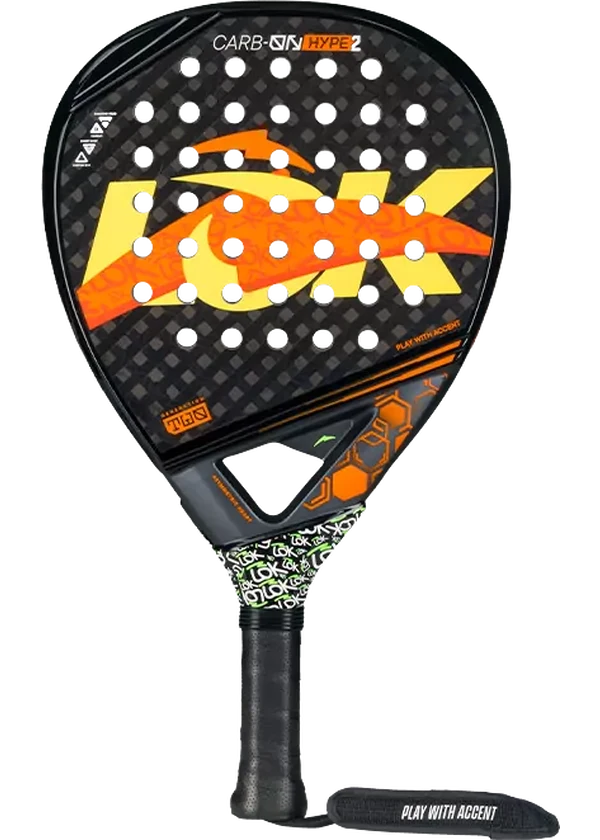


8 Parameters
Carbon Hype Gen 2 2026
On this page
Review
Lok Carbon Hype Gen 2 2026 Review: The Power Case That Actually Controls
Diamond-shaped attackers have always asked players to make a compromise: accept reduced maneuverability in exchange for raw overhead power. The Lok Carbon Hype Gen 2 challenges that framing — not by hiding its attacking intent, but by delivering enough control alongside it to make the trade feel less like a sacrifice and more like a deliberate upgrade. Whether that balance is real or just marketing is exactly what this review settles.
The Carbon Hype Gen 2 is built around a Custom EVA medium-hard foam core and a 6K carbon surface with 3D Spin Lines texture, paired with a full carbon frame that incorporates Carbon Reinforcements and an Asymmetric Heart construction for torsional rigidity. Lok’s Gradual Face system and Dynamic Hole System are engineered to expand the sweetspot zone and modulate ball exit speed. Declared weight runs 360–375g depending on the source, with a high balance point of 268mm. Stiffness sits at 50 RA — firm enough to deliver consistent overhead response without tipping into the punishing range. The racket targets intermediate to advanced offensive players seeking a high-balance, power-dominant tool from the Lok lineup.
Stability at 8.2 is the number that explains everything else. Attacker 8.05 · Hybrid 7.86 · Defender 7.65 — a 0.40-point spread that identifies a clear attacking specialist. The racket has a direction, and it rewards players who already share it.
Performance Breakdown
How the Lok Carbon Hype Gen 2 2026 Plays
STABILITY 8.2
Power and Stability in Exact Balance
The 6K carbon surface and high balance at 268mm combine to make smashes and bandeja shots feel purposeful — the racket generates momentum that transfers cleanly into the ball. Power comes in at 8.2, matching Stability exactly, and that alignment is the defining characteristic of this racket. Where most diamonds sacrifice directional consistency for exit velocity, the Carbon Hype Gen 2 holds both at the same level. The Asymmetric Heart construction is the structural reason: torsional resistance under aggressive contact keeps off-center overhead strikes from losing their line. The 50 RA stiffness sits in a range that delivers consistent response without the arm accumulation that harder diamonds impose over long sessions.
SWEETSPOT 7.6
More Precision Than Diamond Rackets Usually Allow
Control at 8.0 is the genuinely surprising figure here. Diamond shapes typically sacrifice directional precision for power, but the Gradual Face system modulates ball exit in a way that keeps net play placement honest. The 7.6 Sweetspot score reflects the reality of the high-balance geometry — the usable zone sits in the upper portion of the face, and mishits outside it produce clear negative feedback. That feedback is instructive rather than punishing for a player with developed technique, but it is a boundary that intermediate players will feel on bad-contact days.
PLAYABILITY 7.6
Spin That Serves the Attack, Not the Other Way Around
The 3D Spin Lines texture on the 6K carbon surface generates consistent topspin and shaped balls, scoring a solid 7.8 — enough to add shape to bandeja and bajada shots without demanding technique adjustments. Playability at 7.6 means this racket rewards players who already know what they want to do with the ball; it does not coach you through it. The combination of Spin and Playability makes it effective for players who use spin as an attacking weapon rather than a defensive escape route.
COMFORT 7.0
The Price of the High Balance Point
Maneuverability at 7.4 is the lowest score in the set, and it directly connects to the Defender profile score of 7.65 — this racket does not move quickly enough for reactive baseline defense. The 268mm balance means the head carries weight that slows wrist-driven exchanges under pressure. Comfort lands at 7.0: the Custom EVA medium-hard core at 50 RA absorbs vibration adequately for players coming from similar stiffness profiles, but those transitioning from softer cores will notice a firmer, drier feel that can accumulate during long sessions.
Technology
Gradual Face + Asymmetric Heart: Engineering or Labeling?
Lok’s Gradual Face system controls ball exit speed across different contact zones on the face — the idea being that the surface responds progressively depending on where and how hard you strike. In practice, this is what keeps Control at 8.0 despite a geometry that should theoretically sacrifice it. The 6K carbon weave at 50 RA sits at a considered stiffness level — firm enough to drive Power to 8.2, measured enough to keep Comfort at 7.0 rather than lower. Among diamond rackets at this level, that stiffness-to-comfort ratio is a meaningful differentiator.
The Asymmetric Heart is a frame-level reinforcement pattern that distributes structural mass asymmetrically through the throat — the result is the 8.2 Stability score. Most diamond rackets at this weight range are stable through sheer mass; this one achieves similar results through structural geometry, which means the stability does not come at the cost of additional swing weight. The Dynamic Hole System expands the sweetspot zone toward the upper face, explaining how a 7.6 Sweetspot score is achievable on a high-balance shape that would otherwise push that number lower.
The 3D Spin Lines texture on the carbon surface produces consistent grip on the ball through acceleration — this shows up directly in the Spin score of 7.8. For an attacking player generating topspin on drive volleys and shaped overheads, the texture does measurable work. For a player primarily using slice or flat contact, it is irrelevant. The system as a whole is coherent: every technology decision in this racket points toward the same player, which is the clearest signal that the engineering is intentional rather than assembled from a parts catalog.
Player Fit
Who Should Buy the Lok Carbon Hype Gen 2 2026?
The Net-Dominant Intermediate Who Finishes Points
If you’re the type who plays most of your decisive points from the net — finishing with overheads, shaping bandeja shots, and leaning on your smash as your primary weapon — the Carbon Hype Gen 2 was built exactly for that game. Power at 8.2 and Stability at 8.2 mean that aggressive overhead contact is consistently rewarded, and Control at 8.0 gives you enough directional precision to place the ball rather than just hit it hard. You play at intermediate to advanced level, you understand your sweetspot zone, and you’ve moved past needing the racket to compensate for technique gaps. You’ll feel immediately at home — and after three sessions, you won’t remember what you were playing before.
Baseline Defenders and Arm-Sensitive Players
The Defender profile score of 7.65 — the lowest of the three — tells the story directly. Maneuverability at 7.4 means reactive defense under pace becomes a liability; the head simply does not move fast enough through exchanges driven by your opponent’s tempo rather than your own. If you prefer to absorb pressure from the back and build points through consistency rather than finishing them at the net, this racket’s high balance works against you on every critical touch. Players coming from soft-core rackets will also find Comfort at 7.0 accumulative across long sessions — the firmer feel of the 6K carbon does not forgive extended defensive grinding. If your game is built around control from the back, a drop-shaped alternative in the defender racket category is the more honest fit.
FAQ
Frequently Asked Questions
What is the PadelVerdict score for the Lok Carbon Hype Gen 2 2026?
The PadelVerdict score is 8.1, with a Consensus Modifier of 0. Specs are consistent across multiple sources (Data Quality: neutral), declared figures show no implausible outliers (Field Validation: neutral), but no independent physical measurements exist to confirm them (Market Correction: neutral). Profile breakdown: Attacker 8.05 · Hybrid 7.86 · Defender 7.65. The 0.40-point gap between Attacker and Defender confirms a clear offensive lean — versatile enough to function across court positions, but built to reward net dominance above all.
Is the Lok Carbon Hype Gen 2 2026 good for intermediate players?
Conditionally yes. Intermediate players who already play an attacking net game will find the Power 8.2 and Control 8.0 combination accessible and rewarding. The Sweetspot at 7.6 is the gating factor — it sits high on the face and punishes mis-hits clearly. If you’re still developing consistent contact, a racket with a higher Sweetspot score and lower balance point will serve your progression better.
Is the Lok Carbon Hype Gen 2 2026 good for attackers?
Yes, without reservation. The Attacker profile score of 8.05 is the highest of the three, supported by Power 8.2, Stability 8.2, and a Control score of 8.0 that keeps the aggression usable. If you already know your game belongs in the attacker racket category, this racket confirms that instinct with every overhead.
What is the actual weight of the Lok Carbon Hype Gen 2 2026?
Declared weight ranges 360–375g depending on the source, with no independent on-camera or laboratory measurements available to narrow that window. A 15g variance is perceptible on court — it can shift the balance feel and swing weight noticeably. Until independent measurements confirm the actual figure, treat the declared range as indicative rather than precise.
How does the Lok Carbon Hype Gen 2 2026 compare to the Lok Maxx Hype 2026?
Both are diamond-shaped attackers from Lok, but they sit at different points on the demand curve. The Maxx Hype 2026 uses an 18K carbon construction — stiffer and aimed squarely at advanced players who prioritize raw output over feel. The Carbon Hype Gen 2’s 6K carbon at 50 RA sits at a measurable step down in stiffness, giving it the 7.0 Comfort score that makes it usable across longer sessions. The choice is straightforward: if you want the hardest-hitting tool in the Lok lineup and have the arm conditioning for it, the Maxx Hype is the answer. If you want an attacking racket you can practice with daily without accumulating fatigue, the Carbon Hype Gen 2 is the more sustainable choice.
Why does the Lok Carbon Hype Gen 2 2026 have a Consensus Modifier of 0?
Because the data holds together and stops there. Shape, core, surface, and weight range appear consistently across multiple sources without contradiction — that coherence establishes a clean baseline. It is not a reason to move the modifier upward. Neutral is the accurate read of what the evidence confirms, and 0 is where it lands.
Similar Rackets
Independent testing, funded by readers
No brand deals, no sponsored picks. If you found this useful, you can support the next round of tests with a small tip.

